1. Search Result
Search Result
Results for "

Muscarinic

" in MedChemExpress (MCE) Product Catalog:

502

Inhibitors & Agonists

1

Fluorescent Dye

1

Biochemical Assay Reagents

6

Peptides

48

Natural
Products

4

Recombinant Proteins

52

Isotope-Labeled Compounds

6

Antibodies

4

Click Chemistry

Targets Recommended:
Cat. No. Product Name Target Research Areas Chemical Structure
  • HY-105182
    Xanomeline
    5+ Cited Publications

    LY-246708

    mAChR Neurological Disease
    Xanomeline, as an effective and selective muscarinic type 1 and type 4 (M1/M4) receptor agonist, increases neuronal excitability. Xanomeline can be used for the research of neurological disorders, such as schizophrenia .
    Xanomeline
  • HY-N0471
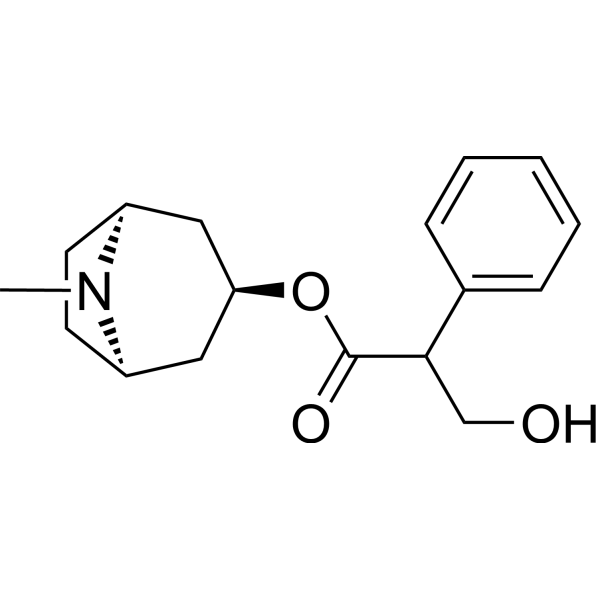
    L-Hyoscyamine
    2 Publications Verification

    Hyoscyamine

    mAChR Neurological Disease
    L-Hyoscyamine (Daturine), a natural plant tropane alkaloid, is a potent and competitive muscarinic receptor (MR) antagonist. L-Hyoscyamine is a levo-isomer to Atropine (HY-B1205) .
    L-Hyoscyamine
  • HY-13204A

    KL 373

    mAChR Neurological Disease
    Biperiden (KL 373) is a non-selective muscarinic receptor antagonist that competitively binds to M1 muscarinic receptors, thereby inhibiting acetylcholine and enhancing dopamine signaling in the central nervous system. Biperiden has the potential for the research of Parkinson's disease and other related psychiatric disorders .
    Biperiden
  • HY-105182A
    Xanomeline tartrate
    5+ Cited Publications

    LY 246708 tartrate

    mAChR Neurological Disease
    Xanomeline (LY 246708) is the potent agonist of muscarinic M1/M4 receptor with antipsychotic-like activity. Xanomeline (LY 246708) increases neuronal excitability. Xanomeline (LY 246708) can be used for the research of schizophrenia .
    Xanomeline tartrate
  • HY-132812

    CVL-231

    mAChR Neurological Disease
    Emraclidine (CVL-231) is a muscarinic M4 receptor positive allosteric modulator (WO2018002760, compound 11). Emraclidine can be used for the research of neurological diseases .
    Emraclidine
  • HY-100234
    DREADD agonist 21
    2 Publications Verification

    mAChR Neurological Disease
    DREADD agonist 21 is a potent human muscarinic acetylcholine M3 receptors (hM3Dq) agonist (EC50=1.7 nM) .
    DREADD agonist 21
  • HY-B1277
    Trihexyphenidyl hydrochloride
    3 Publications Verification

    mAChR Cholinesterase (ChE) Neurological Disease
    Trihexyphenidyl hydrochloride is a selective and orally active M1 muscarinic receptor antagonist with an IC50 of 3.7 nM for rat cerebral cortex M1 muscarinic receptors. Trihexyphenidyl hydrochloride modulates cholinergic activity, countering acetylcholine supersensitivity in neural pathways. Trihexyphenidyl hydrochloride improves movement disorder, inhibits McN-A-343 (HY-107648)-induced pressor responses, vagally-induced bradycardia and vasodilatation. Trihexyphenidyl hydrochloride can be used for the research of Parkinson's disease. .
    Trihexyphenidyl hydrochloride
  • HY-101372A

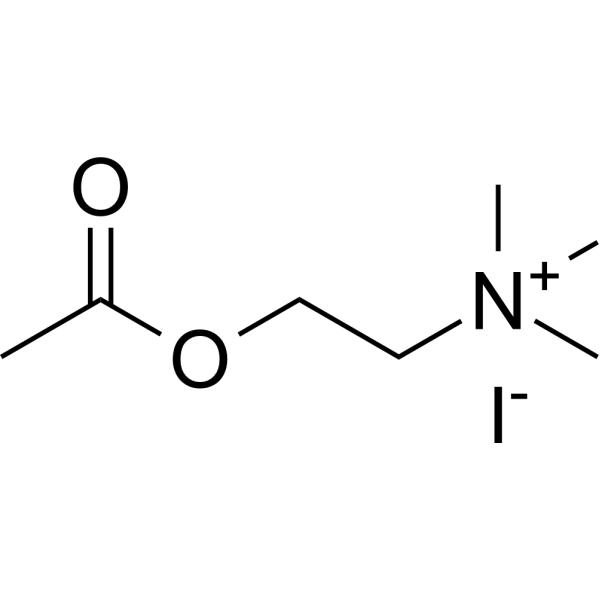
    mAChR Neurological Disease
    Oxotremorine M iodide is a potent and non-selective muscarinic acetylcholine receptor (mAChR) agonist. Oxotremorine M iodide potentiates NMDA receptors by muscarinic receptor dependent and independent mechanisms .
    Oxotremorine M iodide
  • HY-13204

    KL 373 hydrochloride

    mAChR Neurological Disease
    Biperiden (KL 373) hydrochloride is a non-selective muscarinic receptor antagonist that competitively binds to M1 muscarinic receptors, thereby inhibiting acetylcholine and enhancing dopamine signaling in the central nervous system. Biperiden hydrochloride has the potential for the research of Parkinson's disease and other related psychiatric disorders .
    Biperiden hydrochloride
  • HY-100234A
    DREADD agonist 21 dihydrochloride
    2 Publications Verification

    mAChR Neurological Disease
    DREADD agonist 21 dihydrochloride is a potent human muscarinic acetylcholine M3 receptors (hM3Dq) agonist (EC50=1.7 nM) .
    DREADD agonist 21 dihydrochloride
  • HY-B1487

    Tricyclamol hydrochloride; (±)-Procyclidine hydrochloride

    iGluR mAChR Neurological Disease
    Procyclidine (Tricyclamol, (±)-Procyclidine) hydrochloride , an anticholinergic agent, is a muscarinic receptor antagonist that also has the properties of an N-methyl-D-aspartate (NMDA) antagonist. Procyclidine hydrochloride can be used in studies of Parkinson's disease and related psychiatric disorders such as Soman-induced epilepsy .
    Procyclidine hydrochloride
  • HY-107646

    mAChR Neurological Disease
    PD 102807 is a M4 muscarinic receptor antagonist with an IC50 of 90.7 nM. PD 102807 inhibits M1, M2, M3, M5 muscarinic receptor with IC50s of 6558.7, 3440.7, 950.0, and 7411.7 nM, respectively . Antidyskinetic effect.
    PD 102807
  • HY-N8376

    (±)-Fustin; 3,7,3',4'-Tetrahydroxyflavanone

    Amyloid-β mAChR Cholinesterase (ChE) Neurological Disease
    Fustinis ((±)-Fustin; 3,7,3',4'-Tetrahydroxyflavanone) is a potent amyloid β (Aβ) inhibitor. Fustinis ((±)-Fustin; 3,7,3',4'-Tetrahydroxyflavanone) increases the expression of acetylcholine (ACh) levels, choline acetyltransferase (ChAT) activity, and ChAT gene induced by Aβ (1-42). Fustinis ((±)-Fustin; 3,7,3',4'-Tetrahydroxyflavanone) decreases in acetyl cholinesterase (AChE) activity and AChE gene expression induced by Aβ (1-42). Fustinis ((±)-Fustin; 3,7,3',4'-Tetrahydroxyflavanone) increases muscarinic M1 receptor gene expression and muscarinic M1 receptor binding activity. Fustinis ((±)-Fustin; 3,7,3',4'-Tetrahydroxyflavanone) can be used for Alzheimer's disease research .
    Fustin
  • HY-107647
    (S)-(+)-Dimethindene maleate
    1 Publications Verification

    mAChR Histamine Receptor Inflammation/Immunology
    (S)-(+)-Dimethindene maleate, an enantiomer, is a potent M2-selective muscarinic receptor antagonist (pA2 = 7.86/7.74; pKi = 7.78). (S)-(+)-Dimethindene maleate shows lower affinities for the muscarinic M1 (pA2 = 6.83/6.36; pKi = 7.08), the M3 (pA2 = 6.92/6.96; pKi = 6.70) and the M4 receptors (pKi = 7.00), respectively. (S)-(+)-Dimethindene maleate also is a histamine H1 receptor antagonist (pA2 = 7.48) .
    (S)-(+)-Dimethindene maleate
  • HY-B0321
    Tropicamide
    5 Publications Verification

    Ro 1-7683

    mAChR Neurological Disease
    Tropicamide (Ro 1-7683) is a selective M4 muscarinic acetylcholine receptor antagonist. When used as an eye drop, Tropicamide causes short-term mydriasis (pupil dilation) and cycloplegia. Tropicamide can be used in the research of neurological diseases, such as epilepsy .
    Tropicamide
  • HY-109013

    BBI 4000

    mAChR Neurological Disease
    Sofpironium bromide (BBI 4000) is an anticholinergic agent used in the study of primary axillary hyperhidrosis (PAH). Sofpironium bromide reduces sweating by inhibiting M3 muscarinic receptors in eccrine glands at the application site. Sofpironium bromide also has a high afnity for the M1, M2, M4 and M5 subtypes .
    Sofpironium bromide
  • HY-120081A
    Metixene hydrochloride hydrate
    2 Publications Verification

    mAChR Neurological Disease
    Metixene (Piperidine) hydrochloride hydrate is an anticholinergic and antiparkinsonian agent. Metixene hydrochloride hydrate potently inhibits binding of quinuclidinyl benzilate (QNB) with the muscarinic receptor, IC50 and Ki values of 55 nM and 15 nM, respectively. Metixene hydrochloride hydrate can be used for the research of parkinsonian .
    Metixene hydrochloride hydrate
  • HY-19752A

    CID-25010775

    mAChR Neurological Disease
    VU0357017 hydrochloride (CID-25010775) is a potent, selective and brain-penetrant allosteric agonist of M1 muscarinic acetylcholine receptor, with an EC50 of 477 nM. VU0357017 hydrochloride is highly selective for M1 and has no activity at M2-M5 up to the highest concentrations tested (30 μM). VU0357017 hydrochloride can be used for the research of Alzheimer’s disease and schizophrenia .
    VU0357017 hydrochloride
  • HY-116294A
    Methoctramine tetrahydrochloride
    1 Publications Verification

    mAChR Cardiovascular Disease
    Methoctramine tetrahydrochloride is a potent and cardioselectivity antagonist of M2 muscarinic receptor. Methoctramine tetrahydrochloride can inhibit Muscarine (HY-121404)-induced bradycardia in vivo. Methoctramine tetrahydrochloride can be used in the study of cardiovascular diseases .
    Methoctramine tetrahydrochloride
  • HY-107648
    McN-A-343
    2 Publications Verification

    mAChR Neurological Disease Inflammation/Immunology
    McN-A-343 is a selective M1 muscarinic agonist that stimulates muscarinic transmission in sympathetic ganglia. McN-A-343 produces a significant inhibitory effect on Muscarine (HY-121404)-evoked catecholamine secretion from the isolated perfused rat adrenal gland. McN-A-343 is involved in the regulation of neuronal firing and activates enteroendocrine L cells to release glucagon-like peptide 1 (GLP-1) and modulates the secretion of α-melanocyte stimulating hormone (α-MSH) from the pituitary gland in the central nervous system. McN-A-343 reduces colonic inflammation and oxidative stress in Acetic acid (HY-Y0319)-induced ulcerative colitis (UC) mice. McN-A-343 can be used for the study of ulcerative colitis .
    McN-A-343
  • HY-N0584A

    6-Hydroxyhyoscyamine hydrobromide

    mAChR Inflammation/Immunology Cancer
    Anisodamine hydrobromide (6-Hydroxyhyoscyamine hydrobromide), a belladonna alkaloid, is a non-subtype-selective muscarinic and a nicotinic cholinoceptor antagonist. Anisodamine hydrobromide shows antioxidant, anti-inflammatory properties .
    Anisodamine hydrobromide
  • HY-B0460
    Tiotropium bromide monohydrate
    2 Publications Verification

    BA-679 BR monohydrate

    mAChR Inflammation/Immunology
    Tiotropium bromide monohydrate (BA-679 BR monohydrate) is a long-acting anticholinergic bronchodilator. Tiotropium bromide monohydrate blocks the action of acetylcholine at muscarinic M1, M2, and M3 receptors, prevents bronchoconstriction, and dilates bronchial airways. Tiotropium bromide monohydrate is applicable to research related to chronic obstructive pulmonary disease and asthma .
    Tiotropium bromide monohydrate
  • HY-B1475

    Octatropine bromide

    mAChR Neurological Disease Metabolic Disease
    Anisotropine (Octatropine) bromide is an orally active anticholinergic muscarinic antagonist. Anisotropine bromide can inhibit gastric acid secretion and is used as an adjunct to peptic ulcers .
    Anisotropine bromide
  • HY-107649

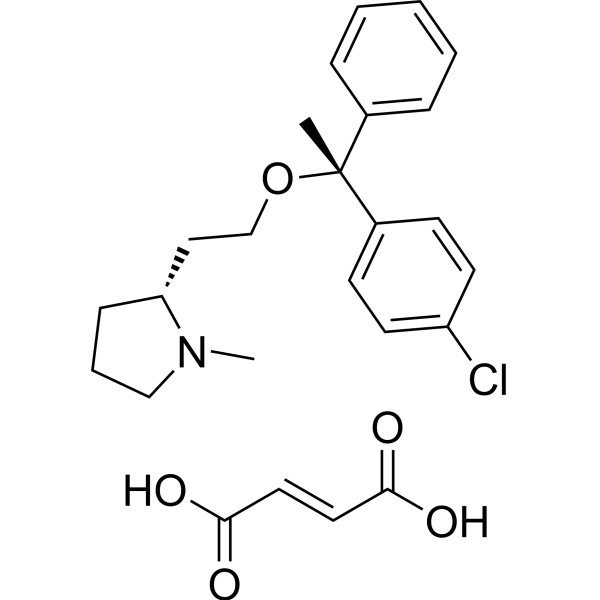
    UK-76654 fumarate

    mAChR Metabolic Disease
    Zamifenacin fumarate (UK-76654 fumarate) is a potent gut-selective muscarinic M3 receptor antagonist. Zamifenacin significantly reduces colonic motility in irritable bowel syndrome .
    Zamifenacin fumarate
  • HY-176200

    AF98943

    mAChR Neurological Disease
    VU6008055 (AF98943) is a brain-penetrant, orally active and selective muscarinic acetylcholine receptor subtype 4 (mAChR4) activator with human EC50 values of 73.4 nM. VU6008055 potentiates mAChR4 receptor activity in the presence of acetylcholine, and exhibits no activity at mAChR1, mAChR3, or mAChR5. VU6008055 can be used for the research of schizophrenia, parkinson’s disease, alzheimer’s disease .
    VU6008055
  • HY-121027

    (-)-Anagyrine; Monolupine; Rhombinine

    mAChR nAChR Neurological Disease
    Anagyrine ((-)-Anagyrine) is a quinolizidine alkaloid that has been found in Lupinus albus. Anagyrine binds to muscarinic and nicotinic acetylcholine receptors with IC50 values of 132 and 2096 µM respectively. Anagyrine is a potent and effective desensitizer of nAChR, and Anagyrine can directly, without metabolism, desensitize nAChR .
    Anagyrine
  • HY-N7247

    mAChR Metabolic Disease
    Thiochrome, a natural oxidation product and metabolite of thiamine, is a selective M4 muscarinic receptor of acetylcholine (ACh) affinity enhancer. Thiochrome has neutral cooperativity with ACh at M1 to M3 receptors .
    Thiochrome
  • HY-N0471A
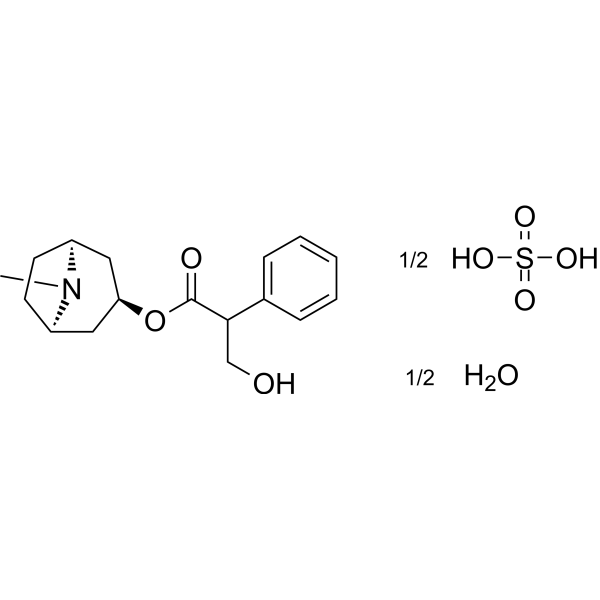
    L-Hyoscyamine sulfate
    2 Publications Verification

    Daturine sulfate

    mAChR Neurological Disease
    L-Hyoscyamine sulfate (Daturine sulfate), a natural plant tropane alkaloid, is a potent and competitive muscarinic receptor (MR) antagonist. L-Hyoscyamine sulfate is a levo-isomer to Atropine (HY-B1205) .
    L-Hyoscyamine sulfate
  • HY-116480

    mAChR Neurological Disease
    LY593093 is a selective, orally active, and brain-penetrant muscarinic M1 receptor agonist with an EC50 of 22.8 nM. LY593093 can be utilized in Alzheimer’s disease research .
    LY593093
  • HY-123337

    UK-76654

    mAChR Metabolic Disease
    Zamifenacin (UK-76654) is a potent gut-selective muscarinic M3 receptor antagonist. Zamifenacin significantly reduces colonic motility in irritable bowel syndrome .
    Zamifenacin
  • HY-116586A

    mAChR Sigma Receptor Neurological Disease
    (Rac)-AF710B is the racemate of AF710B (HY-116586). AF710B is a highly potent and selective allosteric M1 muscarinic and σ1 receptor agonist. AF710B can be used for the research of Alzheimer’s disease .
    (Rac)-AF710B
  • HY-162897

    mAChR Cardiovascular Disease
    BAY-2413555 is an orally active muscarinic acetylcholine receptor M2 modulator that protects the heart and improve cardiac function. BAY-2413555 is promising for research of heart failure .
    BAY-2413555
  • HY-B1277A

    mAChR Cholinesterase (ChE) Cardiovascular Disease Neurological Disease
    Trihexyphenidyl is a selective and orally active M1 muscarinic receptor antagonist with an IC50 of 3.7 nM for rat cerebral cortex M1 muscarinic receptors. Trihexyphenidyl modulates cholinergic activity, countering acetylcholine supersensitivity in neural pathways. Trihexyphenidyl improves movement disorder, inhibits McN-A-343 (HY-107648)-induced pressor responses, vagally-induced bradycardia and vasodilatation. Trihexyphenidyl can be used for the research of Parkinson's disease. .
    Trihexyphenidyl
  • HY-120081

    mAChR Neurological Disease
    Metixene (Piperidine) is an anticholinergic and antiparkinsonian agent. Metixene potently inhibits binding of quinuclidinyl benzilate (QNB) with the muscarinic receptor, IC50 and Ki values of 55 nM and 15 nM, respectively. Metixene can be used for the research of parkinsonian .
    Metixene
  • HY-107656

    mAChR Neurological Disease
    PTAC oxalate is a selective muscarinic receptor ligand. PTAC oxalate is an partial agonist of M2 and M4 but antagonist of M1, M3, and M5 (Ki values of 0.2-2.8 nM for hM1-5 in CHO cells). PTAC oxalate alleviates the mechanical allodynia on the neuropathic pain and has antidepression effects .
    PTAC oxalate
  • HY-119918

    mAChR Neurological Disease
    Cycrimine is an orally active muscarinic cholinergic receptor (mAChR) M1 antagonist, reduces the acetylcholine levels in parkinson model. Cycrimine shows antispasmodic activity, can be used in studies of behavioral and mental disorder .
    Cycrimine
  • HY-P5175

    mAChR Neurological Disease
    Muscarinic toxin 7 is a peptide toxin with selective and noncompetitive antagonism at the muscarinic M1 receptor .
    Muscarinic toxin 7
  • HY-177309

    mAChR Neurological Disease
    Muscarinic M3 receptor antagonist-1 (Example 4) is a muscarinic acetylcholine receptor M3 antagonist. Muscarinic M3 receptor antagonist-1 can be used to study inflammatory and obstructive airway diseases .
    Muscarinic M3 receptor antagonist-1
  • HY-177310

    mAChR Neurological Disease
    Muscarinic M3 receptor antagonist-2 (Compound 30) is a muscarinic M3 receptor antagonist .
    Muscarinic M3 receptor antagonist-2
  • HY-U00302

    mAChR Inflammation/Immunology
    CHF5407 is a selective, long-acting and competitive muscarinic M3 receptor antagonist. CHF5407 shows subnanomolar affinities for human muscarinic M1 (hM1), M2 (hM2) and M3 (hM3) receptors. CHF5407 shows a prolonged antibronchospastic activity .
    CHF5407
  • HY-13204B

    KL 373 lactate

    mAChR Neurological Disease
    Biperiden (KL 373) lactate is an orally active non-selective muscarinic receptor antagonist that competitively binds to M1 muscarinic receptors. Biperiden (KL 373) lactate inhibits acetylcholine and enhances dopamine signaling in the central nervous system. Biperiden (KL 373) lactate has the potential for the research of Parkinson's disease and other related psychiatric disorders .
    Biperiden lactate
  • HY-N0471C

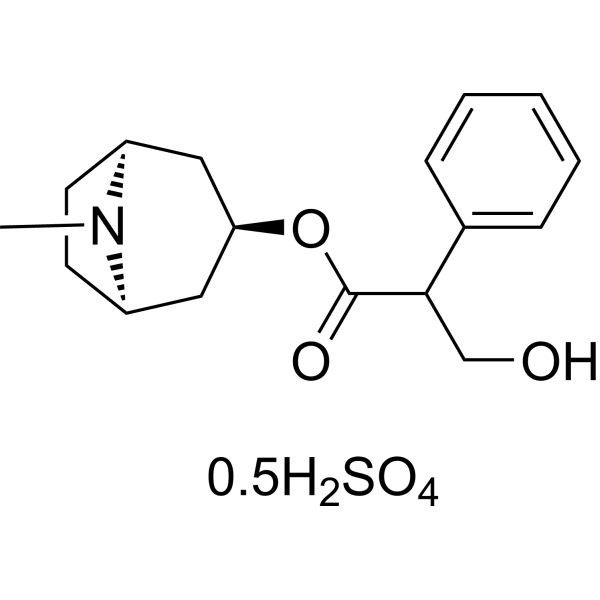
    Daturine sulfate hydrate

    mAChR Neurological Disease
    L-Hyoscyamine sulfate hydrate, a natural plant tropane alkaloid, is a potent and competitive muscarinic receptor (MR) antagonist. L-Hyoscyamine sulfate hydrate is a levo-isomer to Atropine (HY-B1205) .
    L-Hyoscyamine sulfate hydrate
  • HY-W011040

    Cannabinoid Receptor 5-HT Receptor mAChR Neurological Disease
    LY320135 is a potent and selective antagonist of CB1 receptor, with a Ki of 141 nM. LY320135 also binds to 5-HT2 and muscarinic receptors with Kis of 6.4 μM and 2.1 μM, respectively. LY320135 exhibits neuroprotective effect .
    LY320135
  • HY-105182AR

    LY 246708 tartrate (Standard)

    Reference Standards mAChR Neurological Disease
    Xanomeline (tartrate) (Standard) is the analytical standard of Xanomeline (tartrate). This product is intended for research and analytical applications. Xanomeline (LY 246708) is the potent agonist of muscarinic M1/M4 receptor with antipsychotic-like activity. Xanomeline (LY 246708) increases neuronal excitability. Xanomeline (LY 246708) can be used for the research of schizophrenia .
    Xanomeline tartrate (Standard)
  • HY-120408

    Atroscine

    Adrenergic Receptor Neurological Disease
    (±)-Scopolamine (Atroscine) is the racemic modification of Scopolamine. (±)-Scopolamine inhibits α-adrenergic receptor activity. (±)-Scopolamine has Ki values of 33 μM and 7.25 nM for α1-adrenerg receptor and muscarinic cholinergic receptor, respectively .
    (±)-Scopolamine
  • HY-B1487A

    Tricyclamol; (±)-Procyclidine

    mAChR iGluR Neurological Disease
    Procyclidine (Tricyclamol; (±)-Procyclidine), an anticholinergic agent, is a muscarinic receptor antagonist that also has the properties of an N-methyl-D-aspartate (NMDA) antagonist. Procyclidine can be used in studies of Parkinson's disease and related psychiatric disorders such as Soman-induced epilepsy .
    Procyclidine
  • HY-149732

    mAChR Neurological Disease
    M1/M4 muscarinic agonist 3 (compound 44) is a muscarinic mAChR M1/M4 agonist with EC50s of 31 nM and 9.3 nM, respectively .
    M1/M4 muscarinic agonist 3
  • HY-174259

    mAChR Neurological Disease
    Muscarinic M4 modulator-1 is a Muscarinic M4 receptor positive allosteric modulator. Muscarinic M4 modulator-1 activates the muscarinic M4 receptor with allosteric potency EC50 s of 14 and 3 Nm in CHO-K1 cells and HEK293 cells. Muscarinic M4 modulator-1 has an antipsychotic-like activity, promising for psychiatric and/or neurological disorders research .
    Muscarinic M4 modulator-1
  • HY-149731

    mAChR Neurological Disease
    M1/M2/M4 muscarinic agonist 2 (compound 43) is a muscarinic mAChR M1/M2/M4 agonist with EC50s of 30 nM, 200 nM and 6.2 nM, respectively .
    M1/M2/M4 muscarinic agonist 2
  • HY-149733

    mAChR Neurological Disease
    M1/M2/M4 muscarinic agonist 3 (compound 45) is a muscarinic mAChR M1/M2/M4 agonist with EC50s of 3.2 nM, 32 nM and 1.7 nM, respectively .
    M1/M2/M4 muscarinic agonist 3

Inquiry Online

Your information is safe with us. * Required Fields.

Salutation


Country or Region *

Applicant Name *


Organization Name *

Department *


Email Address *


Product Name *

Cat. No.


Requested quantity *

Phone Number *


Remarks

Inquiry Online

Inquiry Information

Product Name:
Cat. No.:
Quantity:
MCE Japan Authorized Agent:

