



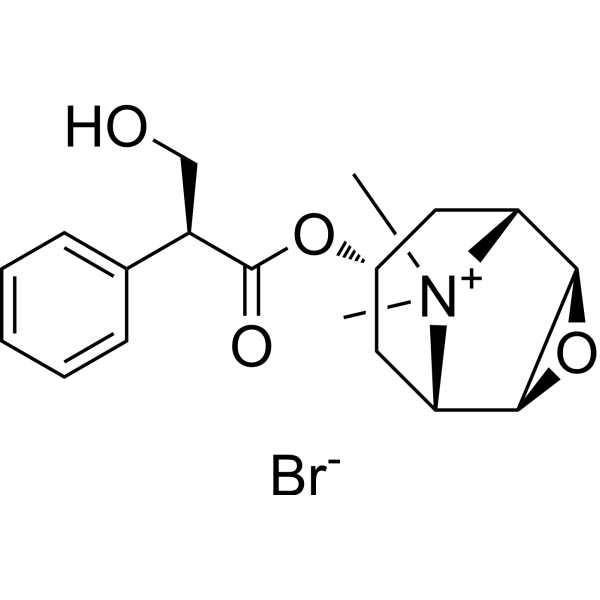
Scopolamine hydrobromide trihydrate
Based on 2 publication(s) in Google Scholar
Scopolamine (Hyoscine) hydrobromide trihydrate is a high-affinity muscarinic antagonist that can cross the blood-brain barrier. Scopolamine hydrobromide trihydrate competitively antagonizes 5-HT3 receptors with an IC50 of 2.09 μM. Scopolamine hydrobromide trihydrate can induce cognitive and memory deficits in animals. Scopolamine hydrobromide trihydrate can be used in the research of preventing postoperative nausea and vomiting, motion sickness, nervous system diseases, etc.
For research use only. We do not sell to patients.
- Purity: 99.96%
- CAS No.: 6533-68-2
- Formula: C17H28BrNO7
- Molecular Weight:438.31
-
Storage:
4°C, sealed storage, away from moisture
* In solvent : -80°C, 6 months; -20°C, 1 month (sealed storage, away from moisture)


To place orders, for customer services and technical support, please contact: MedChemExpress USA
Tel: 609-228-6898 E-mail: [email protected] [email protected]


-
 Biological Activity
-
Chemical Information
-
Solvent & Solubility
- Purity & Documentation
- References
-
 Help & FAQs


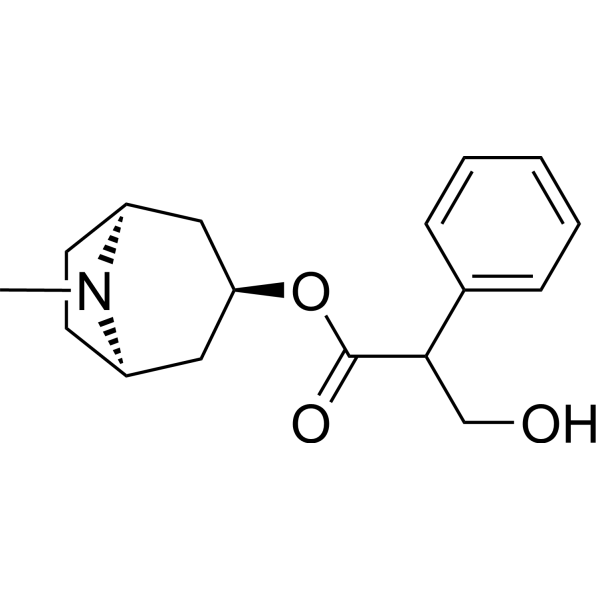
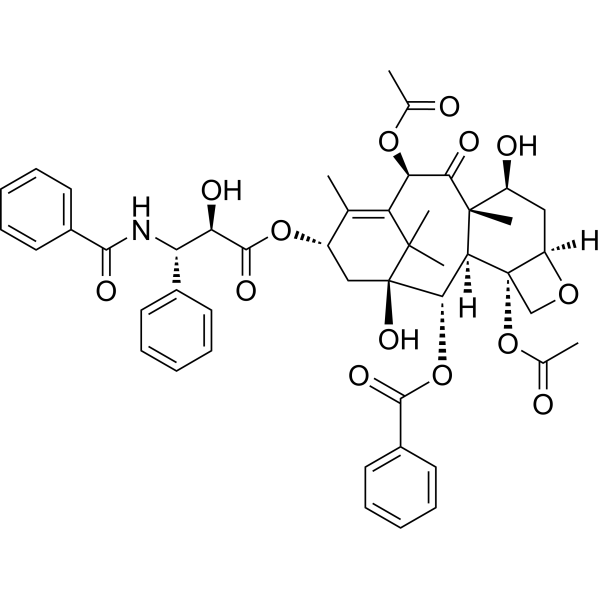
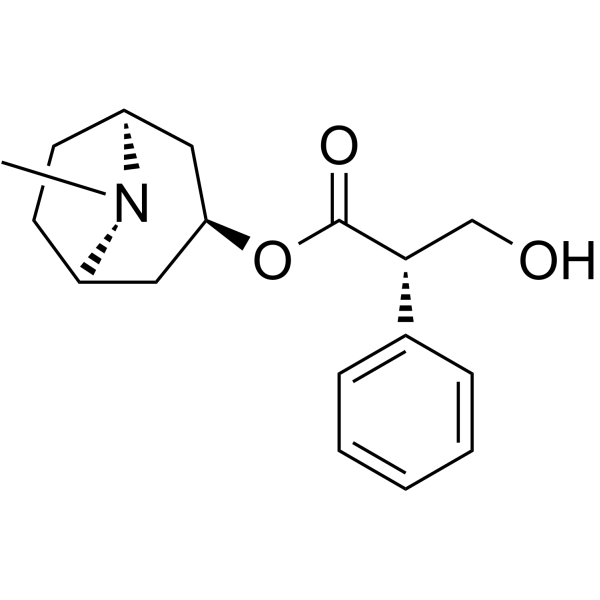
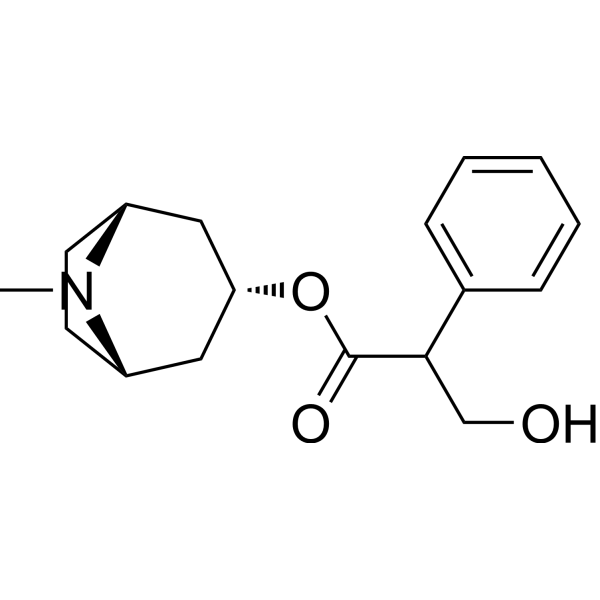

Publications Citing Use of MedChemExpress (MCE) Scopolamine hydrobromide trihydrate
MoreAll 5-HT Receptor Isoforms
More

Biological Activity
receptors (IC50 = 928 μM) and increases the expression of α7 nACh receptors. Scopolamine hydrobromide trihydrate displays concentration-dependent competition with 0.6 nM [3H]Granisetron, yielding an average pKii = 6.76 μM). Concentration-dependent competition of fluorescently labeled form of Granisetron (HY-B0071) with Scopolamine hydrobromide trihydrate gives an average pKi of 5.31 (Ki = 4.90 μM). Scopolamine hydrobromide trihydrate blocks muscarinic receptors and induces a cognitive deficit[1].
Scopolamine (0.1-3 mM; for 24 hours) hydrobromide trihydrate induces cytotoxicity, ROS generation and apoptosis of SH-SY5Y cells[6].
MedChemExpress (MCE) has not independently confirmed the accuracy of these methods. They are for reference only.
-
Cell Line:SH-SY5Y cell line
-
Concentration:0.1-3 mM (usually 2 mM)
-
Incubation Time:24 hours
-
Result:Exposure to 1-3 mM for 24 hours significantly decreased human neuroblastoma SH-SY5Y cell viability in a dose-dependent manner. In all subsequent experiments, 2 mM resulted in 50.6% loss in cell viability.
-
Animal Model:Naive male Swiss mice weighing 20-25 g[7]
-
Dosage:1 mg/kg
-
Administration:Administered intraperitoneally (i.p.); to measure the memory acquisition processes, Scopolamine was administered 20 min before the pretest; to measure the memory consolidation processes, Scopolamine was administered immediately after the pretest
-
Result:There was a significant decrease in the index of latency (IL) value as compared with the saline-treated mice, at the used dose impaired acquisition of memory and learning.
Please do not refer to only one article to determine the experimental conditions. It is recommended to determine the optimal experimental conditions (animal strain, age, dosage, frequency and cycle, detection time and indicators, etc.) through preliminary experiments before the formal experiment.
Scopolamine (1 mg/kg; i.p.; once) induces memory impairment associated with attenuation of cholinergic neurotransmission, as well as an increases of processes connected with oxidative stress in the brain in mice[7].
Scopolamine can be used to induce memory impairment models[4].
Administration: 1 mg/kg/day for 7 days
Behavior-Locomotion activity in open field: Decreased time spent in the centre of the open field. Decreased number of crossing and rearing.
Behavior-Object recognition: Increased time to discover and stay with the familiar object. Decreased number of exploration of the novel object.
Molecular changes: Decreased level of glutathione. Increased activity of acetylcholinesterase in brain.
MedChemExpress (MCE) has not independently confirmed the accuracy of these methods. They are for reference only.


Chemical Information
-
CAS No. 6533-68-2
-
Appearance Solid
-
Molecular Weight 438.31
-
Formula C17H28BrNO7
-
Color White to off-white
-
SMILES
O=C([C@@H](C1=CC=CC=C1)CO)O[C@H]2C[C@H]3[C@@H]4O[C@@H]4[C@H](N3C)C2.[H]Br.[H]O[H].[H]O[H].[H]O[H]
-
Synonyms
Hyoscine hydrobromide trihydrate
-
Structure Classification
-
Initial Source
-
Shipping
Room temperature in continental US; may vary elsewhere.
-
Storage
4°C, sealed storage, away from moisture
* In solvent : -80°C, 6 months; -20°C, 1 month (sealed storage, away from moisture)


Publications (2)
-
Journal Impact Factor
-
Most Recent
-
Eur J Pharmacol
Targeting microglial GLP1R in epilepsy: A novel approach to modulate neuroinflammation and neuronal apoptosis. [Abstract]2024 Oct 15:981:176903. PMID: 39154823 -
J Dig Dis
DREADDs-Based Chemogenetics Induced Slow Transit Constipation via Inhibition of Enteric Neurons. [Abstract]2025 Apr 14. PMID: 40223443


Solvent & Solubility
DMSO : 125 mg/mL (285.19 mM; Need ultrasonic; Hygroscopic DMSO has a significant impact on the solubility of product, please use newly opened DMSO)
Please refer to the solubility information to select the appropriate solvent. Once prepared, please aliquot and store the solution to prevent product inactivation from repeated freeze-thaw cycles.
Storage method and period of stock solution: -80°C, 6 months; -20°C, 1 month (sealed storage, away from moisture). When stored at -80°C, please use it within 6 months. When stored at -20°C, please use it within 1 month.
Please refer to the solubility information to select the appropriate solvent. Once prepared, please aliquot and store the solution to prevent product inactivation from repeated freeze-thaw cycles.
Storage method and period of stock solution: -80°C, 6 months; -20°C, 1 month (sealed storage, away from moisture). When stored at -80°C, please use it within 6 months. When stored at -20°C, please use it within 1 month.
Concentration (start) × Volume (start) = Concentration (final) × Volume (final)


Purity & Documentation
-
Data Sheet (284 KB)
-
SDS (481 KB)
- English - EN (481 KB)
- Français - FR (481 KB)
- Deutsch - DE (481 KB)
- Norwegian - NO (481 KB)
- Español - ES (481 KB)
- Swedish - SV (481 KB)
- Italian - IT (481 KB)
- Korean - KR (481 KB)
- Portuguese - PT (481 KB)
-
Handling Instructions (2659 KB)
References
[1]. Lochner M, et al. The muscarinic antagonists Scopolamine and atropine are competitive antagonists at 5-HT3 receptors. Neuropharmacology. 2016 Sep;108:220-8. [Content Brief]
[2]. O ET, et al. COGNITIVE-ENHANCING PROPERTIES OF MORINDA LUCIDA (RUBIACEAE) AND PELTOPHORUM PTEROCARPUM (FABACEAE) IN SCOPOLAMINE-INDUCED AMNESIC MICE. Afr J Tradit Complement Altern Med. 2017 Mar 1;14(3):136-141. [Content Brief]
[3]. Pattanashetti LA, et al. Evaluation of neuroprotective effect of Quercetin with Donepezil in Scopolamine-induced amnesia in rats. Indian J Pharmacol. 2017 Jan-Feb;49(1):60-64. [Content Brief]
[4]. Yadang FSA, et al. Scopolamine-Induced Memory Impairment in Mice: Neuroprotective Effects of Carissa edulis (Forssk.) Valh (Apocynaceae) Aqueous Extract. Int J Alzheimers Dis. 2020 Aug 31;2020:6372059. [Content Brief]
[5]. Klinkenberg I, et al. The validity of scopolamine as a pharmacological model for cognitive impairment: a review of animal behavioral studies. Neurosci Biobehav Rev. 2010 Jul;34(8):1307-50. [Content Brief]
[6]. Nicha Puangmalai, et al. Neuroprotection of N-benzylcinnamide on scopolamine-induced cholinergic dysfunction in human SH-SY5Y neuroblastoma cells. Neural Regen Res. 2017 Sep;12(9):1492-1498. [Content Brief]
[7]. Barbara Budzynska, et al. Effects of imperatorin on scopolamine-induced cognitive impairment and oxidative stress in mice. Psychopharmacology (Berl). 2015 Mar;232(5):931-42. [Content Brief]


Complete Stock Solution Preparation Table
Please refer to the solubility information to select the appropriate solvent. Once prepared, please aliquot and store the solution to prevent product inactivation from repeated freeze-thaw cycles.
Storage method and period of stock solution: -80°C, 6 months; -20°C, 1 month (sealed storage, away from moisture). When stored at -80°C, please use it within 6 months. When stored at -20°C, please use it within 1 month.
| Optional Solvent | Concentration Solvent Mass | 1 mg | 5 mg | 10 mg | 25 mg |
|---|---|---|---|---|---|
| DMSO | 1 mM | 2.2815 mL | 11.4075 mL | 22.8149 mL | 57.0373 mL |
| 5 mM | 0.4563 mL | 2.2815 mL | 4.5630 mL | 11.4075 mL | |
| 10 mM | 0.2281 mL | 1.1407 mL | 2.2815 mL | 5.7037 mL | |
| 15 mM | 0.1521 mL | 0.7605 mL | 1.5210 mL | 3.8025 mL | |
| 20 mM | 0.1141 mL | 0.5704 mL | 1.1407 mL | 2.8519 mL | |
| 25 mM | 0.0913 mL | 0.4563 mL | 0.9126 mL | 2.2815 mL | |
| 30 mM | 0.0760 mL | 0.3802 mL | 0.7605 mL | 1.9012 mL | |
| 40 mM | 0.0570 mL | 0.2852 mL | 0.5704 mL | 1.4259 mL | |
| 50 mM | 0.0456 mL | 0.2281 mL | 0.4563 mL | 1.1407 mL | |
| 60 mM | 0.0380 mL | 0.1901 mL | 0.3802 mL | 0.9506 mL | |
| 80 mM | 0.0285 mL | 0.1426 mL | 0.2852 mL | 0.7130 mL | |
| 100 mM | 0.0228 mL | 0.1141 mL | 0.2281 mL | 0.5704 mL |


Scopolamine hydrobromide trihydrate Related Classifications
HY-W010892 Related Classifications
 Powered by Bioz