4 Results for "

NAD(P)H binding pockets

" in MedChemExpress (MCE) Product Catalog:
Products (4)

4 Results for "NAD(P)H binding pockets" in MCE Product Catalog:

4
4 Cited Publications
Cat. No.: HY-163002
CAS No.: 951945-67-8
Target:  

Ferroptosis

Research Areas:  

Cancer

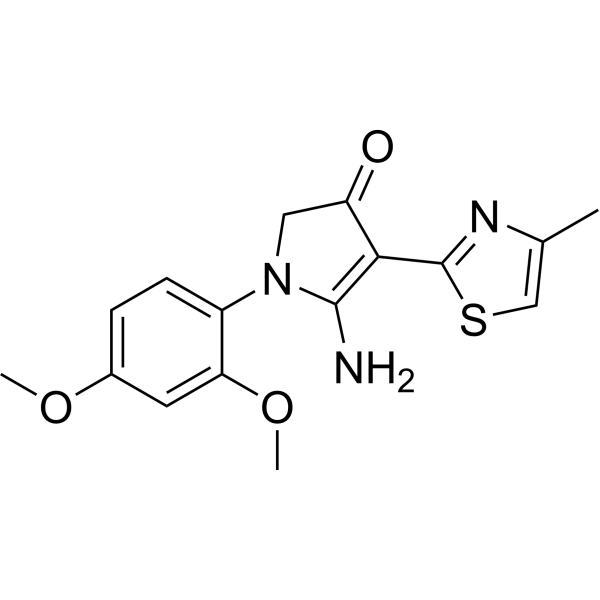
viFSP1 is a species-independent FSP1 inhibitor. viFSP1 directly inhibits FSP1 by targeting the highly conserved NAD(P)H binding pocket of FSP1. viFSP1 can induce Ferroptosis in FSP1-dependent cells. viFSP1 can be used in renal and breast cancer research .
loading...
    loading...
Cat. No.: HY-W490804
CAS No.: 2971-36-0
Research Areas:  

Metabolic Disease

HPTE is the active in vivo metabolite of Methoxychlor (HY-B1873), and acts as an inhibitor of 3β‑HSD and 17β‑HSD3. HPTE binds to the substrate-binding pocket of 3β‑HSD in a non-competitive manner, but competitively occupies the coenzyme NAD +-binding site, thereby inhibiting the conversion of pregnenolone to progesterone. HPTE binds to the androstenedione-binding pocket (the substrate pocket) of 17β‑HSD3 in a non-competitive manner, and competitively occupies the coenzyme NADPH-binding site, thus blocking the conversion of androstenedione to testosterone. HPTE interferes with androgen biosynthesis in Leydig cells by inhibiting the activities of these two key steroidogenic enzymes. HPTE can be used in studies related to androgen biosynthesis .
loading...
    loading...
Cat. No.: HY-184489
CAS No.: 328265-32-3
Research Areas:  

Cancer

PGP/FSP1-IN-1 is a dual PGP and FSP1 inhibitor and ferroptosis inducer that inhibits the oxidoreductase activity of FSP1. PGP/FSP1-IN-1 competes with NAD (P) H for binding to the pocket of FSP1 and induces FSP1 self-assembly, thereby directly blocking the catalytic function of the relevant enzyme. PGP/FSP1-IN-1 promotes lipid peroxidation and significantly enhances cellular sensitivity to ferroptosis when GPX4 activity is impaired or glutathione synthesis is inhibited. PGP/FSP1-IN-1 can be used in cancer research .
loading...
    loading...
Cat. No.: HY-141764S
CAS No.: 1794780-53-2
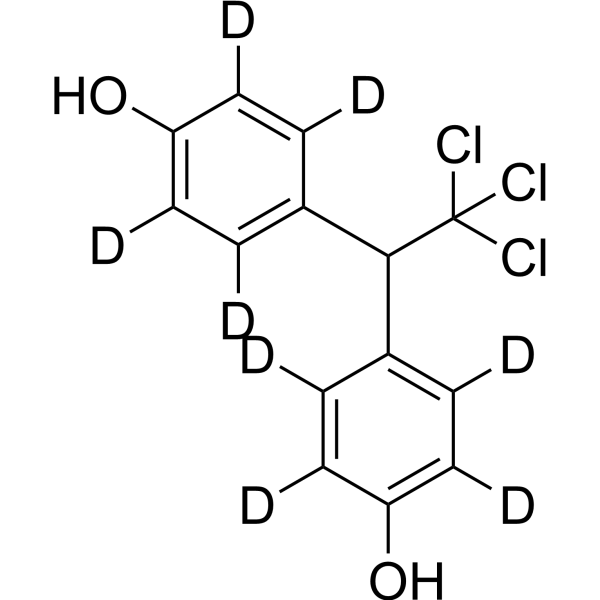
2,2-Bis(p-hydroxyphenyl)-1,1,1-trichloroethane-d8 is the deuterated-labeled HPTE (HY-W490804). HPTE is the active in vivo metabolite of Methoxychlor (HY-B1873), and acts as an inhibitor of 3β‑HSD and 17β‑HSD3. HPTE binds to the substrate-binding pocket of 3β‑HSD in a non-competitive manner, but competitively occupies the coenzyme NAD +-binding site, thereby inhibiting the conversion of pregnenolone to progesterone. HPTE binds to the androstenedione-binding pocket (the substrate pocket) of 17β‑HSD3 in a non-competitive manner, and competitively occupies the coenzyme NADPH-binding site, thus blocking the conversion of androstenedione to testosterone. HPTE interferes with androgen biosynthesis in Leydig cells by inhibiting the activities of these two key steroidogenic enzymes. HPTE can be used in studies related to androgen biosynthesis .
loading...
    loading...

