7 Results for "

Nutrient deprivation

" in MedChemExpress (MCE) Product Catalog:
Products (7)

7 Results for "Nutrient deprivation" in MCE Product Catalog:

Cat. No.: HY-W013136
CAS No.: 620-67-7
Synonyms: UX007
Research Areas:  

Metabolic Disease

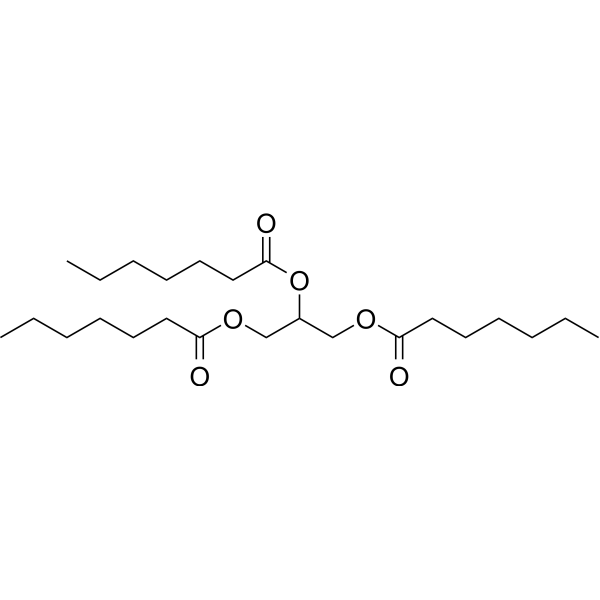
Triheptanoin (Propane-1,2,3-triyl triheptanoate) is a synthetic medium-chain triglyceride (MCT) consisting of three odd-chain 7-carbon (heptanoate) fatty acids on a glycerol backbone. Triheptanoin can be used for the research of inherited metabolic disorders .
loading...
    loading...
Cat. No.: HY-125199
CAS No.: 945377-65-1
Target:  

ULK Autophagy

Research Areas:  

Cancer

ULK-100 is a potent ULK1/ULK2 inhibitor, with IC50 values of 1.6 nM and 2.6 nM against human ULK1 and ULK2, respectively. ULK-100 reduces ULK1-mediated phosphorylation of Beclin 1 at Ser15, inhibits autophagy by targeting the ULK1 pathway, and also suppresses autophagy in tumor cells. ULK-100 enhances the sensitivity of tumor cells to nutrient deprivation. ULK-100 can be used in research on autophagy initiation and cancer .
loading...
    loading...
Cat. No.: HY-136348
CAS No.: 1630160-25-6
Target:  

Bacterial

Research Areas:  

Infection

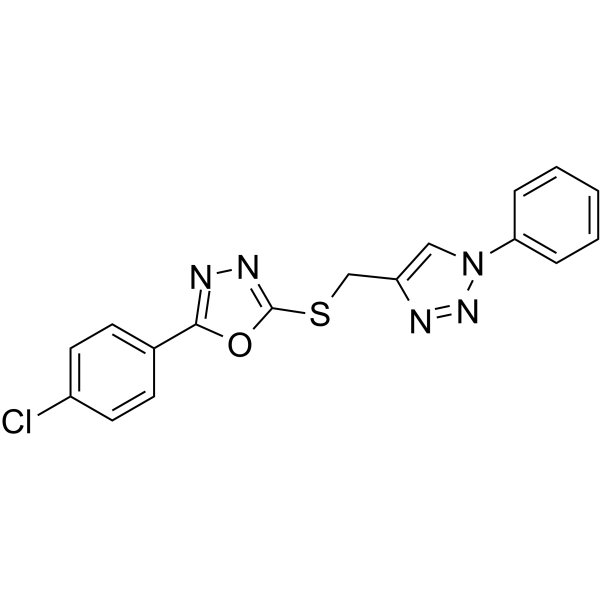
ML338 is a selective small molecule inhibitor probe of non-replicating Mycobacterium tuberculosis bacilli and is against the non-replicating M. tuberculosis with IC90 and IC99 values of 1 μM and 4 μM, respectively by CFU. ML338 is a invaluable tool for identifying both essential functions and vulnerabilities of the M. tuberculosis bacilli in the nutrient deprivation states. ML338 can be used for the study of M. tuberculosis chemotherapy .
loading...
    loading...
Cat. No.: HY-W013136R
CAS No.: 620-67-7
Synonyms: UX007 (Standard)
Triheptanoin (Standard) is the analytical standard of Triheptanoin. This product is intended for research and analytical applications. Triheptanoin (Propane-1,2,3-triyl triheptanoate) is a synthetic medium-chain triglyceride (MCT) consisting of three odd-chain 7-carbon (heptanoate) fatty acids on a glycerol backbone. Triheptanoin can be used for the research of inherited metabolic disorders .
loading...
    loading...
Cat. No.: HY-183257
CAS No.: 1242983-93-2
Research Areas:  

Cancer

ATI-1 is an autophagy initiation inhibitor. ATI-1 targets valosin-containing protein (VCP/p97, disrupts its interaction with UFL1, impairs UFMylation homeostasis associated with VCP, promotes polyubiquitination and degradation of Beclin1, and blocks the formation of early autophagosomes. ATI-1 induces synergistic death of autophagy-dependent malignant tumor cells under nutrient deprivation conditions, accompanied by decreased mitochondrial membrane potential, reduced ROS levels and lysosomal stress. ATI-1 exhibits anti-tumor efficacy in a pancreatic adenocarcinoma xenograft mouse model. ATI-1 can be used for the research of pancreatic adenocarcinoma and lung cancer .
loading...
    loading...
Cat. No.: HY-D3073
CAS No.: 2477607-64-8
Target:  

Fluorescent Dye

Research Areas:  

Others

DXB-NIR is a push-pull dioxaboron fluorescent probe with solvatochromic properties, featuring high fluorescence brightness, photostability, and a large two-photon absorption cross-section. DXB-NIR exhibits Ex/Em of 550/620–780 nm (with two-photon excitation at 930 nm). DXB-NIR quantifies local polarity via the intensity ratio I (>640)/I (<640) between the far-red channel (<640 nm) and the near-infrared channel (>640 nm), and it can simultaneously label the plasma membrane, endoplasmic reticulum, and lipid droplets in live cells. DXB-NIR monitors the increase in local polarity of various cell compartments under conditions of cholesterol depletion, starvation, and oxidative stress. DXB-NIR can be used for polarity imaging of biological membranes and lipid droplets, as well as studies related to cellular stress .
loading...
    loading...
Cat. No.: HY-186224
CAS No.: 118458-58-5
Research Areas:  

Cancer

GW296115 is a multi-target inhibitor with the following IC50 values against its targets: 8.4 nM for BRSK2, 21 nM for BRSK1, 1.8 μM for PDGFRβ, 5.5 nM for STK17B/DRAK2, 28 nM for DRAK1, 20 nM for PHKG1, and 89 nM for DCAMKL3. GW296115 downregulates the phosphorylation of S317 site on ULK1 and S351 site on P62, which are AMPK substrates driven by BRSK2. GW296115 does not alter the phosphorylation level of AMPK at T172, reduces nutrient deprivation-mediated Autophagy and autophagosome formation, and enhances Apoptosis. GW296115 exhibits anticancer activity against triple-negative breast cancer. GW296115 is applicable for breast cancer-related research .
loading...
    loading...

