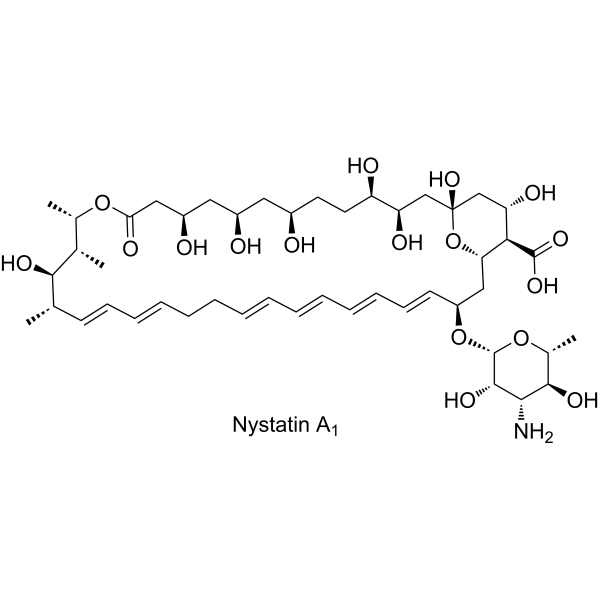
4 Results for "

Nystatin A1

" in MedChemExpress (MCE) Product Catalog:
Products (4)

4 Results for "Nystatin A1" in MCE Product Catalog:

59
59 Cited Publications
Cat. No.: HY-17409
CAS No.: 1400-61-9
Nystatin is an orally active polyene antifungal antibiotic effective against yeast and mycoplasma. Nystatin increases the permeability of plasma membranes to small monovalent ions, including chloridion . Nystatin is a cholesterol-sequestering agent , partially prevents Oxaliplatin-induced lipid raft aggregation, DR4 and DR5 clustering, and thereby reduces apoptosis .
loading...
    loading...
Cat. No.: HY-152909
CAS No.: 65086-32-0
Nystatin A2 is an active component of antifungal agent, Nystatin (HY-17409). Nystatin is an orally active polyene antifungal antibiotic effective against yeast and mycoplasma .
loading...
    loading...
Cat. No.: HY-113819
CAS No.: 100-95-8
Synonyms: Dodecarbonium chloride
Research Areas:  

Infection

Metalkonium chloride (Dodecarbonium chloride) is a quaternary ammonium salt, surfactant, and transdermal penetration enhancer. Metalkonium chloride increases skin permeability to facilitate transdermal delivery. Metalkonium chloride enhances the growth inhibitory activity of Nystatin (HY-17409) ointment against C. monosa. Metalkonium chloride can be used in studies related to Candida monosa infections .
loading...
    loading...
Cat. No.: HY-D3117
CAS No.: 2146114-18-1
Target:  

Fluorescent Dye

Research Areas:  

Others

MBCB is a two-photon Fluorescent probe for dual-detection of mitochondrial SO₂ derivatives and viscosity. For SO₂ derivatives detection, the probe utilizes a Michael addition mechanism: nucleophilic addition of SO₂ derivatives to the C=C bond between the carbazole skeleton and 3-methylbenzothiazolium moiety destroys the strong intramolecular charge transfer (ICT) system between these groups, while enhancing the weak ICT system between the benzothiazole group and carbazole framework; this causes the red emission at 600 nm to decrease and the blue emission at 434 nm to increase, creating a ratiometric response based on the I₄₃₄ₙₘ/I₆₀₀ₙₘ intensity ratio. For viscosity detection, in low-viscosity environments, steric hindrance creates a twisted ICT (TICT) system with weak fluorescence, while in high-viscosity environments, intramolecular rotation is blocked, the TICT state is disrupted, and the strong ICT system is recovered, leading to a strong red emission at 567 nm with negligible change to the short-wavelength emission at 415 nm, creating a ratiometric response based on the I₅₆₇ₙₘ/I₄₁₅ₙₘ intensity ratio that has a logarithmic linear relationship with viscosity. The probe has excitation/emission wavelengths of Ex/Em = 351/434, 600 nm for SO₂ derivatives detection and Ex/Em = 351/567 nm for viscosity detection, with two-photon excitation at 740 nm for bioimaging; it also exhibits good mitochondrial targeting ability with a Pearson's colocalization coefficient of 0.93 when paired with Mito-Tracker Green. The probe shows high sensitivity and selectivity for SO₂ derivatives, has low cell cytotoxicity, and can be applied to detect exogenous/endogenous HSO₃⁻ in living cells and in vivo, as well as visualize mitochondrial viscosity changes induced by nystatin[1].
loading...
    loading...

