18 Results for "

Plasma membrane integrity

" in MedChemExpress (MCE) Product Catalog:
Products (18)

18 Results for "Plasma membrane integrity" in MCE Product Catalog:

1
1 Cited Publications
Cat. No.: HY-P5712
CAS No.: 113-73-5
Synonyms: Gramicidin soviet
Research Areas:  

Infection

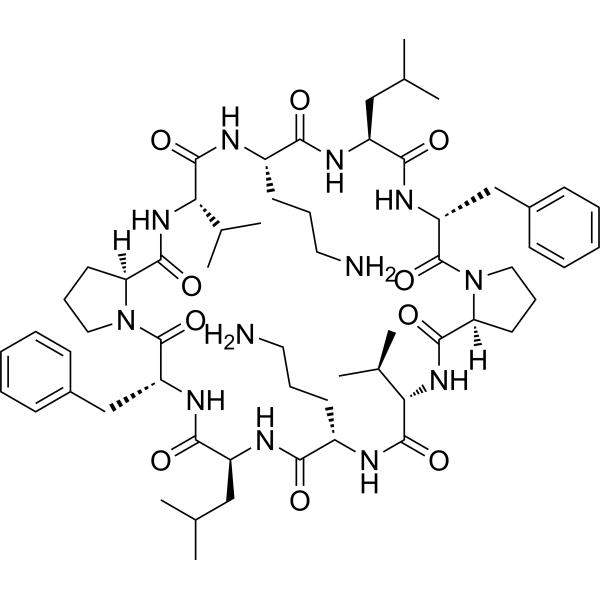
Gramicidin S (Gramicidin soviet) is a cationic cyclic peptide antibiotic that selectively targets bacterial cell membranes and has anticancer activity. Gramicidin S also exerts antibacterial activity by destroying membrane integrity and interfering with membrane protein function. Gramicidin S inserts into the phospholipid bilayer through hydrophobic amino acid residues, specifically binds to negatively charged membrane lipids and disrupts membrane structure, thereby inhibiting cell division and cell wall synthesis, and ultimately causing bacterial death. Gramicidin S also inhibits ion channels, with IC50s of 41 μM, 24 μM, and 3 μM for Na +/K +-ATPase, tobacco leaf plasma membrane Mg 2+/K +-ATPase, and rat heart plasma membrane Ca 2+-ATPase, respectively .
loading...
    loading...
Cat. No.: HY-D0920
CAS No.: 166196-17-4
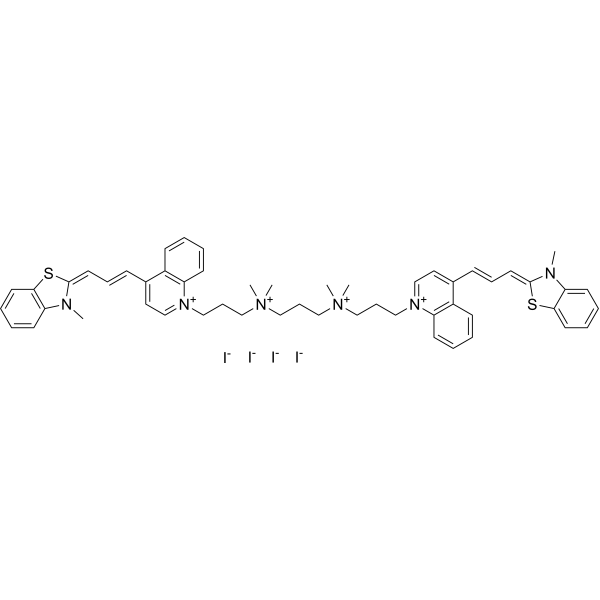
TOTO-3 is a cyanine nucleic acid intercalating fluorescent probe that binds to both RNA and DNA (Ex=642 nm, Em=660 nm). TOTO-3 cannot enter intact cells, but can penetrate cells with permeabilized plasma membranes, staining cytoplasmic RNA and nucleoli to distinguish intact cells from damaged ones. TOTO-3 is taken up by macrophages in an ultrasound-independent manner. TOTO-3 accumulates in tumor cells via ultrasound-mediated enhancement of plasma membrane permeability. TOTO-3 supports optical imaging for real-time assessment of plasma membrane integrity, nucleic acid detection, and monitoring of ultrasound-mediated intracellular delivery processes. TOTO-3 is applicable to studies related to rectal cancer .
loading...
    loading...
Cat. No.: HY-119431
CAS No.: 2043-43-8
Synonyms: 2-Hydroxypropanamide
Lactamide (2-Hydroxypropanamide) is an amide compound. Lactamide can be used as a cryoprotectant and is employed in experiments for the cryopreservation of white rabbit sperm .
loading...
    loading...
Cat. No.: HY-178476
CAS No.: 3096122-10-7
Research Areas:  

Infection

Anti-MRSA agent 36 (Compound III13) is an antibacterial agent with strong anti MRSA activity (MIC = 1 μg/mL). Anti-MRSA agent 36 targets phosphatidylglycerol (PG) on bacterial membranes, disrupting membrane integrity, leading to DNA leakage and increased ROS. Anti-MRSA agent 36 has advantages such as low cytotoxicity, low hemolysis, difficulty in inducing drug resistance, and good plasma stability. Anti-MRSA agent 36 can be used for the study of skin abscess and systemic infection models .
loading...
    loading...
Cat. No.: HY-P5286
CAS No.: 184870-30-2
BMAP-27 is a cationic amphipathic α-helical antimicrobial peptide with anticancer activity. BMAP-27 disrupts the integrity and permeability of cell membranes, leading to the leakage of intracellular DNA, proteins and alkaline phosphatase. BMAP-27 increases intracellular ROS levels and reduces plasma endotoxin and TNF-α concentrations. BMAP-27 can be used in studies related to Salmonella infection, breast cancer, lung cancer and obstructive jaundice .
loading...
    loading...
Cat. No.: HY-151284
CAS No.: 2833772-94-2
Target:  

Bacterial Fungal

Research Areas:  

Infection

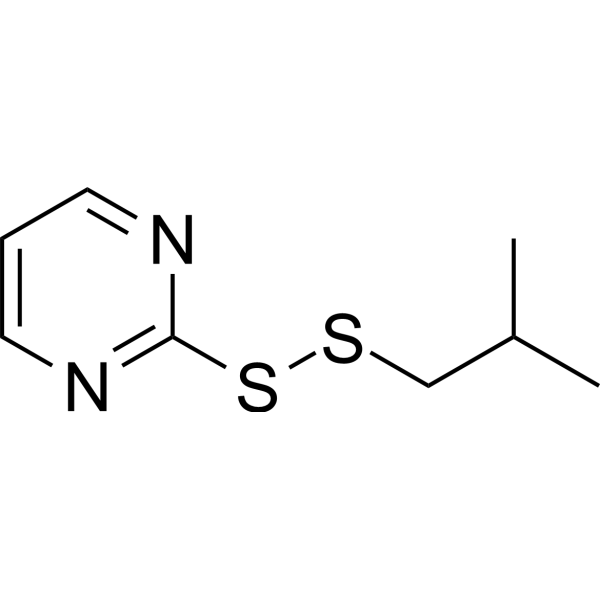
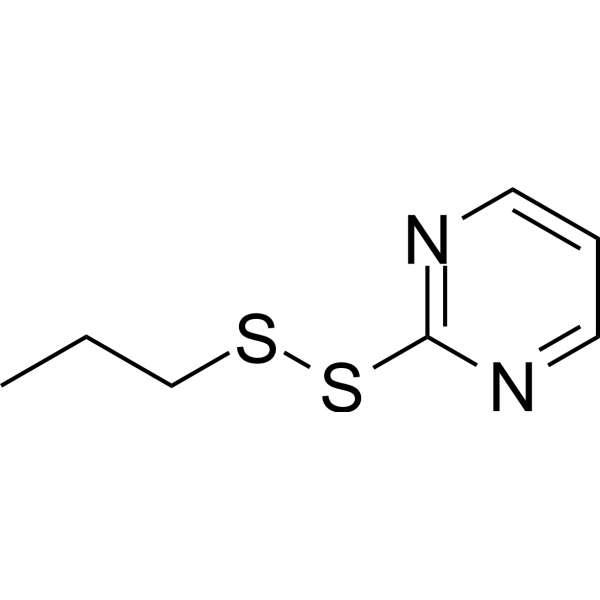
Antifungal agent 38 is a geterocyclic disulfide, an antifungal and antibacterial agent. Antifungal agent 38 induces the shrinkage of hyphae, disrupts the integrity of the plasma membrane, and causes the damage and leakage of cell contents .
loading...
    loading...
Cat. No.: HY-151280
CAS No.: 2833772-92-0
Target:  

Bacterial Fungal

Research Areas:  

Infection

Antifungal agent 37 is a geterocyclic disulfide, with antifungal activity .
loading...
    loading...
Cat. No.: HY-161988
CAS No.: 3055131-42-2
Target:  

Bacterial

Research Areas:  

Infection Inflammation/Immunology

Antimicrobial agent-34 (compound 4h) is an antibacterial agent (MIC = 1–4 μg/mL), with a clogP value of 9.14. Antimicrobial agent-34 has good plasma stability (HC50 of 131.1 μg/mL) and good membrane selectivity (HC50/MIC is 65.6), with rapid sterilization capability. Antimicrobial agent-34 destroys the integrity of bacterial cell membranes, induces an increase in intracellular reactive oxygen species, and leaks protein and DNA, ultimately leading to bacterial death. Antimicrobial agent-34 demonstrates significant in vivo antibacterial potency in a mouse sepsis model infected with Staphylococcus aureus ATCC43300 .
loading...
    loading...
Cat. No.: HY-130743
CAS No.: 4433-08-3
Synonyms: Bis-eugenol; Dehydrodieugenol
Target:  

Parasite

Research Areas:  

Infection

Dieugenol is a neolignan that has been found in N. leucantha and has antioxidative and antiprotozoal activities. It inhibits the formation of thiobarbituric acid reactive substances (TBARS) and scavenges superoxide anions, but not hydroxyl radicals, in cell-free assays. It has anti-trypanosomal activity against T. cruzi amastigotes and trypomastigotes (IC50s=15.1 and 11.5 μM, respectively) but is cytotoxic to NCTC L-929 fibroblasts with a 50% cytotoxic concentration (CC50) value of 58.2 μM.2 Dieugenol (15 μM) disrupts the integrity of the T. cruzi trypomastigote plasma membrane but does not induce the production of reactive oxygen species (ROS) in trypomastigotes or LPS-stimulated and unstimulated isolated mouse peritoneal macrophages.
loading...
    loading...
Cat. No.: HY-W778649
CAS No.: 1795136-21-8
Sarmentine-d8 is the deuterium labeled Sarmentine. Sarmentine is a broad-spectrum contact herbicide and PSII inhibitor, with an IC50 of 3.0 μM and a Ki of 1.5 μM against spinach, an IC50 of 1.72 μM against wild-type Amaranthus retroflexus, and an IC50 of 0.97 μM against triazine-resistant Amaranthus retroflexus. Sarmentine competitively binds to the QB binding site of plastoquinone on PSII, thereby blocking photosynthetic electron transport. Sarmentine inhibits enoyl-ACP reductase in Arabidopsis thaliana by targeting the early fatty acid synthesis process, with an IC50 of 18.3 μM. Sarmentine induces light-independent loss of plasma membrane integrity and electrolyte leakage. Sarmentine also exhibits antiplasmodial, antimycobacterial, antituberculous, and antiplatelet aggregation activities .
loading...
    loading...
Cat. No.: HY-181492
Target:  

Fungal

Research Areas:  

Infection Inflammation/Immunology

Antifungal agent 155 hydrochloride is an antifungal agent. Antifungal agent 155 hydrochloride induces bent, twisted, abnormally swollen hyphae, compromises fungal hyphal plasma membrane integrity, and triggers fungal cell death. Antifungal agent 155 hydrochloride can be used for the research of fusarium keratitis .
loading...
    loading...
Cat. No.: HY-P11897
Target:  

Bacterial

Research Areas:  

Infection

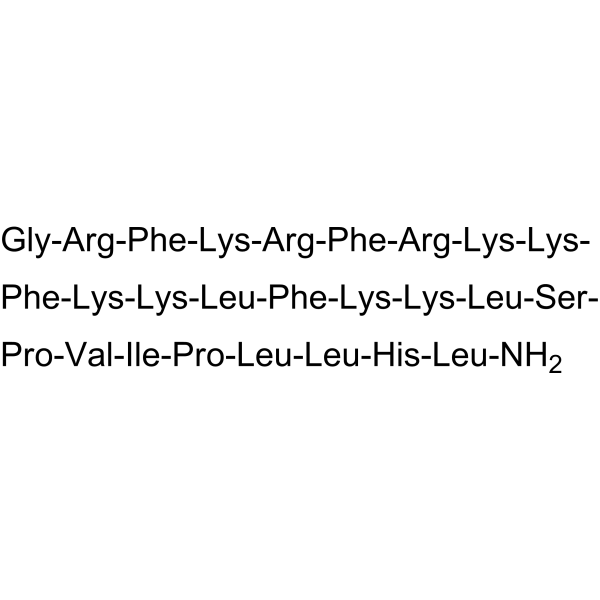
RBWH11 is a synthetic antimicrobial peptide. RBWH11 disrupts the integrity of bacterial plasma membranes, induces changes in membrane permeability and causes bacterial death. RBWH11 can eliminate established bacterial biofilms. RBWH11 exhibits broad-spectrum antimicrobial activity against Gram-negative and Gram-positive ESKAPE pathogens, including multidrug-resistant strains. RBWH11 can be used for the research of multidrug-resistant bacterial infections .
loading...
    loading...
Cat. No.: HY-183295
CAS No.: 3103869-13-9
Research Areas:  

Infection

Antifungal agent 160 is a cytochrome bc1 complex inhibitor with activity against Alternaria solani, Gibberella zeae, Colletotrichum gloeosporioides, and Fusarium oxysporum f. sp. melonis. Antifungal agent 160 impairs ATP synthesis, suppresses ATPase activity, induces ROS bursts, compromises plasma membrane integrity, and suppresses fungal growth. Antifungal agent 160 can be used for the research of fungal infection .
loading...
    loading...
Cat. No.: HY-P5286A
BMAP-27 acetate is a cationic amphipathic α-helical antimicrobial peptide with anticancer activity. BMAP-27 acetate disrupts the integrity and permeability of cell membranes, leading to the leakage of intracellular DNA, proteins and alkaline phosphatase. BMAP-27 acetate increases intracellular ROS levels and reduces plasma endotoxin and TNF-α concentrations. BMAP-27 acetate can be used in studies related to Salmonella infection, breast cancer, lung cancer and obstructive jaundice .
loading...
    loading...
Cat. No.: HY-180125
Research Areas:  

Infection

Antibacterial agent 307 is an antibacterial agent. Antibacterial agent 307 shows MICs of 1-4 μg/mL against Gram-positive bacteria, moderate activity against Gram-negative bacteria, low hemolytic toxicity, and excellent plasma stability. Antibacterial agent 307 compromises bacterial membrane integrity via increased permeability and depolarization, induces endogenous ROS accumulation, causes cytoplasmic protein and nucleic acid leakage, and drives rapid bacterial cell death. Antibacterial agent 307 can be used for the research of bacterial infection .
loading...
    loading...
Cat. No.: HY-180125A
Research Areas:  

Infection

Antibacterial agent 307 hydrochloride is an antibacterial agent. Antibacterial agent 307 hydrochloride shows MICs of 1-4 μg/mL against Gram-positive bacteria, moderate activity against Gram-negative bacteria, low hemolytic toxicity, and excellent plasma stability. Antibacterial agent 307 hydrochloride compromises bacterial membrane integrity via increased permeability and depolarization, induces endogenous ROS accumulation, causes cytoplasmic protein and nucleic acid leakage, and drives rapid bacterial cell death. Antibacterial agent 307 hydrochloride can be used for the research of bacterial infection .
loading...
    loading...
Cat. No.: HY-P5289A
Target:  

Drug Intermediate

pre-BMAP-27 TFA is a precursor to BMAP-27 (HY-P5286). BMAP-27 is a cationic amphipathic α-helical antimicrobial peptide with anticancer activity. BMAP-27 disrupts the integrity and permeability of cell membranes, leading to the leakage of intracellular DNA, proteins and alkaline phosphatase. BMAP-27 increases intracellular ROS levels and reduces plasma endotoxin and TNF-α concentrations. BMAP-27 can be used in studies related to Salmonella infection, breast cancer, lung cancer and obstructive jaundice .
loading...
    loading...
Cat. No.: HY-W099725
CAS No.: 78910-33-5
Sarmentine is a broad-spectrum contact herbicide and PSII inhibitor, with an IC50 of 3.0 μM and a Ki of 1.5 μM against spinach, an IC50 of 1.72 μM against wild-type Amaranthus retroflexus, and an IC50 of 0.97 μM against triazine-resistant Amaranthus retroflexus. Sarmentine competitively binds to the QB binding site of plastoquinone on PSII, thereby blocking photosynthetic electron transport. Sarmentine inhibits enoyl-ACP reductase in Arabidopsis thaliana by targeting the early fatty acid synthesis process, with an IC50 of 18.3 μM. Sarmentine induces light-independent loss of plasma membrane integrity and electrolyte leakage. Sarmentine also exhibits antiplasmodial, antimycobacterial, antituberculous, and antiplatelet aggregation activities .
loading...
    loading...
  • 1

