1. Search Result
Search Result
Results for "

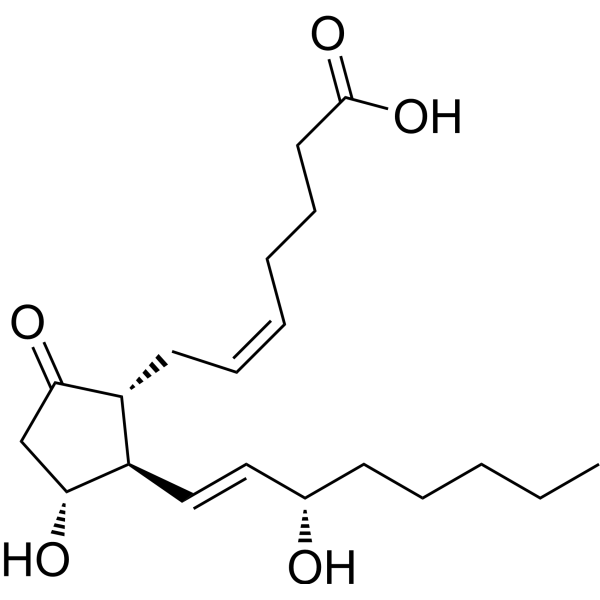
Prostaglandin E2 (Standard)

" in MedChemExpress (MCE) Product Catalog:

11

Inhibitors & Agonists

4

Natural
Products

Cat. No. Product Name Target Research Areas Chemical Structure
  • HY-101952R
    Prostaglandin E2 (Standard)
    50+ Cited Publications

    PGE2(Standard); Dinoprostone (Standard)

    Reference Standards Prostaglandin Receptor Endogenous Metabolite Cardiovascular Disease Endocrinology
    Prostaglandin E2 (Standard) is the analytical standard of Prostaglandin E2. This product is intended for research and analytical applications. Prostaglandin E2 (PGE2) is a hormone-like substance that participate in a wide range of body functions such as the contraction and relaxation of smooth muscle, the dilation and constriction of blood vessels, control of blood pressure, and modulation of inflammation.
    Prostaglandin E2 (Standard)
  • HY-135023R

    5-trans Prostaglandin E2 (Standard)

    Cytochrome P450 Prostaglandin Receptor Reference Standards Cancer
    5-trans-PGE2 (Standard) is the analytical standard of 5-trans-PGE2. This product is intended for research and analytical applications. 5-trans-PGE2 (5-trans Prostaglandin E2) is the active isomer of PGE2 and a potent activator of aromatase. Supplements the process of paracrine signaling between epithelial cells (expressing high levels of PGE2) and surrounding stromal cells (expressing high levels of aromatase). This process is involved in the growth and development of breast cancer .
    5-trans-PGE2 (Standard)
  • HY-N3617R

    Laricin (Standard)

    Reference Standards Fungal Infection
    Coniferin (Standard) is an analytical standard for Coniferin. This product is intended for research and analytical applications. Coniferin (Laricin) is a glucoside of coniferyl alcohol. Coniferin inhibits fungal melanization. Coniferin inhibits the release of certain hormones from cells, including Prostaglandin E2 and Thromboxane B2 .
    Coniferin (Standard)
  • HY-16781R

    CJ-023423 (Standard); RQ-00000007 (Standard); AAT-007 (Standard)

    Prostaglandin Receptor Reference Standards Metabolic Disease Endocrinology Cancer
    Grapiprant (Standard) is the analytical standard of Grapiprant. This product is intended for research and analytical applications. Grapiprant (CJ-023423) is a selective EP4 receptor antagonist whose physiological ligand is prostaglandin E2 (PGE2). Grapiprant displaces [3H]-PGE2 (1 nM) binding to dog recombinant EP4 receptor with IC50 value of 35 nM and Ki value of 24 nM. Grapiprant has the potential for osteoarthritic pain and inflammation treatment .
    Grapiprant (Standard)
  • HY-W748591R

    Amyloid-β Apoptosis Reference Standards KMO Neurological Disease Inflammation/Immunology Cancer
    Cannflavin A (Standard) is the analytical standard of Cannflavin A. This product is intended for research and analytical applications. Cannflavin A can be isolated from Cannabis sativa L.. Cannflavin A has anti-cancer, neuroprotective and anti-inflammatory activity. Cannflavin A inhibits 1-42 aggregation. Cannflavin A also inhibits kynurenine-3-monooxygenase (KMO) (IC50 = 29.4 μM). Cannflavin A activates apoptosis via caspase-3 cleavage. Cannflavin A exerts anti-inflammatory effects by inhibiting pro-inflammatory enzymes, including prostaglandin E2 and cytochrome c oxidases I and II in PC12 cell line .
    Cannflavin A (Standard)
  • HY-B2121R

    6-MNA (Standard); Naproxen impurity O (Standard)

    Reference Standards Drug Metabolite COX Neurological Disease Inflammation/Immunology
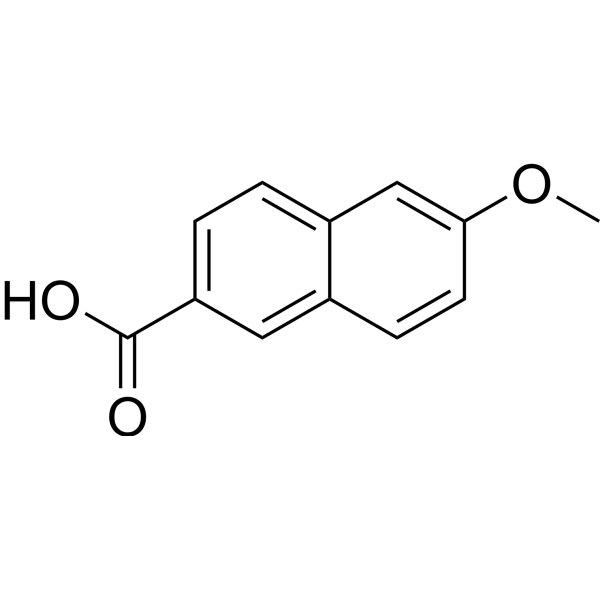
    6-Methoxy-2-naphthoic acid (Standard) (6-MNA (Standard)) is the analytical standard of 6-Methoxy-2-naphthoic acid (HY-B2121). This product is intended for research and analytical applications. 6-Methoxy-2-naphthoic acid (6-MNA) is the active metabolite of Nabumetone (HY-B0559). 6-Methoxy-2-naphthoic acid is also an inhibitor of COX-1 and COX-2. 6-Methoxy-2-naphthoic acid can inhibit the synthesis of gastric mucosal prostaglandin E2. 6-Methoxy-2-naphthoic acid can be used in the research of inflammation and pain-related diseases. In addition, 6-Methoxy-2-naphthoic acid is an impurity in Naproxen (HY-15030) and can also be used in the synthesis of other active compounds.
    6-Methoxy-2-naphthoic acid (Standard)
  • HY-B1311R

    SKF-525A (Standard); U-5446 (Standard); RP-5171 (Standard)

    Reference Standards Cytochrome P450 Monoamine Oxidase Bcl-2 Family Survivin PARP Neurological Disease Inflammation/Immunology Cancer
    Proadifen (hydrochloride) (Standard) is the analytical standard of Proadifen (hydrochloride). This product is intended for research and analytical applications. Proadifen (SKF-525A) hydrochloride is a non-competitive Cytochrome P450 inhibitor with an IC50 value of 19 μM. Proadifen hydrochloride reduces monoamine oxidase A (MAO-A) activity and reverses the antidepressantlike behavioral effect of Imipramine (HY-B1490A) and Desipramine (HY-B1272A) in rats. Proadifen hydrochloride also reduces N, N-dimethyltryptamine (DMT) metabolism in liver microsomes and inhibits N-demethylationand Acridone (HY-W007771) formation. Proadifen hydrochloride augments Lipopolysaccharide (LPS) (HY-D1056)-induced fever and exacerbates Prostaglandin E2 (PGE2) (HY-101952) levels in the rat. Proadifen hydrochloride is promising for research of metabolism-related deseases, ovarian carcinoma, inflammation and dopamine neurons-related deseases [4] .
    Proadifen hydrochloride (Standard)
  • HY-100516R

    UR-8880 (Standard)

    Reference Standards Cytochrome P450 COX Inflammation/Immunology
    Cimicoxib (Standard) is the analytical standard of Cimicoxib. This product is intended for research and analytical applications. Cimicoxib (UR-8880) is an orally active, blood-brain barrier-permeable COX-2 inhibitor that also exerts targeted inhibition on CYP2D15. It has an IC50 of 66 nM against hCOX-2, an IC50 of 1.6 μM against canine CYP2D15, and an IC50 of 0.056 μM against feline CYP2D15. By inhibiting the COX-2 pathway to reduce the production of thromboxane B2 and prostaglandin E2, Cimicoxib exerts antipyretic, anti-inflammatory and analgesic effects. Cimicoxib is metabolized by CYP2D15 to form demethyl-cimicoxib, undergoes glucuronidation via UDP-glucuronosyltransferases, and exhibits biphasic elimination kinetics in beagle dogs. Cimicoxib is widely used in studies of inflammatory diseases, osteoarthritis, and perioperative pain associated with orthopedic or soft tissue surgeries .
    Cimicoxib (Standard)
  • HY-N0353R

    (+)-Curdione (Standard)

    Reference Standards Ferroptosis Apoptosis Reactive Oxygen Species (ROS) Autophagy Glutathione Peroxidase Keap1-Nrf2 Heme Oxygenase (HO) TGF-β Receptor Indoleamine 2,3-Dioxygenase (IDO) Others
    Curdione (Standard) is the analytical standard of Curdione. This product is intended for research and analytical applications. Curdione ((+)-Curdione) is an orally active sesquiterpenoid. Curdione inhibits platelet aggregation. Curdione induces ferroptosis in colorectal cancer via m6A methylation mediated by METTL14 and YTHDF2. Curdione inhibits ferroptosis in Isoproterenol (HY-B0468)-induced myocardial infarction by regulating the Keap1/Trx1/GPX4 signaling pathway, suppressing oxidative stress (ROS) and apoptosis. Curdione ameliorates Doxorubicin (HY-15142)-induced cardiotoxicity by inhibiting oxidative stress (ROS) and activating the Nrf2/HO-1 pathway. Curdione ameliorates sepsis-induced lung injury by inhibiting platelet-mediated neutrophil extracellular trap formation. Curdione ameliorates Bleomycin (HY-17565A)-induced pulmonary fibrosis by inhibiting TGF-β-induced fibroblast-to-myofibroblast differentiation. Curdione exhibits neuroprotective effects against focal cerebral ischemia-reperfusion injury in rats. Curdione exerts antiproliferative effects against human uterine leiomyosarcoma by targeting IDO1. Curdione protects vascular endothelial cells and atherosclerosis by regulating DNMT1-mediated ERBB4 promoter methylation. Curdione inhibits inducible prostaglandin E2 production (IC50 = 1.1 μM) and cyclooxygenase 2 expression .
    Curdione (Standard)
  • HY-108563AR

    Reference Standards Prostaglandin Receptor Neurological Disease
    SC 51089 free base (Standard) is the analytical standard of SC 51089 (free base) (HY-108563A). This product is intended for research and analytical applications. SC 51089 free base is a selective antagonist of prostaglandin E2 EP1 receptor, with Kis of 1.3, 11.2, 17.5, and 61.1 μM for EP1, TP, EP3, and FP receptors, respectively. SC 51089 free base exhibits neuroprotective activity .
    SC 51089 free base (Standard)
  • HY-102065R

    Reference Standards Prostaglandin Receptor RANKL/RANK Metabolic Disease
    SC-19220 (Standard) is the analytical standard of SC-19220 (HY-102065). This product is intended for research and analytical applications. SC-19220 is a prostaglandin E2 receptor EP1 antagonist. SC-19220 blocks functional EP1 receptor activation, and RANK/RANKL signaling pathway. SC-19220 inhibits osteoclast formation and bone resorption by pre-existing osteoclasts. SC-19220 can be used for the research of osteoporotic disorders, inflammatory bone resorption .
    SC-19220 (Standard)

Inquiry Online

Your information is safe with us. * Required Fields.

Salutation


Country or Region *

Applicant Name *


Organization Name *

Department *


Email Address *


Product Name *

Cat. No.


Requested quantity *

Phone Number *


Remarks

Inquiry Online

Inquiry Information

Product Name:
Cat. No.:
Quantity:
MCE Japan Authorized Agent:

