4 Results for "

U46619-induced platelet aggregation

" in MedChemExpress (MCE) Product Catalog:
Products (4)

4 Results for "U46619-induced platelet aggregation" in MCE Product Catalog:

Cat. No.: HY-N3228
CAS No.: 89786-84-5
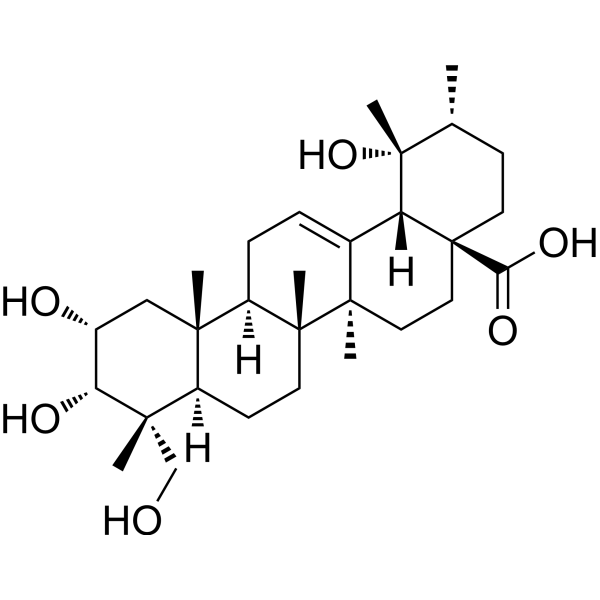
Myrianthic acid is a pentacyclic triterpenoid compound. Myrianthic acid can exist in the root wood of Myrianthus arboreus and the leaves of Campsis grandiflora. Myrianthic acid inhibits adrenaline-induced platelet aggregation, with a IC50 of 46.2 μM for this activity. Myrianthic acid can be used in studies related to thrombosis .
loading...
    loading...
Cat. No.: HY-165587
CAS No.: 284464-83-1
Research Areas:  

Cardiovascular Disease

BM-573 is an orally active dual thromboxane A₂ (TXA₂) modulator with an IC50 of 1.3 nM. BM-573 possesses both thromboxane synthase (TxAS) inhibition and thromboxane receptor (TP) antagonistic effects. BM-573 can completely inhibit platelet aggregation induced by Arachidonic acid (HY-109590) or U-46619 (TXA₂ analogues). BM-573 completely blocks the generation of TXB₂ (the stable metabolite of TXA₂) in human platelets and does not inhibit cyclooxygenase (COX-1/COX-2), thus avoiding interference with other prostaglandin synthesis. BM-573 has an inhibitory effect on U-46619-induced contractions in rat gastric fundus smooth muscle (ED₅₀ = 4.2 μM), but has no effect on contractions caused by PGE₂, PGF₂α, or PGI₂. BM-573 can be used in the study of atherosclerosis, myocardial infarction, pulmonary hypertension and shock .
loading...
    loading...
Cat. No.: HY-113884
CAS No.: 10219-69-9
Synonyms: 13(R)-HODE
Target:  

Endogenous Metabolite

Research Areas:  

Metabolic Disease

13(R)-HODE is the opposite enantiomer of the 13(S)-HODE produced when linoleic acid is incubated with soybean lipoxygenase. The presence of 13(R)-HODE in the supernatants and membranes of cultured bovine endothelial cells has been attributed to COX metabolism.1 13(R)-HODE is a weak (IC50=2.7 μM) inhibitor of U-46619-induced platelet aggregation.
loading...
    loading...
Cat. No.: HY-117044A
CAS No.: 81187-21-5
Research Areas:  

Metabolic Disease

(±)12-HEPE is produced by non-enzymatic oxidation of EPA. It contains equal amounts of 12(S)-HEPE and 12(R)-HEPE. The biological activity of (±)12-HEPE is likely mediated by one of the individual isomers, most commonly the 12(S) isomer in mammalian systems. 12-HEPE inhibits platelet aggregation with the same potency as 12-HETE, exhibiting IC50 values of 24 and 25 μM, respectively.1 These compounds are also equipotent as inhibitors of U46619-induced contraction of rat aorta (IC50s=8.6-8.8 μM).
loading...
    loading...

