
9 Results for "

advanced solid tumours

" in MedChemExpress (MCE) Product Catalog:
Products (9)

9 Results for "advanced solid tumours" in MCE Product Catalog:

5
5 Cited Publications
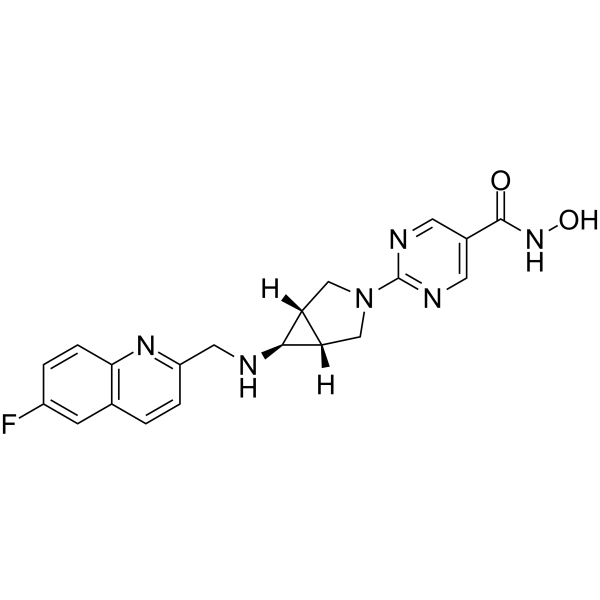
Cat. No.: HY-13432
CAS No.: 1256448-47-1
Purity:  99.34%
Synonyms: CHR-3996
Target:  

HDAC Apoptosis

Research Areas:  

Cancer

Nanatinostat (CHR-3996) is a potent, class I selective and orally active HDAC inhibitor with IC50s of 3 nM, 4 nM, and 7 nM for HDAC1, HDAC2, and HDAC3, respectively. Nanatinostat has low activity against HDAC5 (IC50 of 200 nM) and HDAC6 (IC50 of 2100 nM). Nanatinostat induces apoptosis in myeloma cells. Nanatinostat has potent anticancer effects, such as myeloma, advanced solid tumours and colorectal cancer .
loading...
    loading...
Cat. No.: HY-118953
CAS No.: 270902-51-7
Target:  

MetAP Drug Intermediate

Research Areas:  

Cancer

LAF389, a prodrug of LAF153 (HY-183876), is a methionine aminopeptidase (MetAps) inhibitor with an IC50 of 800 nM against MetAp2, and exhibits a maximum inhibition rate of 20% against MetAp1 at 300 nM. LAF389 possesses antiproliferative, antiangiogenic and cytotoxic activities. LAF389 can be used in research related to cancers such as advanced solid tumors .
loading...
    loading...
Cat. No.: HY-148954
CAS No.: 1620909-95-6
Research Areas:  

Cancer

PBF-999 is a phosphodiesterase10A (PDE-10A) and adenosine A2A receptor (A2AR) dual antagonist.
loading...
    loading...
Cat. No.: HY-P99867
CAS No.: 1204390-13-5
Synonyms: MEDI 573

Target:  

Inhibitory Antibodies

Research Areas:  

Cancer

Dusigitumab is a fully human IgG2λ monoclonal antibody that targets IGF-1 and IGF-2 with picomolar binding affinity. Dusigitumab blocks IGF-1 and IGF-2-induced phosphorylation of IGF-1R as well as activation of IR-A, thereby inhibiting the activation of downstream signaling pathways. Dusigitumab is applicable to research related to advanced solid tumors and hormone receptor-positive metastatic breast cancer .
loading...
    loading...
Cat. No.: HY-13432A
CAS No.: 1256448-48-2
Synonyms: CHR-3996 TFA
Target:  

HDAC Apoptosis

Research Areas:  

Cancer

Nanatinostat (CHR-3996) TFA is a potent, class I selective and orally active HDAC inhibitor with IC50s of 3 nM, 4 nM, and 7 nM for HDAC1, HDAC2, and HDAC3, respectively. Nanatinostat TFA has low activity against HDAC5 (IC50 of 200 nM) and HDAC6 (IC50 of 2100 nM). Nanatinostat TFA induces apoptosis in myeloma cells. Nanatinostat TFA has potent anticancer effects, such as myeloma, advanced solid tumours and colorectal cancer .
loading...
    loading...
Cat. No.: HY-P991605

Target:  

LAG-3

Research Areas:  

Cancer

HLX26 is a humanised anti-LAG-3 monoclonal antibody. HLX26 has antitumor activity especially advanced solid tumours. HLX26 can be used for lymphoma research .
loading...
    loading...
Cat. No.: HY-P992315
Synonyms: PTZ-522

Target:  

TNF Receptor

Research Areas:  

Cancer

ASP1951 (PTZ-522) is a monoclonal antibody that targets GITR and is a GITR agonist. ASP1951 can be used for the research of advanced solid tumours .
loading...
    loading...
Cat. No.: HY-P992368

Target:  

TNF Receptor

Research Areas:  

Cancer

HLX51 is a regulatory T cell inhibitor and OX40/CD134/TNFRSF4 agonist with tumour growth inhibitory activity. HLX51 inhibits regulatory T cell differentiation and activity, relieves tumour microenvironment immunosuppression, enhances effector T cell function. HLX51 competitively binds OX40, activates OX40, promotes immune cell proliferation and T cell killing ability. HLX51 modulates immune cell function to inhibit tumour growth. HLX51 can be used for the research of advanced/metastatic solid tumours and lymphomas .
loading...
    loading...
Cat. No.: HY-P992434

Research Areas:  

Cancer

OSE-279 is a high-affinity humanized monoclonal bivalent antibody targeting PD-1, the recommended isotype control is HY-P99003. OSE-279 blocks PD-1 ligand binding, inhibits PDL1-induced SHP1 phosphorylation, restores T cell activation, and promotes reactivation of primary T cell effector functions. OSE-279 binds hFcRn receptor, predicts long half-life, induces CD4 and CD8 T cell proliferation, and promotes interleukin 2 and interferon gamma secretion. OSE-279 can be used for the research of advanced malignancies, colon cancer, hepatocarcinoma, mesothelioma .
loading...
    loading...

