
8 Results for "

antennal response

" in MedChemExpress (MCE) Product Catalog:
Products (8)

8 Results for "antennal response" in MCE Product Catalog:

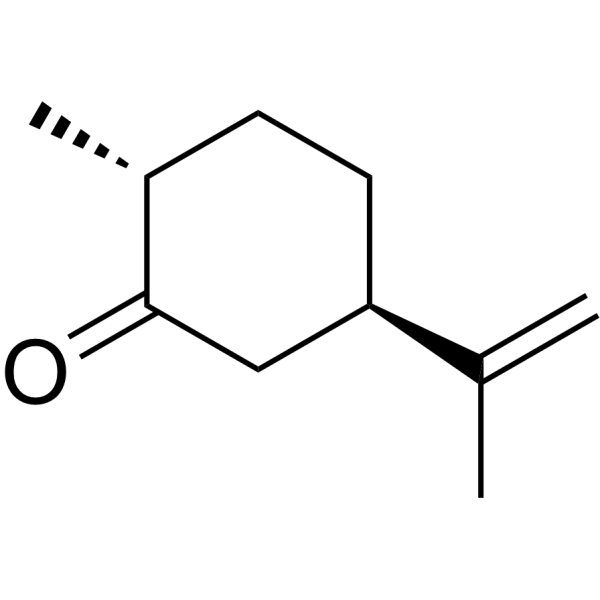
Cat. No.: HY-N8491A
CAS No.: 5524-05-0
(+)-Dihydrocarvone elicits strong antennal responses of A. mellifera. (+)-Dihydrocarvone influences bee foraging preference for tomato .
loading...
    loading...
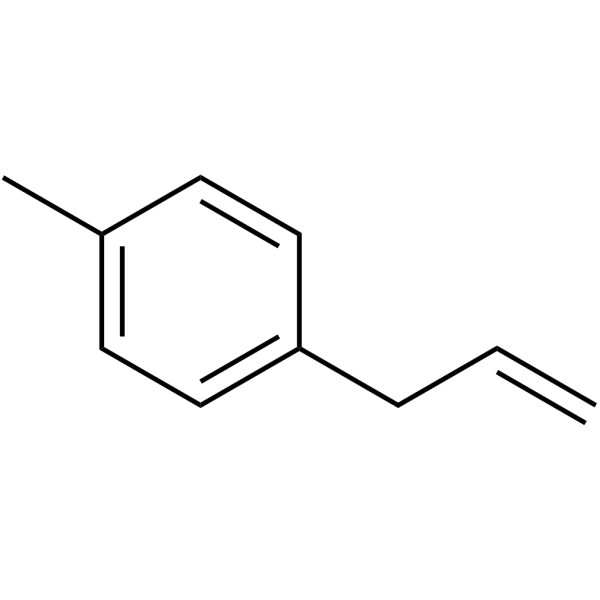
Cat. No.: HY-W074514
CAS No.: 3333-13-9
Target:  

Insecticide

Research Areas:  

Others

4-Allyltoluene, an aromatic compound, can elicite antennal olfactory response of Mediterranean fruit fly measured by electroantennography (EAG) .
loading...
    loading...
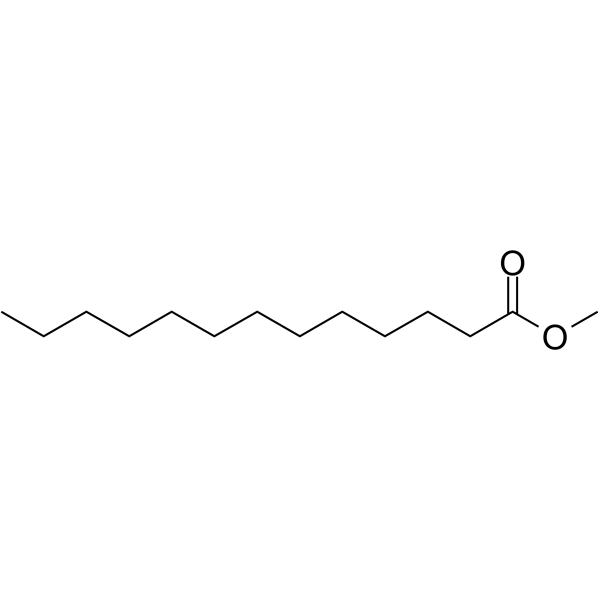
Cat. No.: HY-W004287
CAS No.: 1731-88-0
Methyl tridecanoate is a fatty acid methyl ester. Methyl tridecanoate exhibits an IC50 of 3.26 μM and a Ki of 2.30 μM against AsOBP21f in Anopheles sinensis. Methyl tridecanoate induces electroantennographic responses in female Anopheles sinensis. Methyl tridecanoate shows a dose-dependent attractive effect on Anopheles sinensis. Methyl tridecanoate weakly inhibits β-amyloid aggregation and AChE activity. Methyl tridecanoate can be used in the research of malaria and Alzheimer's disease .
loading...
    loading...
Cat. No.: HY-W009165R
CAS No.: 27519-02-4
Synonyms: cis-9-Tricosene (Standard)
(Z)-9-Tricosene (Standard) (cis-9-Tricosene (Standard)) is the analytical standard of (Z)-9-Tricosene (HY-W009165). This product is intended for research and analytical applications. (Z)-9-Tricosene (cis-9-Tricosene) is an insect pheromone found in dipteran flies. (Z)-9-Tricosene has multiple functions as a sex pheromone, aggregation pheromone and aphrodisiac pheromone, and mediates insect behaviors such as attraction, oviposition and mating via antennal receptors (e.g., the Or7a receptor). (Z)-9-Tricosene can be used in studies related to insecticides and insect chemical ecology .
loading...
    loading...
Cat. No.: HY-W009165
CAS No.: 27519-02-4
Synonyms: cis-9-Tricosene
Target:  

Insecticide

(Z)-9-Tricosene (cis-9-Tricosene) is an insect pheromone found in dipteran flies. (Z)-9-Tricosene has multiple functions as a sex pheromone, aggregation pheromone and aphrodisiac pheromone, and mediates insect behaviors such as attraction, oviposition and mating via antennal receptors (e.g., the Or7a receptor). (Z)-9-Tricosene can be used in studies related to insecticides and insect chemical ecology .
loading...
    loading...
Cat. No.: HY-W108424
CAS No.: 20711-10-8
Target:  

Insecticide

Research Areas:  

Infection

(Z)-11-Tetradecenyl acetate is a sex pheromone component and male attractant. (Z)-11-Tetradecenyl acetate triggers strong and stable electrophysiological responses in the antennal sensilla of male Euhyponomeutoides albithoracellus. (Z)-11-Tetradecenyl acetate, when used in combination with (E)-11-tetradecenyl acetate (HY-W1067200), attracts male Euhyponomeutoides albithoracellus. (Z)-11-Tetradecenyl acetate contributes to the development of sustainable pest control strategies including monitoring and mating disruption .
loading...
    loading...
Cat. No.: HY-W106720
CAS No.: 33189-72-9
Target:  

Insecticide

Research Areas:  

Infection

(E)-11-Tetradecenyl acetate is a monounsaturated 14-carbon acetate insecticide and a component of the sex pheromone of the currant shoot borer. (E)-11-Tetradecenyl acetate triggers strong antennal responses in males and is used in combination with (Z)-11-tetradecenyl acetate to produce an attracting effect. (E)-11-Tetradecenyl acetate has important application value in the sustainable control of pests, and can be used to monitor population dynamics and implement mating disruption. (E)-11-Tetradecenyl acetate is highly species-specific, triggering only extremely weak responses and showing no attracting activity towards Melanotus communis beetles. (E)-11-Tetradecenyl acetate can be used in studies related to the currant shoot borer and targeted pest control .
loading...
    loading...
Cat. No.: HY-W010415
CAS No.: 1191-16-8
Prenyl acetate is an insecticide. At low concentrations, prenyl acetate exhibits an attractant effect on worker ants of the red imported fire ant, and it elicits strong antennal electroantennogram (EAG) responses in all castes of the red imported fire ant. Prenyl acetate shows low toxicity to mammals. It can be used in research related to the control of the red imported fire ant (Solenopsis invicta) .
loading...
    loading...

