



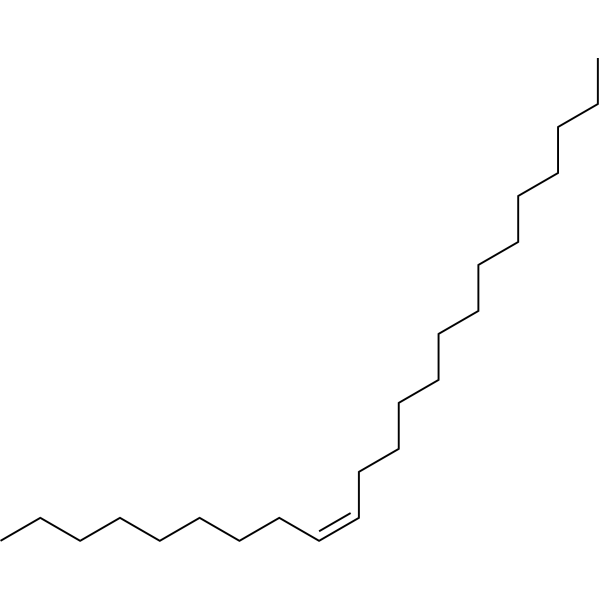
(Z)-9-Tricosene

Based on 1 Customer Validation
(Z)-9-Tricosene (cis-9-Tricosene) is an insect pheromone found in dipteran flies. (Z)-9-Tricosene has multiple functions as a sex pheromone, aggregation pheromone and aphrodisiac pheromone, and mediates insect behaviors such as attraction, oviposition and mating via antennal receptors (e.g., the Or7a receptor). (Z)-9-Tricosene can be used in studies related to insecticides and insect chemical ecology.
For research use only. We do not sell to patients.
- Purity : 98.0%
- CAS No.: 27519-02-4
- Formula: C23H46
- Molecular Weight:322.61
-
Storage:
-20°C, protect from light, stored under nitrogen
* In solvent : -80°C, 6 months; -20°C, 1 month (protect from light, stored under nitrogen)

To place orders, for customer services and technical support, please contact: MedChemExpress USA
Tel: 609-228-6898 E-mail: [email protected] [email protected]


-
 Biological Activity
-
Chemical Information
-
Solvent & Solubility
- Purity & Documentation
- References
-
 Help & FAQs


-

HY-W009165R
(Z)-9-Tricosene (Standard)Reference Standard -

HY-21197
Perfluoroenanthic acidPollutant -

HY-21194
Perfluorohexanoic acid -

HY-31962
BourgeonalhOR17-4 Agonist -
HY-125339
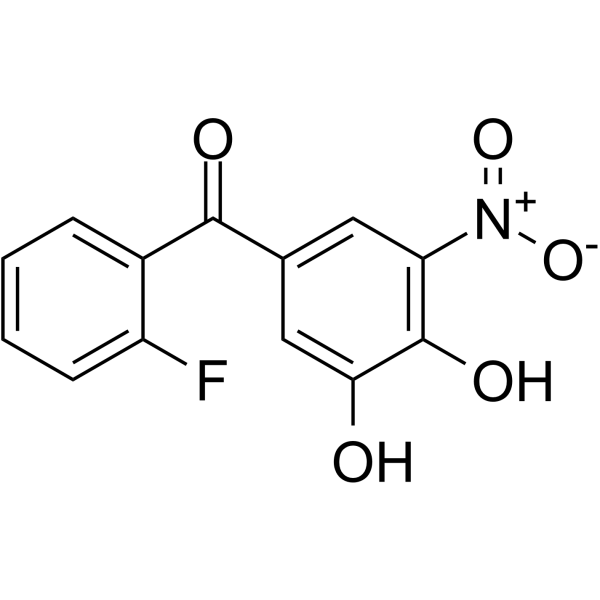
Ro 41-0960COMT Inhibitor -
HY-112257
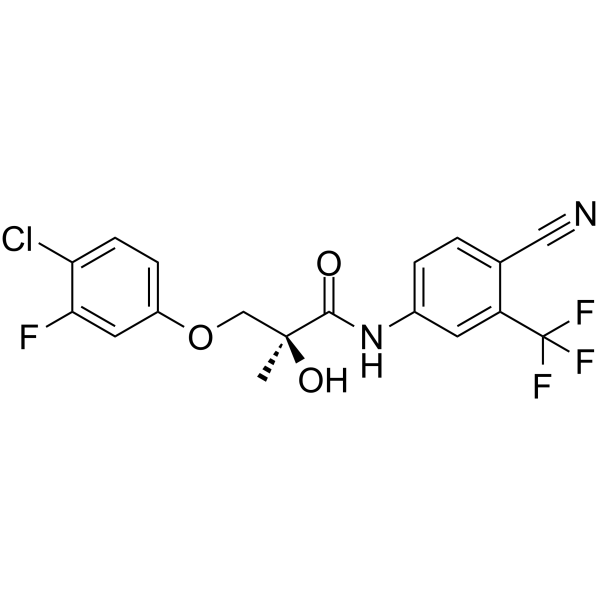
S-23Selective Androgen Receptor Modulator -

HY-B1970
o,p'-DDT -

HY-P0013A
Antide acetateLHRH Antagonist


Biological Activity
Description
In Vitro
(Z)-9-Tricosene (0.1 μg/μl; 8 min) induces strong electrophysiological responses in excised first leg tarsi of sexually receptive female Pholcus beijingensis, with a mean EAG amplitude of 0.223 mV[3].
(Z)-9-Tricosene (0.001-0.01 mg) used in GC-MS calibration reveals a mean titre of 0.114 mg of (Z)-9-tricosene per mate-searching male Pholcus beijingensis body extract[3].
MedChemExpress (MCE) has not independently confirmed the accuracy of these methods. They are for reference only. .
In Vivo
(Z)-9-Tricosene regulates oviposition site selection in female Drosophila melanogaster by guiding egg-laying to sites where this pheromone has been deposited[1].
Addition of (Z)-9-Tricosene (content: 0.049%; free feeding; 60-minute no-choice feeding assay) to the diet has no effect on methomyl-induced mortality in methomyl-susceptible or resistant Musca domestica strains in no-choice laboratory assays[2].
(Z)-9-tricosene (1 μg; air exposure) acts as an aphrodisiac stimulant for Pholcus beijingensis, reduces the courtship duration of males, and thus promotes faster mating with sexually receptive females[3].
(Z)-9-tricosene (1 mg; air-exposed) reduces predatory behavior, decreases prey capture probability, and lowers the number of captured prey in food-deprived female Pholcus beijingensis spiders[3].
(Z)-9-tricosene (0.01-1 mg; air exposure) exhibits no attractive activity towards sexually receptive female Pholcus beijingensis in dual-choice behavioral assays[3].
(Z)-9-tricosene (0.25-25 μg/μl; applied to filter paper in the experimental arena) exhibits repellent effects on Lucilia sericata larvae at low concentrations, while no behavioral effects are observed at high concentrations[4].
(Z)-9-tricosene (0.25-25 μg/μl; applied to filter paper placed in the experimental arena) attracts Calliphora vomitoria larvae and increases their crawling speed at high concentrations, while no behavioral effects are observed at low concentrations[4].
MedChemExpress (MCE) has not independently confirmed the accuracy of these methods. They are for reference only.
-
Animal Model:wild-type (mixed virgin/mated male and female)[1]
-
Dosage:10-5 V, 10-4 V, 10-3 V
-
Administration:applied directly to arena surfaces
-
Result:Induced dose-dependent aggregation behavior in flies.
Reached an attraction index (AI) of 0 at 10-5 V.
Reached an attraction index (AI) of ~0.2 at 10-4 V.
Reached an attraction index (AI) of ~0.47 at 10-3 V.
-
Animal Model:methomyl-susceptible UCR strain; methomyl-resistant laboratory strain (3.5-day-old adult, starved 18 hours)[2]
-
Dosage:0.049%; 0.049% plus 1.1% methomyl
-
Administration:ad libitum; 60 minutes no-choice feeding assay; 10 replications per strain
-
Result:Exhibited 0 mortality at 30 minutes for sugar plus 0.049% (Z)-9-tricosene treatment in methomyl-susceptible strain.
Showed no significant mortality difference between sugar plus 1.1% methomyl and sugar plus 1.1% methomyl plus 0.049% (Z)-9-tricosene in methomyl-susceptible strain (mean 39.2 and 39.3 dead flies, respectively) at 30 minutes.
Increased mortality by a mean of 0.4 flies at 60 minutes for sugar plus 0.049% (Z)-9-tricosene treatment in methomyl-susceptible strain, compared to an increase of 9 flies for both methomyl-containing treatments.
Showed similar mortality at 60 minutes between sugar plus 1.1% methomyl (mean 3.3 dead flies) and sugar plus 1.1% methomyl plus 0.049% (Z)-9-tricosene (mean 4.0 dead flies) in methomyl-resistant strain.
Led to significantly more consumption by methomyl-susceptible strain than methomyl-resistant strain, with both strains consuming more of this treatment than methomyl-containing treatments.
-
Animal Model:Pholcus beijingensis (adult sexually receptive females)[3]
-
Dosage:1 μg
-
Administration:airborne exposure
-
Result:Reduced male courtship time significantly compared to control.
Showed no significant difference in male acclimation time between groups.
Showed no significant difference in male mating time between groups.
-
Animal Model:Pholcus beijingensis (adult sexually receptive females, food-deprived)[3]
-
Dosage:1 mg
-
Administration:airborne exposure
-
Result:Reduced mean number of fruitflies caught to 1.0 compared to control's 2.35.
Decreased percentage of females displaying predatory behaviour to 47% compared to control's 88%.
Showed no significant difference in time to catch first prey between groups.
-
Animal Model:Pholcus beijingensis (adult sexually receptive females)[3]
-
Dosage:0.01 μg, 0.1 μg, 1 mg
-
Administration:airborne exposure
-
Result:Showed no significant preference for the chamber containing (Z)-9-tricosene at any tested dose, choosing treated and solvent control chambers at similar rates.
-
Animal Model:Lucilia sericata (wild-collected)[4]
-
Dosage:0.25 μg/μl; 25 μg/μl
-
Administration:applied to filter paper in arena
-
Result:Spent significantly less time in the (Z)-9-tricosene-treated semi-circle compared to the solvent-only semi-circle at 0.25 μg/μl.
Showed no difference in average crawling speed at 0.25 μg/μl.
Exhibited no differences in time spent or average crawling speed between the (Z)-9-tricosene-treated and solvent-only semi-circles at 25 μg/μl.
-
Animal Model:Calliphora vomitoria (wild-collected)[4]
-
Dosage:0.25 μg/μl; 25 μg/μl
-
Administration:applied to filter paper in arena
-
Result:Showed no differences in time spent or average crawling speed between the (Z)-9-tricosene-treated and solvent-only semi-circles at 0.25 μg/μl.
Spent significantly more time in the (Z)-9-tricosene-treated semi-circle compared to the solvent-only semi-circle at 25 μg/μl.
Crawled significantly faster in the (Z)-9-tricosene-treated semi-circle compared to the solvent-only semi-circle at 25 μg/μl.


Chemical Information
-
CAS No. 27519-02-4
-
Appearance Liquid (Density: 0.802±0.06 g/cm3)
-
Molecular Weight 322.61
-
Formula C23H46
-
Color Colorless to light yellow
-
SMILES
CCCCCCCC/C=C\CCCCCCCCCCCCC
-
Synonyms
cis-9-Tricosene
-
Structure Classification
-
Initial Source
Musca domestica
-
Shipping
Room temperature in continental US; may vary elsewhere.
-
Storage
-20°C, protect from light, stored under nitrogen
* In solvent : -80°C, 6 months; -20°C, 1 month (protect from light, stored under nitrogen)


Solvent & Solubility
In Vitro:
Ethanol : 100 mg/mL (309.97 mM; Need ultrasonic)
Please refer to the solubility information to select the appropriate solvent. Once prepared, please aliquot and store the solution to prevent product inactivation from repeated freeze-thaw cycles.
Storage method and period of stock solution: -80°C, 6 months; -20°C, 1 month (protect from light, stored under nitrogen). When stored at -80°C, please use it within 6 months. When stored at -20°C, please use it within 1 month.
Please refer to the solubility information to select the appropriate solvent. Once prepared, please aliquot and store the solution to prevent product inactivation from repeated freeze-thaw cycles.
Storage method and period of stock solution: -80°C, 6 months; -20°C, 1 month (protect from light, stored under nitrogen). When stored at -80°C, please use it within 6 months. When stored at -20°C, please use it within 1 month.
Concentration (start) × Volume (start) = Concentration (final) × Volume (final)
In Vivo:
Select the appropriate dissolution method based on your experimental animal and administration route.
- For the following dissolution methods, please ensure to first prepare a clear stock solution using an In Vitro approach and then sequentially add co-solvents:
- To ensure reliable experimental results, the clarified stock solution can be appropriately stored based on storage conditions. As for the working solution for In Vivo experiments, it is recommended to prepare freshly and use it on the same day.
- The percentages shown for the solvents indicate their volumetric ratio in the final prepared solution. If precipitation or phase separation occurs during preparation, heat and/or sonication can be used to aid dissolution.
Add each solvent one by one: 10% EtOH 40% PEG300 5% Tween-80 45% Saline
Solubility: ≥ 2.5 mg/mL (7.75 mM); Clear solution
This protocol yields a clear solution of ≥ 2.5 mg/mL (saturation unknown).
Taking 1 mL working solution as an example, add 100 μL EtOH stock solution (25.0 mg/mL) to 400 μL PEG300, and mix evenly; then add 50 μL Tween-80 and mix evenly; then add 450 μL Saline to adjust the volume to 1 mL.
Preparation of Saline: Dissolve 0.9 g sodium chloride in ddH₂O and dilute to 100 mL to obtain a clear Saline solution.
Add each solvent one by one: 10% EtOH 90% (20% SBE-β-CD in Saline)
Solubility: ≥ 2.5 mg/mL (7.75 mM); Clear solution
This protocol yields a clear solution of ≥ 2.5 mg/mL (saturation unknown).
Taking 1 mL working solution as an example, add 100 μL EtOH stock solution (25.0 mg/mL) to 900 μL 20% SBE-β-CD in Saline, and mix evenly.
Preparation of 20% SBE-β-CD in Saline (4°C, storage for one week): 2 g SBE-β-CD powder is dissolved in 10 mL Saline, completely dissolve until clear.
Add each solvent one by one: 10% EtOH 90% Corn Oil
Solubility: ≥ 2.5 mg/mL (7.75 mM); Clear solution
This protocol yields a clear solution of ≥ 2.5 mg/mL (saturation unknown). If the continuous dosing period exceeds half a month, please choose this protocol carefully.
Taking 1 mL working solution as an example, add 100 μL EtOH stock solution (25.0 mg/mL) to 900 μL Corn oil, and mix evenly.
In Vivo Dissolution Calculator
Please enter the basic information of animal experiments:
-
-
-
-
Recommended: Prepare an additional quantity of animals to account for potential losses during experiments.
Working solution concentration: 0.22 mg/mL


Purity & Documentation
-
Data Sheet (283 KB)
-
SDS (394 KB)
- English - EN (394 KB)
- Français - FR (394 KB)
- Deutsch - DE (394 KB)
- Norwegian - NO (394 KB)
- Español - ES (394 KB)
- Swedish - SV (394 KB)
- Italian - IT (394 KB)
- Korean - KR (394 KB)
- Portuguese - PT (394 KB)
-
Handling Instructions (2659 KB)
References


Complete Stock Solution Preparation Table
Please refer to the solubility information to select the appropriate solvent. Once prepared, please aliquot and store the solution to prevent product inactivation from repeated freeze-thaw cycles.
Storage method and period of stock solution: -80°C, 6 months; -20°C, 1 month (protect from light, stored under nitrogen). When stored at -80°C, please use it within 6 months. When stored at -20°C, please use it within 1 month.
| Optional Solvent | Concentration Solvent Mass | 1 mg | 5 mg | 10 mg | 25 mg |
|---|---|---|---|---|---|
| Ethanol | 1 mM | 3.0997 mL | 15.4986 mL | 30.9972 mL | 77.4930 mL |
| 5 mM | 0.6199 mL | 3.0997 mL | 6.1994 mL | 15.4986 mL | |
| 10 mM | 0.3100 mL | 1.5499 mL | 3.0997 mL | 7.7493 mL | |
| 15 mM | 0.2066 mL | 1.0332 mL | 2.0665 mL | 5.1662 mL | |
| 20 mM | 0.1550 mL | 0.7749 mL | 1.5499 mL | 3.8746 mL | |
| 25 mM | 0.1240 mL | 0.6199 mL | 1.2399 mL | 3.0997 mL | |
| 30 mM | 0.1033 mL | 0.5166 mL | 1.0332 mL | 2.5831 mL | |
| 40 mM | 0.0775 mL | 0.3875 mL | 0.7749 mL | 1.9373 mL | |
| 50 mM | 0.0620 mL | 0.3100 mL | 0.6199 mL | 1.5499 mL | |
| 60 mM | 0.0517 mL | 0.2583 mL | 0.5166 mL | 1.2915 mL | |
| 80 mM | 0.0387 mL | 0.1937 mL | 0.3875 mL | 0.9687 mL | |
| 100 mM | 0.0310 mL | 0.1550 mL | 0.3100 mL | 0.7749 mL |


(Z)-9-Tricosene Related Classifications
HY-W009165 Related Classifications
 Powered by Bioz
Keywords
- (Z)-9-Tricosene
- 27519-02-4
- cis-9-Tricosene
- Insecticide
- oviposition site selection
- Pholcus beijingensis
- antennal basiconic Or7a receptors
- Calliphora vomitoria larvae
- house fly
- methomyl-resistant house fly strains
- electroantennogram responses
- Lucilia sericata larvae
- Drosophila melanogaster
- methomyl-susceptible house fly strains
- Inhibitor
- inhibitor
- inhibit