9 Results for "

contact allergy

" in MedChemExpress (MCE) Product Catalog:
Products (9)

9 Results for "contact allergy" in MCE Product Catalog:

Cat. No.: HY-D0154
CAS No.: 80724-20-5
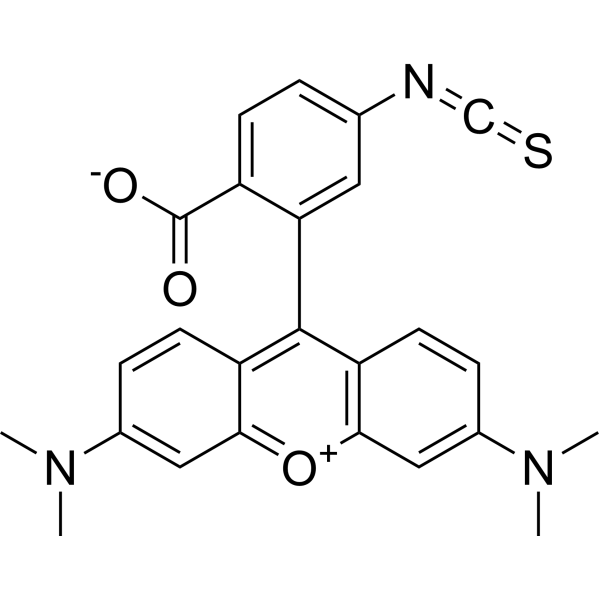
Synonyms: Tetramethylrhodamine-6-isothiocyanate
6-TRITC (Tetramethylrhodamine-6-isothiocyanate) is a potent fluorescent tracer. 6-TRITC can be used as an probe for haptenated proteins/peptides for the research of contact allergy. 6-TRITC can be used as a tracer for the confocal imaging in living cells .
loading...
    loading...
Cat. No.: HY-B1419
CAS No.: 90-01-7
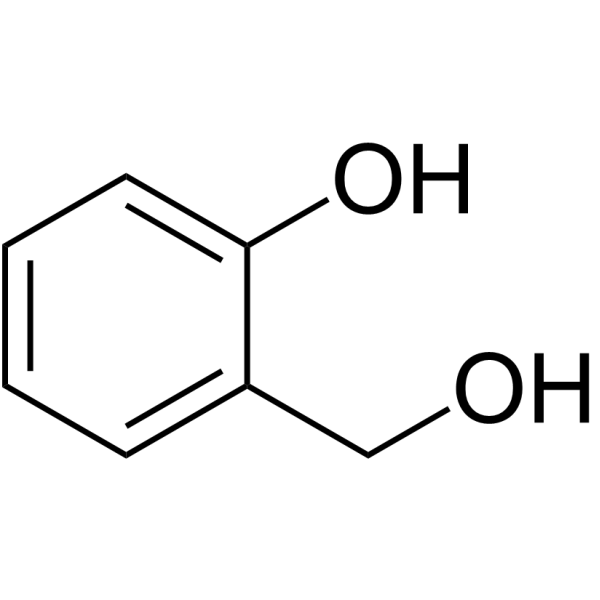
Synonyms: 2-Hydroxybenzyl alcohol; Saligenin
Salicyl alcohol (2-Hydroxybenzyl alcohol; Saligenin) is a phenolic alcohol-type topical anesthetic and strong sensitizer with antiseptic, antibacterial and antipyretic activities. Salicyl alcohol serves as a precursor for salicin synthesis. Salicyl alcohol induces contact dermatitis and eczematous skin reactions, and is a well-known allergen identified in phenolic resins. Salicyl alcohol is isolated from the barks of European aspen (Populus tremula), rowan (Sorbus aucuparia) and willow (Salix spp.). Salicyl alcohol is used in studies related to allergic contact dermatitis .
loading...
    loading...
Cat. No.: HY-W130442
CAS No.: 101-72-4
Target:  

SOD

Research Areas:  

Inflammation/Immunology

N-Isopropyl-N'-phenyl-p-phenylenediamine is an antioxidant used in rubber manufacturing to reduce the detrimental effect of oxygen. N-Isopropyl-N'-phenyl-p-phenylenediamine can cause contact allergy .
loading...
    loading...
Cat. No.: HY-W020755
CAS No.: 95-33-0
Research Areas:  

Inflammation/Immunology

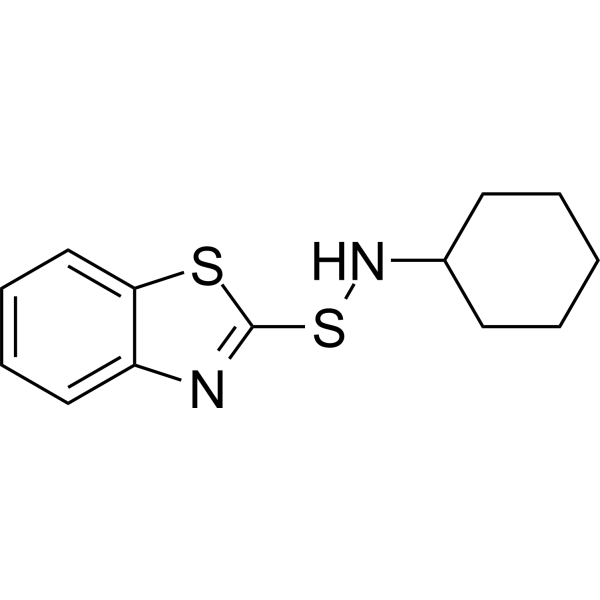
Thiohexam is a rubber vulcanization accelerator. Thiohexam is used in allergy research .
loading...
    loading...
Cat. No.: HY-D1177
CAS No.: 6925-69-5
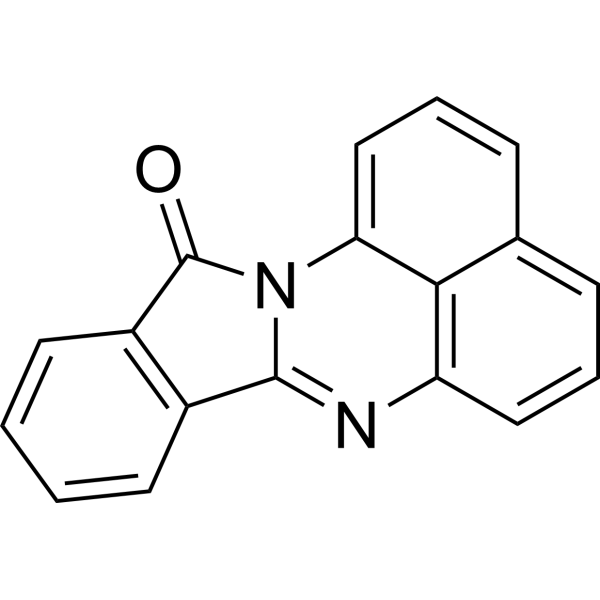
Solvent orange 60 is a cyclic ketone dye commonly used in plastic materials such as eyeglass frames and has been shown to cause contact allergies.
loading...
    loading...
Cat. No.: HY-W761985
CAS No.: 65907-30-4
Target:  

Insecticide

Research Areas:  

Inflammation/Immunology

Furathiocarb is a carbamate pro-insecticide and a contact allergen. Furathiocarb is commonly used in studies related to contact allergy. Furathiocarb induces significant proliferation of MHC II-positive B cells in auricular lymph node cells and induces the production of Th1 cytokines (such as IL-2, TNF-γ and IFN-γ). However, Furathiocarb does not induce respiratory allergy in mice. After absorption through the abdominal skin of isolated rats, Furathiocarb is completely metabolized into carbofuran, and its permeation amount increases with time and dosage. The skin permeation rates of both emulsifiable concentrate (EC) and wettable powder (WP) formulations of Furathiocarb are higher than that of Furathiocarb itself, with no significant difference between the two formulations .
loading...
    loading...
Cat. No.: HY-119958
CAS No.: 74161-27-6
Target:  

Drug Intermediate

Research Areas:  

Inflammation/Immunology

Acamelin is a Benzofuranoquinone compound that acts as a contact sensitizer. It can be isolated from the heartwood of Acacia melanoxylon R. Br., an Australian blackwood. Acamelin induces positive skin reactions and contact allergy in guinea pigs. It is applicable to research related to allergic contact dermatitis .
loading...
    loading...
Cat. No.: HY-184853
CAS No.: 99-84-3
Target:  

Drug Intermediate

Research Areas:  

Inflammation/Immunology

β-Terpinene is a naturally occurring monoterpene, prohapten/metabolic substrate, and contact allergen inducer, with moderate potency as a sensitizer .β-Terpinene undergoes metabolic activation to epoxides that conjugate with glutathione .β-Terpinene induces contact allergy via reactive allylic epoxide metabolites .β-Terpinene does not significantly reduce growth of Erwinia amylovora at concentrations up to 1500 mg/l .β-Terpinene can be used for the research of Aspergillus flavus infection.
loading...
    loading...
Cat. No.: HY-NP229
DNP-BSA is a multivalent antigen and protein-binding reagent. DNP-BSA binds to subdomain IIA (Site I) of bovine serum albumin via predominantly hydrophobic forces, with spontaneous complex formation via combined dynamic and static quenching. DNP-BSA induces cross-linking of IgE-bound FceRI, triggering tyrosine phosphorylation of FceRI β and γ subunits. DNP-BSA binds to anti-DNP IgE via its DNP groups, forming cross-links between IgE-FceRI complexes, with most DNP groups initially unavailable but transiently exposed for binding. DNP-BSA induces FITC fluorescence quenching in FITC-labeled anti-DNP IgE, proportional to occupied IgE Fab binding sites. DNP-BSA can be used for the research of allergy, inflammation, and contact sensitivity (allergic contact dermatitis) .
loading...
    loading...

