8 Results for "

crystal salt preparation

" in MedChemExpress (MCE) Product Catalog:
Products (8)

8 Results for "crystal salt preparation" in MCE Product Catalog:

Cat. No.: HY-W129513
CAS No.: 26266-57-9
Research Areas:  

Others

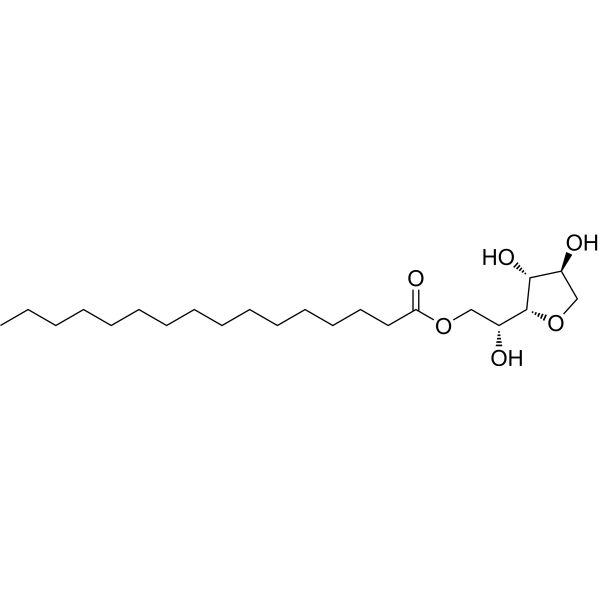
Sorbitan monopalmitate is a food-grade, non-ionic emulsifier that exhibits oral activity. Sorbitan monopalmitate functions as a crystallization modifier, promoting the aggregation of spherical mango butter crystals, introducing lattice defects, and regulating the crystallization rate of mango butter. Sorbitan monopalmitate serves as a component of precursor vesicle gels, enabling the controlled and sustained release of drugs and facilitating the preparation of stable transdermal delivery formulations .
loading...
    loading...
Cat. No.: HY-148198
CAS No.: 2373330-78-8
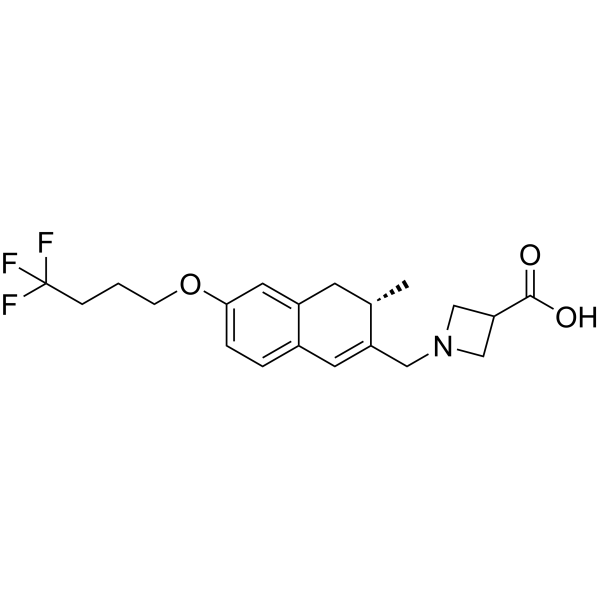
S1P5 receptor agonist-1 (Example 6) is an effective and selective S1P5 receptor (S1P5 receptor) agonist. The EC50 values for S1P5 and S1P1 receptors are 20 nM and > 3 μM, respectively. S1P5 receptor agonist-1 can be used in studies on neuroprotection and immune regulation .
loading...
    loading...
Cat. No.: HY-Y1359S
CAS No.: 1173022-19-9
Synonyms: 2-Methyl-1H-imidazole-d6
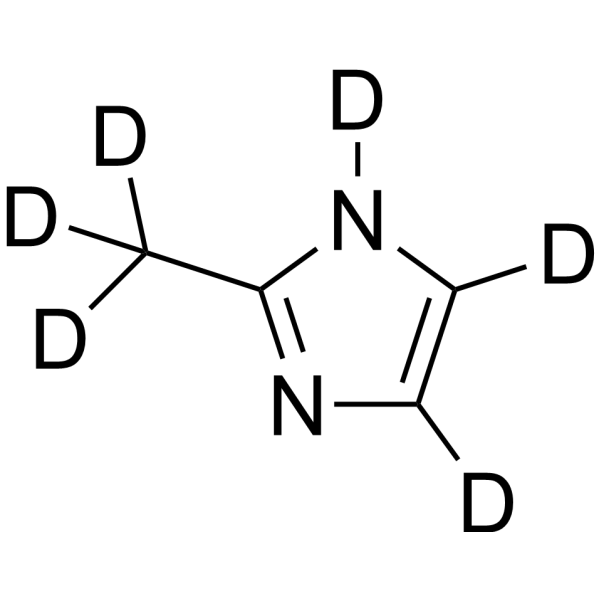
2-Methylimidazole-d6 is the deuterium labeled 2-Methylimidazole. 2-Methylimidazole (2-Methyl-1H-imidazole) is a nitrogen-containing MOF ligand that serves as a laccase-mimicking activity enhancer and a morphology regulator for copper-based metal-organic frameworks. 2-Methylimidazole promotes the formation of natural laccase-like nanoenzyme structures, accelerates electron transfer and enhances catalytic activity. During hydrothermal synthesis, 2-Methylimidazole inhibits the vertical growth of crystals, thus enabling the preparation of two-dimensional nanosheet morphology .
loading...
    loading...
Cat. No.: HY-W010361
CAS No.: 10581-12-1
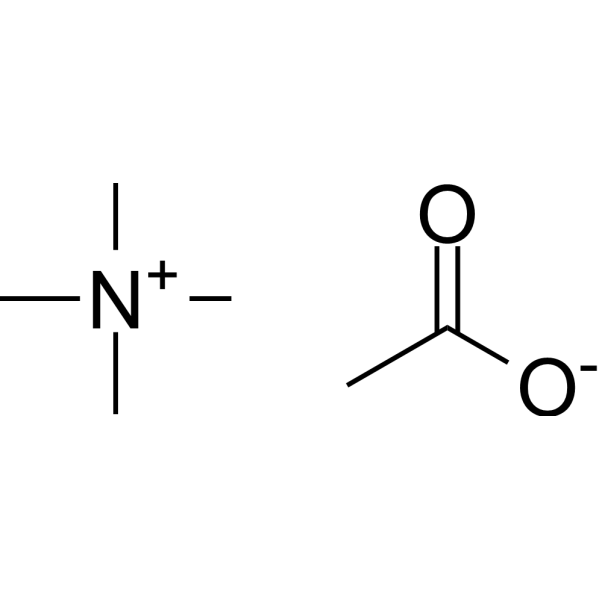
Tetramethylammonium acetate is an organic compound commonly used as a phase transfer catalyst in organic synthesis reactions, especially those involving charged species or polar reagents. It can facilitate the transfer of reactants between two immiscible phases, such as water and organic solvents, by forming stable ion pairs. Additionally, Tetramethylammonium acetate has been used to prepare a variety of organic compounds, including esters, amides, and carboxylic acids. Due to its unique physicochemical properties, it has also been investigated for its potential use in developing new materials such as ionic liquids and liquid crystals. "x" in the formula represents the number of water molecules in the crystal structure, which can vary depending on the preparation method.
loading...
    loading...
Cat. No.: HY-Y1359R
CAS No.: 693-98-1
Synonyms: 2-Methyl-1H-imidazole (Standard)
Research Areas:  

Others

2-Methylimidazole (Standard) is the analytical standard of 2-Methylimidazole. This product is intended for research and analytical applications. 2-Methylimidazole (2-Methyl-1H-imidazole) is a nitrogen-containing MOF ligand that serves as a laccase-mimicking activity enhancer and a morphology regulator for copper-based metal-organic frameworks. 2-Methylimidazole promotes the formation of natural laccase-like nanoenzyme structures, accelerates electron transfer and enhances catalytic activity. During hydrothermal synthesis, 2-Methylimidazole inhibits the vertical growth of crystals, thus enabling the preparation of two-dimensional nanosheet morphology .
loading...
    loading...
Cat. No.: HY-W203147
CAS No.: 26330-06-3
Research Areas:  

Others

1-Azidopentane is comprised of an azide group attached to a 5-carbon tail. 1-Azidopentane is used in preparation method of multi-axis liquid crystal refrigeration material by click chemistry.
loading...
    loading...
Cat. No.: HY-W173921
CAS No.: 6926-45-0
Synonyms: Hexyl azide
Research Areas:  

Others

1-Azidohexane (Hexyl azide) is comprised of an azide group attached to a 6-carbon tail. 1-Azidohexane is used in preparation method of multi-axis liquid crystal refrigeration material by click chemistry.
loading...
    loading...
Cat. No.: HY-184616
Nanomaterials with sizes ranging from 1 to 100 nm are generally referred to as nanocrystals. The preparation of platinum nanocrystals with controllable morphology was first reported in 1996. Pt, Ag, Au, Rh, and other nanocrystals have been synthesized using various methods. Platinum has a face-centered cubic (fcc) structure, but unlike Ag, Au, and Pd, it rarely forms twins; most platinum nanocrystals are single-crystal structures. XFJ116 platinum nanoparticles were prepared via a chemical reduction method, exhibiting uniform size and good dispersibility, and can also provide platinum nanoparticles with amino and carboxyl terminator modifications.
loading...
    loading...

