



7 Results for "

osteoblast survival

" in MedChemExpress (MCE) Product Catalog:
Products (7)

7 Results for "osteoblast survival" in MCE Product Catalog:

3
3 Cited Publications
Cat. No.: HY-P1252
CAS No.: 12583-68-5
Research Areas:  

Metabolic Disease

Parathyroid Hormone (1-34), bovine is a potent parathyroid hormone (PTH) receptor agonist. Parathyroid Hormone (1-34), bovine increases calcium and inorganic phosphate levels in vivo. Parathyroid Hormone (1-34), bovine can be used for th reseach of osteoporosis .
loading...
    loading...
Cat. No.: HY-N0507
CAS No.: 84954-92-7
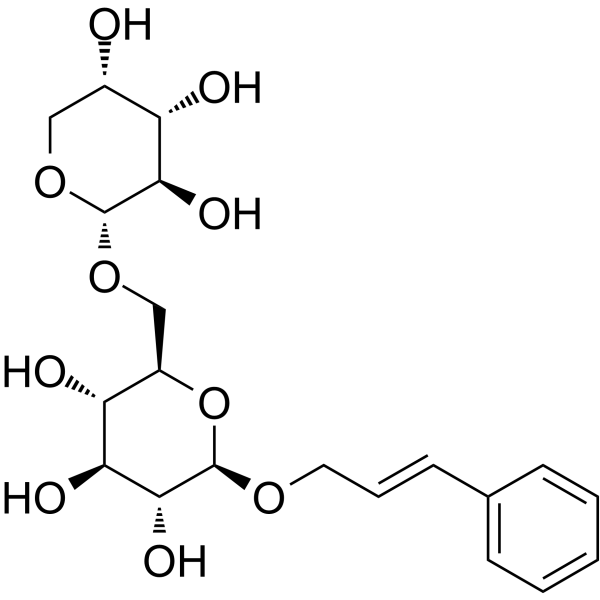
Rosavin, an orally bioactive phenylpropanoid from Rhodiola rosea L. (RRL), is an adaptogen that enhances the body’s response to environmental stress. Rosavin significantly influences bone tissue metabolism by inhibiting osteoclastogenesis and promoting osteoblast differentiation, also impacts various diseases, demonstrating antidepressant, adaptogenic, and anxiolytic effects in mouse models. Additionally, Rosavin improves survival, reducing intestinal damage in irradiated rats and Ischemia-reperfusion(I/R)-induced cerebral injury in vivo by regulating inflammation and oxidative stress, making it a promising candidate for research in radiation-induced intestinal injury, I/R-induced cerebral injury and osteoporosis .
loading...
    loading...
Cat. No.: HY-N0507R
CAS No.: 84954-92-7
Rosavin (Standard) is the analytical standard of Rosavin. This product is intended for research and analytical applications. Rosavin, an orally bioactive phenylpropanoid from Rhodiola rosea L. (RRL), is an adaptogen that enhances the body’s response to environmental stress. Rosavin significantly influences bone tissue metabolism by inhibiting osteoclastogenesis and promoting osteoblast differentiation, also impacts various diseases, demonstrating antidepressant, adaptogenic, and anxiolytic effects in mouse models. Additionally, Rosavin improves survival, reducing intestinal damage in irradiated rats and Ischemia-reperfusion(I/R)-induced cerebral injury in vivo by regulating inflammation and oxidative stress, making it a promising candidate for research in radiation-induced intestinal injury, I/R-induced cerebral injury and osteoporosis .
loading...
    loading...
Cat. No.: HY-P2633
CAS No.: 400090-20-2
Synonyms: AC-100
Target:  

Inhibitory Antibodies

Research Areas:  

Metabolic Disease

Dentonin (AC-100) is a synthetic fragment derived from MEPE. Dentonin enhances osteogenesis by promoting osteoprogenitor adhesion and facilitates immature adherent cells survival. Dentonin has no significant effect to mature osteoblasts. Dentonin can be used for the research of phosphate homeostasis and bone metabolism .
loading...
    loading...
Cat. No.: HY-P2633A
Synonyms: AC-100 TFA
Target:  

Integrin

Research Areas:  

Metabolic Disease

Dentonin TFA (AC-100 TFA) is a synthetic fragment derived from MEPE. Dentonin TFA enhances osteogenesis by promoting osteoprogenitor adhesion and facilitates immature adherent cells survival. Dentonin TFA has no significant effect to mature osteoblasts. Dentonin TFA can be used for the research of phosphate homeostasis and bone metabolism .
loading...
    loading...
Cat. No.: HY-P1252A
Research Areas:  

Metabolic Disease

Parathyroid Hormone (1-34), bovine TFA is a potent parathyroid hormone (PTH) receptor agonist. Parathyroid Hormone (1-34), bovine increases calcium and inorganic phosphate levels in vivo. Parathyroid Hormone (1-34), bovine can be used for th reseach of osteoporosis .
loading...
    loading...
Cat. No.: HY-W115785
CAS No.: 1332-07-6
Research Areas:  

Metabolic Disease

Zinc borate is a bioactive inorganic substance with properties including osteogenic induction, pro-angiogenesis, antioxidation, antimutagenesis and cytotoxicity. In the field of bone tissue engineering, Zinc borate is often incorporated into chitosan scaffolds. By releasing zinc ions and borate ions, Zinc borate induces the differentiation of human dental pulp stem cells into osteoblasts, upregulates the expression of bone-related genes and promotes calcium deposition. Zinc borate also promotes angiogenesis by upregulating key factors such as vascular endothelial growth factor. Zinc borate exhibits antioxidant capacity to scavenge free radicals, and can specifically reduce mutagenicity under specific conditions. Zinc borate reduces the survival rate of mouse fibroblasts, but it can still be used in studies related to bone tissue engineering .
loading...
    loading...

