


23 Results for "

phospholipid probe

" in MedChemExpress (MCE) Product Catalog:
Products (23)

23 Results for "phospholipid probe" in MCE Product Catalog:

26
26 Publications Verification
Art. -Nr.: HY-D0080
CAS. Nr.: 74515-25-6
Laurdan is a membrane-permeable fluorescent probe that displays spectral sensitivity to the phospholipid phase of the cell membrane to which it is bound. Quantitation of generalized polarization (GP) of Laurdan can be used to identify phospholipid phase (Ex/Em = 370/440-490 nm).
loading...
    loading...
11
11 Cited Publications
Art. -Nr.: HY-D0986
CAS. Nr.: 115534-33-3
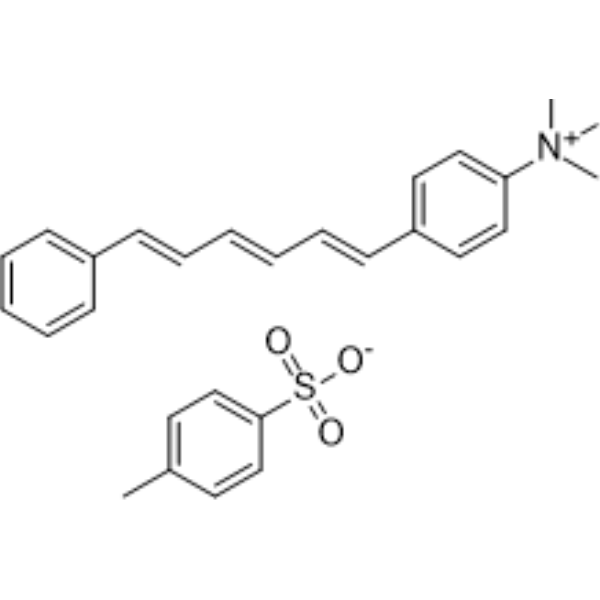
TMA-DPH is a hydrophobic fluorescent membrane probe (Ex=355 nm; Em=430 nm). TMA-DPH is able to anchor on the cell surface and localize to different regions of the phospholipid bilayer. By analyzing the fluorescence polarization values of TMA-DPH in the plasma membrane and membrane substructures, the fluidity of the cell membrane can be determined .
loading...
    loading...
5
5 Cited Publications
Art. -Nr.: HY-W009756
CAS. Nr.: 90-30-2
N-Phenyl-1-naphthylamine is a dye that fluoresces strongly when bound to the inner phospholipid bilayer of Gram-negative bacteria. N-Phenyl-1-naphthylamine can be used to measure outer membrane permeability. N-Phenylnaphthalen-1-amine is a fluorescence probe for odorant-binding proteins (OBP) with a dissociation constant of 1.67 μM. N-Phenylnaphthalen-1-amine exhibits an excitation wavelength of 337 nM and an emission wavelength of 407 nM .
loading...
    loading...
5
5 Cited Publications
Art. -Nr.: HY-125623
CAS. Nr.: 1392820-50-6
Reinheit:  98.14%
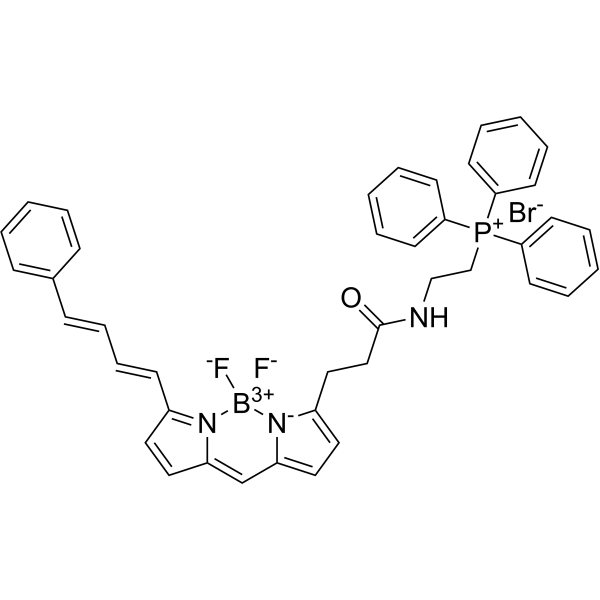
MitoPerOx is a mitochondrial-targeted, lipid peroxidation-indicating fluorescent probe with BODIPY581/591 fluorophores. The triphenylphosphine cation (TPP+) of MitoPerOx can be selectively enriched in mitochondria (depending on membrane potential) and can be used to detect lipid peroxidation in the inner mitochondrial membrane. Under the action of lipid peroxides, the BODIPY581/591 fluorophores of MitoPerOx shift their emission wavelength from 590 nm (reduced state) to 520 nm (oxidized state), and ratiometric detection can be performed at an excitation wavelength of 488 nm. MitoPerOx can specifically monitor the peroxidation of mitochondrial phospholipids (especially cardiolipin) and is used in the study of oxidative stress-related diseases (such as aging, neurodegenerative diseases, and mitochondrial dysfunction)[1][2].
loading...
    loading...
Art. -Nr.: HY-162543
CAS. Nr.: 384833-00-5
Synonyms: 18:1 Lissamine rhodamine PE
Target:  

Fluorescent Dye

Forschungsgebiete:  

Others

18:1 Liss Rhod (18:1 Lissamine rhodamine) PE is a fluorescent phospholipid and fluorescent probe.18:1 Liss Rhod PE admixes into phospholipid inks for large-scale monitoring of dip-pen nanolithography-generated lithographic structures via fluorescence microscopy.18:1 Liss Rhod PE undergoes phase separation or self-quenching under certain conditions in thin lipid membrane stacks .
loading...
    loading...
Art. -Nr.: HY-DY1057
CAS. Nr.: 115534-33-3
TMA-DPH (solution) is a hydrophobic fluorescent membrane probe (Ex=355 nm; Em=430 nm). TMA-DPH is able to anchor on the cell surface and localize to different regions of the phospholipid bilayer. By analyzing the fluorescence polarization values of TMA-DPH in the plasma membrane and membrane substructures, the fluidity of the cell membrane can be determined .
Solvent and concentration: DMSO: 10 mM
loading...
    loading...
Art. -Nr.: HY-DY1025
CAS. Nr.: 74515-25-6
Laurdan (solution) is a membrane-permeable fluorescent probe that displays spectral sensitivity to the phospholipid phase of the cell membrane to which it is bound. Quantitation of generalized polarization (GP) of Laurdan can be used to identify phospholipid phase.
Solvent and concentration: DMSO: 5 mM
loading...
    loading...
Art. -Nr.: HY-DY1073
CAS. Nr.: 1392820-50-6
MitoPerOx (solution) is a mitochondrial-targeted, lipid peroxidation-indicating fluorescent probe with BODIPY581/591 fluorophores. The triphenylphosphine cation (TPP+) of MitoPerOx can be selectively enriched in mitochondria (depending on membrane potential) and can be used to detect lipid peroxidation in the inner mitochondrial membrane. Under the action of lipid peroxides, the BODIPY581/591 fluorophores of MitoPerOx shift their emission wavelength from 590 nm (reduced state) to 520 nm (oxidized state) , and ratiometric detection can be performed at an excitation wavelength of 488 nm. MitoPerOx can specifically monitor the peroxidation of mitochondrial phospholipids (especially cardiolipin) and is used in the study of oxidative stress-related diseases (such as aging, neurodegenerative diseases, and mitochondrial dysfunction) .
Solvent and concentration: DMSO: 2 mM
loading...
    loading...
Art. -Nr.: HY-P10644A
Target:  

Peptides

Forschungsgebiete:  

Cancer

CPP9 TFA is a small, amphipathic, cyclic cell penetrating peptide (CPP). CPPs bind directly to the plasma membrane phospholipids and enter mammalian cells via endocytosis, followed by efficient release from the endosome. CPP9 TFA can be used for intracellular delivery of therapeutic agents and chemical probes .
loading...
    loading...
Art. -Nr.: HY-W127459
CAS. Nr.: 35418-55-4
Synonyms: D-DPPC, 95%
2,3-Dipalmitoyl-sn-glycero-1-phosphocholine, 95% (D-DPPC, 95%) is a chiral phospholipid that serves as a membrane-forming lipid component for bicelle assembly. 2,3-Dipalmitoyl-sn-glycero-1-phosphocholine, 95% can form bicelle assemblies with DHPC, which induce an induced circular dichroism (ICD) signal in the chiral probe DPH, with a polarity opposite to that induced by chiral L-DPPC/DHPC bicelles .
loading...
    loading...
Art. -Nr.: HY-P10649A
Target:  

Peptides

Forschungsgebiete:  

Cancer

CPP12 TFA is a small, amphipathic, cyclic cell-penetrating peptide (CPP). CPP12 TFA binds directly to plasma membrane phospholipids, enters mammalian cells via endocytosis, and then efficiently escapes from endosomes. CPP12 TFA can be used for the intracellular delivery of drugs and chemical probes .
loading...
    loading...
Art. -Nr.: HY-P10649
CAS. Nr.: 1831064-62-0
Target:  

Peptides

Forschungsgebiete:  

Cancer

CPP12 is a small, amphipathic, cyclic cell-penetrating peptide (CPP). CPP12 binds directly to plasma membrane phospholipids, enters mammalian cells via endocytosis, and then efficiently escapes from endosomes. CPP12 can be used for the intracellular delivery of drugs and chemical probes .
loading...
    loading...
Art. -Nr.: HY-125385
CAS. Nr.: 187099-99-6
Reinheit:  ≥95.0%
Target:  

Endogenous Metabolite

Forschungsgebiete:  

Metabolic Disease

Sulforhodamine 101 DHPE is a fluorescent probe made from the conjugation of the phospholipid 1,2-dipalmitoyl-sn-glycero-3-PE to sulforhodamine 101, a red fluorescent dye that displays excitation/emission spectra of 586/605 nm, respectively. It integrates into phospholipid bilayers and has been used for imaging of solid supported lipid bilayers, detection of protein-ligand binding on bilayers, and to monitor colocalization of lipid probes in liposomes via resonance energy transfer (RET).
loading...
    loading...
Art. -Nr.: HY-P11430
CAS. Nr.: 290360-66-6
Forschungsgebiete:  

Infection

UBI (31-38) is a Ubiquicidin-derived octapeptide and anti-bacterial agent. UBI (31-38) selectively interacts with anionic phospholipid membranes and restricts lipid lateral motion. UBI (31-38) induces anionic vesicle aggregation via electrostatic repulsion screening, and undergoes conformational changes in membrane-mimicking environments. UBI (31-38) can be used for the research of infection imaging probes .
loading...
    loading...
Art. -Nr.: HY-D2762
CAS. Nr.: 2315262-12-3
18:1 PE AF 594 triammonium is a fluorescently labeled phospholipid probe. 18:1 PE AF 594 triammonium can be used as a fluorescent tracer for lipid nanoparticles (LNPs). 18:1 PE AF 594 triammonium is promising for research of drug delivery systems .
loading...
    loading...
Art. -Nr.: HY-P10644
CAS. Nr.: 1831064-63-1
Target:  

Fluorescent Dye

Forschungsgebiete:  

Cancer

CPP9 is a small, amphipathic, cyclic cell penetrating peptide (CPP). CPPs bind directly to the plasma membrane phospholipids and enter mammalian cells via endocytosis, followed by efficient release from the endosome. CPP9 can be used for intracellular delivery of therapeutic agents and chemical probes .
loading...
    loading...
Art. -Nr.: HY-D2817
Target:  

Fluorescent Dye

Forschungsgebiete:  

Others

FITC-PLL is a fluorescently labeled polycationic polypeptide probe composed of polylysine (PLL) and FITC (HY-66019), with a typical Ex/Em of 495/520 nm. The fluorescence intensity and lifetime of FITC-PLL are sensitive to pH and FITC density. FITC-PLL can be used for quantifying hapten receptor binding and endocytosis kinetics in macrophages, as a patternable substrate for neuron guidance, for negatively charged phospholipid membrane binding and transmembrane transport, and for live-cell imaging of starch nanoparticle conjugates and lysosome labeling .
loading...
    loading...
Art. -Nr.: HY-175086
Synonyms: DOPI-3,4,5-P3-fluorescein triethylammonium; PI(3,4,5)P3-fluorescein triethylammonium; PIP3[3',4',5']-fluorescein triethylammonium
Target:  

Fluorescent Dye

Forschungsgebiete:  

Others

PtdIns-(3,4,5)-P3 is a second messenger. PtdIns-(3,4,5)-P3-fluorescein triethylammonium is a fluorescent probe that can detect any protein that has a high-affinity binding interaction with inositol-(3,4,5)-triphosphate phospholipids .
loading...
    loading...
Art. -Nr.: HY-D1770
CAS. Nr.: 117056-66-3
NBD Dihexadecylamine is a fluorescent probe used for labeling phospholipids.
loading...
    loading...
Art. -Nr.: HY-N15937
CAS. Nr.: 2707415-27-6
Forschungsgebiete:  

Others

IKS02, a phosphatidylcholine (PC) phospholipid, is a photoaffinity labeling (PAL) probe .
loading...
    loading...

