



N-Phenylnaphthalen-1-amine
Based on 7 publication(s) in Google Scholar
N-Phenyl-1-naphthylamine is a dye that fluoresces strongly when bound to the inner phospholipid bilayer of Gram-negative bacteria. N-Phenyl-1-naphthylamine can be used to measure outer membrane permeability. N-Phenylnaphthalen-1-amine is a fluorescence probe for odorant-binding proteins (OBP) with a dissociation constant of 1.67 μM. N-Phenylnaphthalen-1-amine exhibits an excitation wavelength of 337 nM and an emission wavelength of 407 nM.
For research use only. We do not sell to patients.
- Purity: 99.98%
- CAS No.: 90-30-2
- Formula: C16H13N
- Molecular Weight:219.29
-
Storage:
4°C, protect from light
* In solvent : -80°C, 6 months; -20°C, 1 month (protect from light)


To place orders, for customer services and technical support, please contact: MedChemExpress USA
Tel: 609-228-6898 E-mail: [email protected] [email protected]


-
 Biological Activity
-
Chemical Information
-
Solvent & Solubility
- Purity & Documentation
- References
-
 Help & FAQs


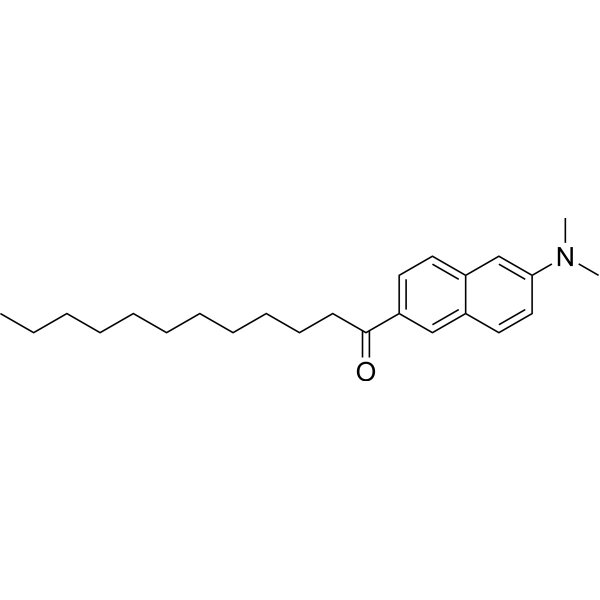
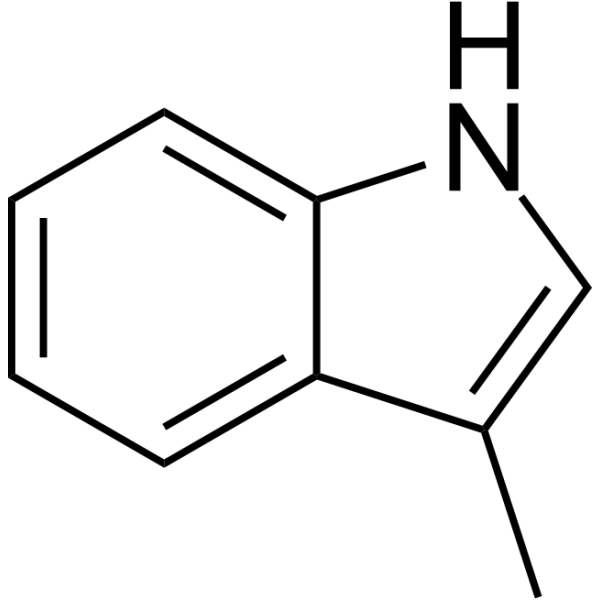
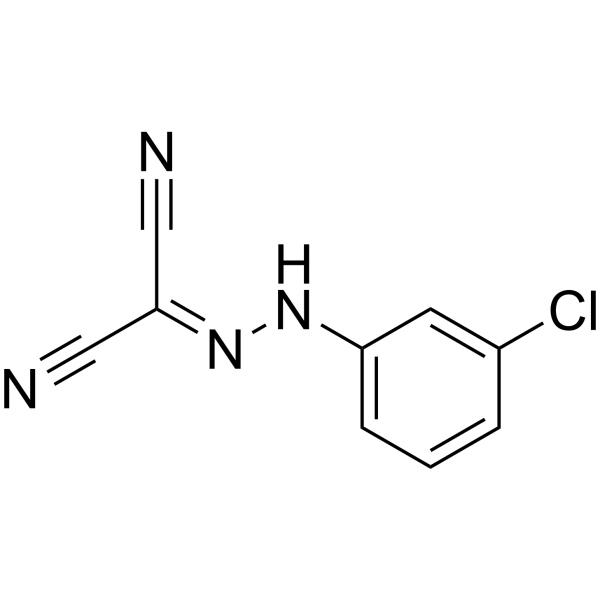

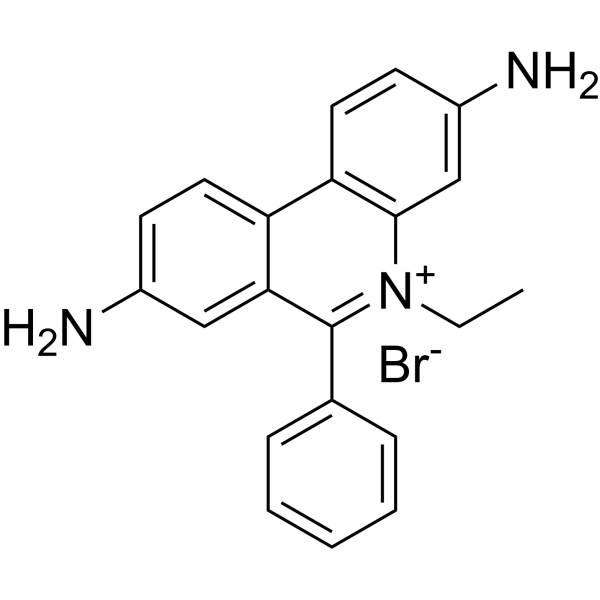
Publications Citing Use of MedChemExpress (MCE) N-Phenylnaphthalen-1-amine
More- Adv Funct Mater. 2026 Jun 12.
- Adv Sci (Weinh). 2026 Jul 20:e76681.
- EBioMedicine. 2025 Oct:120:105923. [Abstract]
- Environ Pollut. 2025 Nov 15:385:127111. [Abstract]
- Virulence. 2026 Dec 31;17(1):2707759.
- Nat Prod Bioprospect. 2026 May 12;16(1):64. [Abstract]
- ACS Omega. 2026 Feb 9;11(7):12450-12460. [Abstract]
 Customer Validation & Images

-
Others
-
Others


Biological Activity
Description
In Vitro
Guide (The following is our recommended protocol. This protocol is only a guide and should be modified according to your specific needs).
Odorant Binding Protein (OBP) Binding Affinity Assay[1]
1. Materials Preparation
Fluorescent probe: N-phenyl-1-naphthylamine, dissolved in methanol (MeOH) to prepare a 1 mM stock solution
Protein solution: 2 μM odorant binding protein (OBP), dissolved in 50 mM Tris-HCl buffer (pH 7.4)
Experimental temperature: 25 °C
Fluorescence spectrophotometer: equipped with a 1 cm quartz cuvette, excitation and emission slit widths set to 5 nm
Detection wavelengths: Excitation wavelength (λex): 337 nm; Emission wavelength (λem): 407 nm
2. Fluorescence Binding Assay Procedure
2.1 Place 2 μM odorant binding protein solution into the cuvette.
2.2 Gradually add the N-phenyl-1-naphthylamine stock solution (1 mM in methanol), mixing gently after each addition.
2.3 Set the final concentration range to 1-20 μM.
2.4 After each addition, immediately record the fluorescence emission spectrum (range 380-460 nm).
2.5 Measure and record the emission intensity at 407 nm for plotting the binding curve.
3. Data Analysis
3.1 Plot fluorescence intensity against the concentration of free N-phenyl-1-naphthylamine.
3.2 Use a Scatchard plot for linearization and calculation of the binding constant.
3.3 Assume a 1:1 binding ratio and 100% protein activity.
2.4 The dissociation constant (Kd) of N-phenyl-1-naphthylamine with loc-OBP1 is 1.67 μM.
4. Competitive Binding Assay
4.1 Use a fixed concentration of 2 μM odorant binding protein and 1 μM N-phenyl-1-naphthylamine.
4.2 Add test ligands (dissolved in methanol) at final concentrations typically ranging from 1-20 μM.
4.3 Monitor the decrease in fluorescence intensity and plot the competitive binding curve.
4.4 Calculate the IC50, and then convert it to the dissociation constant (Kd) of the test ligand.
MedChemExpress (MCE) has not independently confirmed the accuracy of these methods. They are for reference only.


Chemical Information
-
CAS No. 90-30-2
-
Appearance Solid
-
Molecular Weight 219.29
-
Formula C16H13N
-
Color Light yellow to brown
-
SMILES
C12=CC=CC=C1C(NC3=CC=CC=C3)=CC=C2
-
Initial Source
Locusta migratoria
-
Shipping
Room temperature in continental US; may vary elsewhere.
-
Storage
4°C, protect from light
* In solvent : -80°C, 6 months; -20°C, 1 month (protect from light)


Publications (7)
-
Journal Impact Factor
-
Most Recent
-
-
-
EBioMedicine
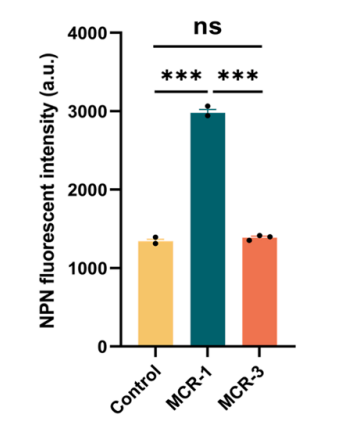
Fitness costs of mobilised colistin resistance gene 3 (mcr-3): systematic review, epidemiological study, and functional analysis. [Abstract]2025 Oct:120:105923. PMID: 40945051
N-Phenylnaphthalen-1-amine purchased from MedChemExpress. Usage Cited in: EBioMedicine. 2025 Oct:120:105923. [Abstract]
Determination of outer membrane integrity. The outer membrane permeability of mcr-1- or mcr-3-bearing strains was evaluated by measuring the NPN (N-Phenylnaphthalen-1-amine: 20 μM) uptake of logarithmic phase cultures.
-
Environ Pollut
UV-aged biodegradable and non-biodegradable microplastics further enhance horizontal transfer of antibiotic resistance plasmids both in vitro and in intestinal flora. [Abstract]2025 Nov 15:385:127111. PMID: 40939716
N-Phenylnaphthalen-1-amine purchased from MedChemExpress. Usage Cited in: Environ Pollut. 2025 Nov 15:385:127111. [Abstract]
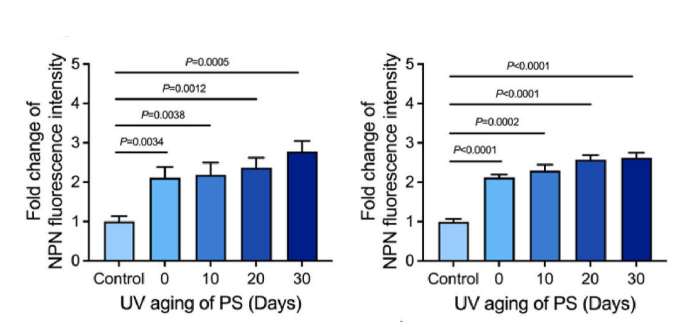
In the presence of PS and PLA microplastics, the uptake of NPN (N-Phenylnaphthalen-1-amine: 10 μM; 30 min) by both donor and recipient bacteria was significantly increased, indicating that the outer membrane was damaged.
-
-
Nat Prod Bioprospect
Four new Cyclohexenone with antibacterial activity from the coral-derived fungus Aspergillus flavus. [Abstract]2026 May 12;16(1):64. PMID: 42115529 -
ACS Omega
High-Throughput Screening of FDA-Approved Drugs for Antibacterial and Antibiofilm Activities Against Multidrug-resistant Pseudomonas aeruginosa. [Abstract]2026 Feb 9;11(7):12450-12460. PMID: 41768696


Solvent & Solubility
In Vitro:
DMSO : ≥ 100 mg/mL (456.02 mM; Hygroscopic DMSO has a significant impact on the solubility of product, please use newly opened DMSO)
* "≥" means soluble, but saturation unknown.
Please refer to the solubility information to select the appropriate solvent. Once prepared, please aliquot and store the solution to prevent product inactivation from repeated freeze-thaw cycles.
Storage method and period of stock solution: -80°C, 6 months; -20°C, 1 month (protect from light). When stored at -80°C, please use it within 6 months. When stored at -20°C, please use it within 1 month.
Please refer to the solubility information to select the appropriate solvent. Once prepared, please aliquot and store the solution to prevent product inactivation from repeated freeze-thaw cycles.
Storage method and period of stock solution: -80°C, 6 months; -20°C, 1 month (protect from light). When stored at -80°C, please use it within 6 months. When stored at -20°C, please use it within 1 month.
Concentration (start) × Volume (start) = Concentration (final) × Volume (final)


Purity & Documentation
-
Data Sheet (279 KB)
-
SDS (762 KB)
- English - EN (762 KB)
- Français - FR (762 KB)
- Deutsch - DE (762 KB)
- Norwegian - NO (762 KB)
- Español - ES (762 KB)
- Swedish - SV (762 KB)
- Italian - IT (762 KB)
- Korean - KR (762 KB)
- Portuguese - PT (762 KB)
-
Handling Instructions (2659 KB)
References
[1]. Ban L, et al., Biochemical characterization and bacterial expression of an odorant-binding protein from Locusta migratoria. Cell Mol Life Sci. 2003 Feb;60(2):390-400. [Content Brief]
[2]. Vanderlinde EM, et al. Mutation of the sensor kinase chvG in Rhizobium leguminosarum negatively impacts cellular metabolism, outer membrane stability, and symbiosis. J Bacteriol. 2012 Feb;194(4):768-77. [Content Brief]


Complete Stock Solution Preparation Table
Please refer to the solubility information to select the appropriate solvent. Once prepared, please aliquot and store the solution to prevent product inactivation from repeated freeze-thaw cycles.
Storage method and period of stock solution: -80°C, 6 months; -20°C, 1 month (protect from light). When stored at -80°C, please use it within 6 months. When stored at -20°C, please use it within 1 month.
| Optional Solvent | Concentration Solvent Mass | 1 mg | 5 mg | 10 mg | 25 mg |
|---|---|---|---|---|---|
| DMSO | 1 mM | 4.5602 mL | 22.8009 mL | 45.6017 mL | 114.0043 mL |
| 5 mM | 0.9120 mL | 4.5602 mL | 9.1203 mL | 22.8009 mL | |
| 10 mM | 0.4560 mL | 2.2801 mL | 4.5602 mL | 11.4004 mL | |
| 15 mM | 0.3040 mL | 1.5201 mL | 3.0401 mL | 7.6003 mL | |
| 20 mM | 0.2280 mL | 1.1400 mL | 2.2801 mL | 5.7002 mL | |
| 25 mM | 0.1824 mL | 0.9120 mL | 1.8241 mL | 4.5602 mL | |
| 30 mM | 0.1520 mL | 0.7600 mL | 1.5201 mL | 3.8001 mL | |
| 40 mM | 0.1140 mL | 0.5700 mL | 1.1400 mL | 2.8501 mL | |
| 50 mM | 0.0912 mL | 0.4560 mL | 0.9120 mL | 2.2801 mL | |
| 60 mM | 0.0760 mL | 0.3800 mL | 0.7600 mL | 1.9001 mL | |
| 80 mM | 0.0570 mL | 0.2850 mL | 0.5700 mL | 1.4251 mL | |
| 100 mM | 0.0456 mL | 0.2280 mL | 0.4560 mL | 1.1400 mL |


N-Phenylnaphthalen-1-amine Related Classifications
HY-W009756 Related Classifications
 Powered by Bioz