
13 Results for "

viral transduction

" in MedChemExpress (MCE) Product Catalog:
Products (13)

13 Results for "viral transduction" in MCE Product Catalog:

4
4 Cited Publications
Cat. No.: HY-P1122
CAS No.: 83602-39-5
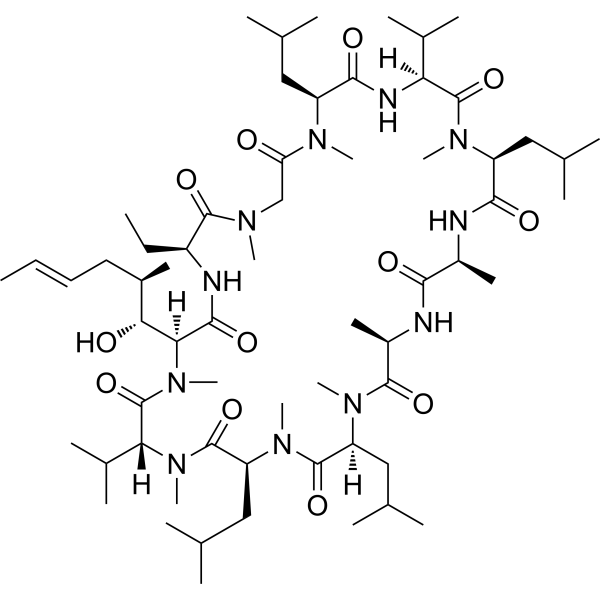
Cyclosporin H is a selective and potent inhibitor of FPR-1 (formyl peptide receptor 1). Cyclosporin H, a viral transduction enhancer, increases lentiviral transduction up to 10-fold in human cord blood-derived hematopoietic stem and progenitor cells (HSPCs). Cyclosporin H displays an additive effect when combined with Rapamycin (HY-10219) or Prostaglandin E2 (HY-101952). Cyclosporin H lacks immunosuppressant activity of Cyclosporin A.
loading...
    loading...
2
2 Cited Publications
Cat. No.: HY-122704A
CAS No.: 5424-37-3
Synonyms: Aminoquinuride dihydrochloride
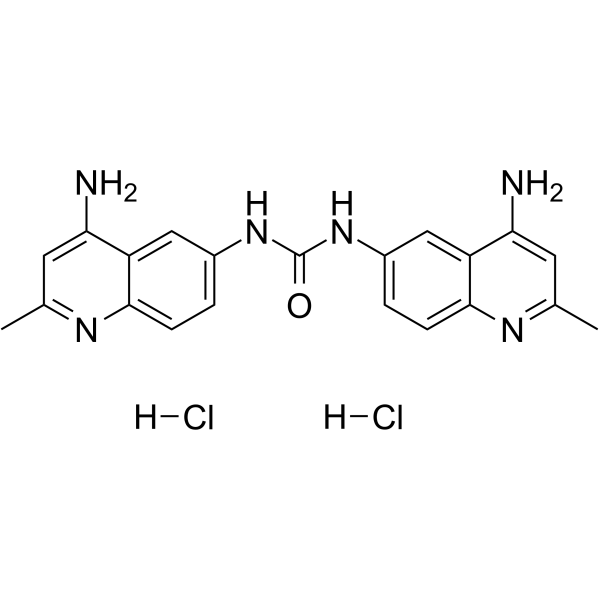
Surfen dihydrochloride is a potent heparan sulfate antagonist. Surfen inhibits FGF2 binding and signal transduction. Surfen binds to glycosaminoglycans and reduces tau hyperphosphorylation. Surfen dihydrochloride inhibits the activity of recombinant uronyl 2-O-sulfotransferase with an IC50 of approximately 2 μM. Surfen dihydrochloride inhibits HSV-1 viral infection. Surfen dihydrochloride inhibits neural differentiation, delays remyelination, and alleviates EAE .
loading...
    loading...
Cat. No.: HY-P990094
CAS No.: 2643974-98-3
Synonyms: CSL311

Target:  

c-Fms

Research Areas:  

Inflammation/Immunology

Trabikibart (CSL311) is a specific inhibitor targeting the βc receptor (CSF2RB) that inhibits signal transduction mediated by GM-CSF, IL-5, and IL-3. Trabikibart exhibits significant anti-inflammatory and anti-edema effects, reduces myeloid cell infiltration, and inhibits inflammatory cell survival. Trabikibart also possesses antiviral immune functions, which alleviate pulmonary inflammation, reverse airway dysfunction and fibrosis, and thereby restore impaired pulmonary function. Trabikibart can be used in research on related diseases such as acute respiratory distress syndrome, viral pneumonia, asthma, and chronic rhinosinusitis with nasal polyps .
loading...
    loading...
Cat. No.: HY-P11460
Target:  

Drug Derivative

Research Areas:  

Infection

Vectofusin-1 is a histidine-rich cationic amphipathic peptide derived from the LAH4 (HY-P0311) peptide family, and also acts as a Viral entry enhancer. Vectofusin-1 promotes the adhesion and fusion of retroviral/lentiviral vectors with cell membranes during viral entry, thereby improving transduction efficiency. Vectofusin-1 potently enhances lentiviral transduction of cells .
loading...
    loading...
Cat. No.: HY-P10719
CAS No.: 1421052-89-2
Target:  

MyD88

Research Areas:  

Infection Inflammation/Immunology

Pepinh-MYD is a MyD88 inhibitor that contains a domain sequence from MyD88 TIR and a protein transduction sequence, enabling it to penetrate the cell membrane. Pepinh-MYD interferes with MyD88-mediated TLR signaling pathways, thereby inhibiting related immune responses. It holds potential for studying the role of MyD88 in viral infections .
loading...
    loading...
Cat. No.: HY-149037A
Purity:  98.60%
Synonyms: N4-Spermine cholesteryl carbamate pentahydrochloride
Research Areas:  

Others

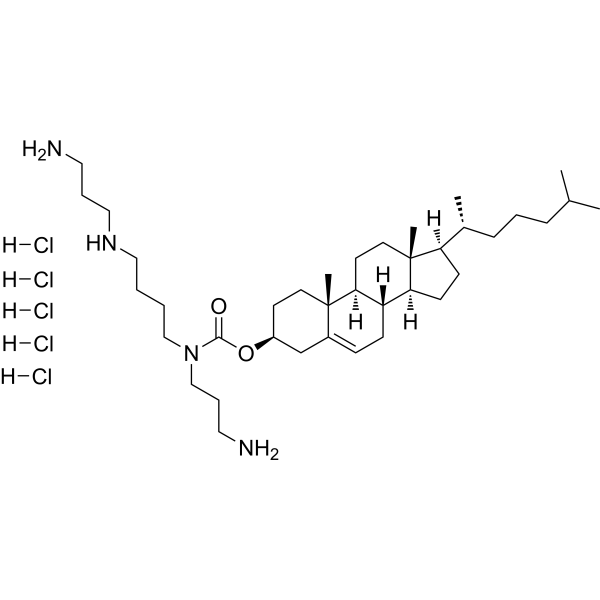
GL67 pentahydrochloride (N4-Spermine cholesteryl carbamate pentahydrochloride) is a cationic lipid that serves as a non-viral siRNA delivery vector and a non-viral gene transfer vector. GL67 pentahydrochloride enhances the encapsulation efficiency of siRNA in liposomal formulations and promotes the cellular uptake of siRNA across cancer cell membranes. GL67 pentahydrochloride mediates the transduction of plasmid DNA into cells. GL67 pentahydrochloride can be used in drug delivery-related research .
loading...
    loading...
Cat. No.: HY-P10719A
Target:  

MyD88

Research Areas:  

Infection Inflammation/Immunology

Pepinh-MYD TFA is a MyD88 inhibitor that contains a domain sequence from MyD88 TIR and a protein transduction sequence, enabling it to penetrate the cell membrane. Pepinh-MYD TFA interferes with MyD88-mediated TLR signaling pathways, thereby inhibiting related immune responses. Pepinh-MYD TFA holds potential for studying the role of MyD88 in viral infections .
loading...
    loading...
Cat. No.: HY-122704
CAS No.: 3811-56-1
Synonyms: Aminoquinuride
Surfen is a potent heparan sulfate antagonist. Surfen inhibits FGF2 binding and signal transduction. Surfen binds to glycosaminoglycans and reduces tau hyperphosphorylation. Surfen inhibits the activity of recombinant uronyl 2-O-sulfotransferase with an IC50 of approximately 2 μM. Surfen inhibits HSV-1 viral infection. Surfen inhibits neural differentiation, delays remyelination, and alleviates EAE .
loading...
    loading...
Cat. No.: HY-106055
CAS No.: 74817-61-1
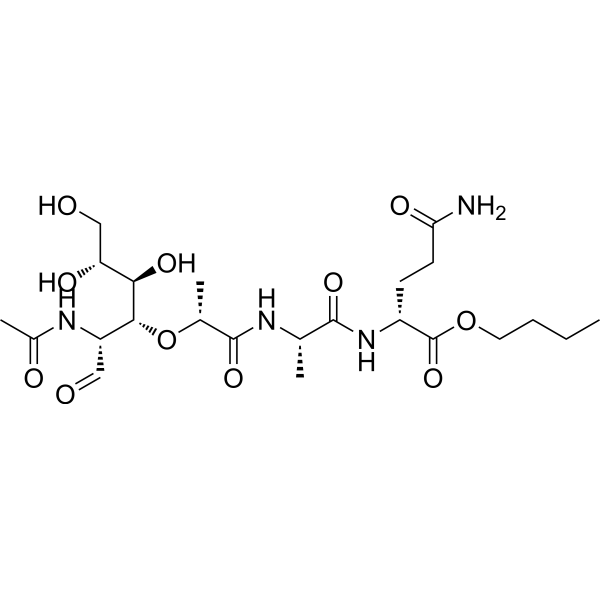
Murabutide is an immunomodulator and also a NOD2 receptor agonist . Murabutide enhances the signal transduction of ATR and NOD2, mediates the activation of the DDR pathway, and thereby repairs radiation-induced DNA double-strand breaks. Murabutide inhibits radiation-induced cell apoptosis and protects cells and mice from radiation-induced toxic damage. Murabutide induces the expression and DNA-binding activity of Oct-1 in macrophages, thereby inhibiting the transcription and replication of HIV-1. Murabutide reduces the expression levels of CD4 and CCR5 on the surface of macrophages, and induces the secretion of β-chemokines, TNF-α and IL-6. Murabutide enhances non-specific viral resistance and targets reticuloendothelial cells. Murabutide can be used in research related to radiation-induced damage and human immunodeficiency virus type 1 infection .
loading...
    loading...
Cat. No.: HY-149037
CAS No.: 179075-30-0
Synonyms: N4-Spermine cholesteryl carbamate
Research Areas:  

Others

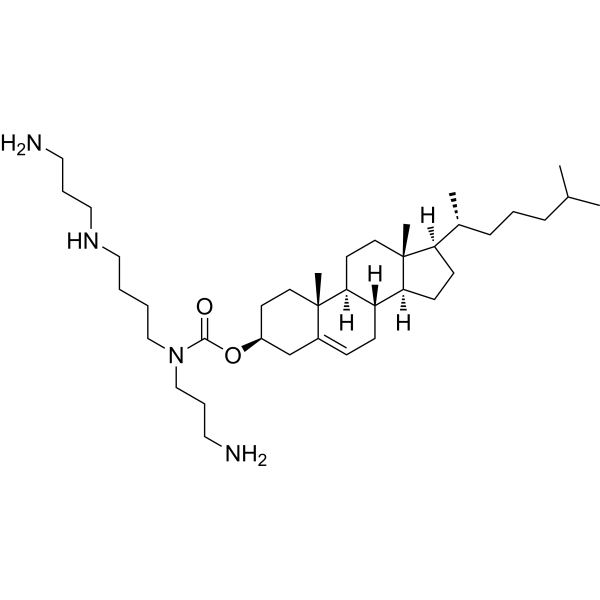
GL67 (N4-Spermine cholesteryl carbamate) is a cationic lipid that serves as a non-viral siRNA delivery vector and a non-viral gene transfer vector. GL67 enhances the encapsulation efficiency of siRNA in liposomal formulations and promotes the cellular uptake of siRNA across cancer cell membranes. GL67 mediates the transduction of plasmid DNA into cells. GL67 can be used in drug delivery-related research .
loading...
    loading...
Cat. No.: HY-171788
CAS No.: 2765258-26-0
Research Areas:  

Cancer

NMT-IN-8 (Compound Ex.129) is an orally active and highly selective inhibitor of N-myristoyl transferase (NMT) with an IC50 value of <10 nM. NMT-IN-8 binds to the peptide binding pocket of NMT, blocking its catalyzed protein N-myristoylation to interfere with key pathways such as protein trafficking, signal transduction, and viral replication. NMT-IN-8 is promising for research of oncology (e.g., MYC-addicted cancers, B-cell lymphoma) and infectious diseases (e.g., malaria, HIV, rhinovirus infection) .
loading...
    loading...
Cat. No.: HY-174720
Target:  

mRNA

Research Areas:  

Inflammation/Immunology

Human EIF2AK2 mRNA encodes the human eukaryotic translation initiation factor 2 alpha kinase 2 (EIF2AK2) protein, a serine/threonine protein kinase that is activated by autophosphorylation after binding to dsRNA. EIF2AK2 plays a key role in the innate immune response to viral infection and is also involved in the regulation of signal transduction, apoptosis, cell proliferation and differentiation.
loading...
    loading...
Cat. No.: HY-174517
Target:  

mRNA

Research Areas:  

Inflammation/Immunology

Human TNFRSF14 mRNA encodes the human TNF receptor superfamily member 14 (TNFRSF14) protein, a member of the TNF receptor superfamily. TNFRSF14 functions in signal transduction pathways that activate inflammatory and inhibitory T-cell immune response. It binds herpes simplex virus (HSV) viral envelope glycoprotein D (gD), mediating its entry into cells.
loading...
    loading...
  • 1

