1. Search Result
Search Result
Results for "

zymosan

" in MedChemExpress (MCE) Product Catalog:

14

Inhibitors & Agonists

2

Biochemical Assay Reagents

3

Peptides

3

Natural
Products

1

Oligonucleotides

Cat. No. Product Name Target Research Areas Chemical Structure
  • HY-W250113
    Zymosan A
    2 Publications Verification

    zymosan A from Saccharomyces cerevisiae

    Toll-like Receptor (TLR) Inflammation/Immunology
    Zymosan A (Zymosan A from Saccharomyces cerevisiae) is a TLR2 agonist, that targeting TLRs can prevent and suppress IR-induced intestinal injury. Zymosan A exhibits a significant radioprotective effect, and protects IR-induced intestinal injury in mice. Zymosan A promotes the regeneration of intestinal stem cells (ISCs), after IR injury .
    Zymosan A
  • HY-13508
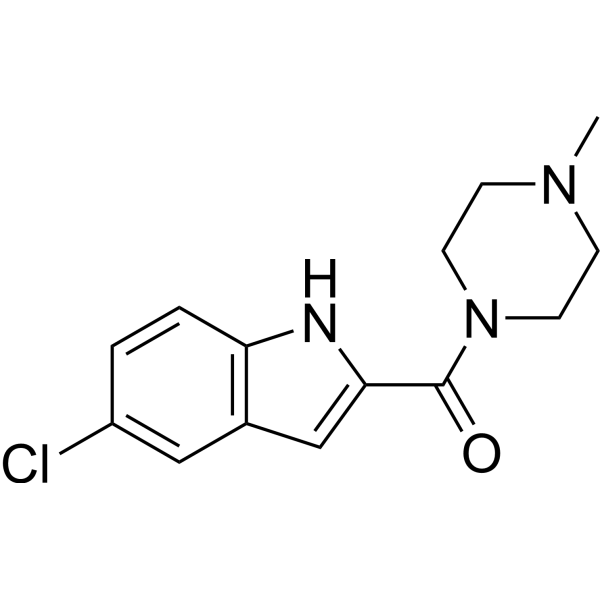
    JNJ-7777120
    1 Publications Verification

    Histamine Receptor Inflammation/Immunology
    JNJ-7777120 is a potent and selective histamine H4 receptor antagonist (Ki=4.5 nM). JNJ-7777120 effectively blocks histamine-induced migration of mouse tracheal mast cells from connective tissue to epithelial cells. JNJ-7777120 also significantly blocks neutrophil infiltration in a mouse Zymosan-induced peritonitis model. JNJ-7777120 has a good potential to study antipruritic and anti-inflammatory .
    JNJ-7777120
  • HY-159069

    Toll-like Receptor (TLR) TNF Receptor Connexin Infection Cancer
    Zymosan (ZM), 95% is a yeast cell wall-derived carbohydrate-rich preparation and immunomodulator. Zymosan (ZM), 95% binds to and activates TLR-2, TLR-4, and Dectin-1 receptor to trigger downstream signaling pathways. Zymosan (ZM), 95% upregulates TLR-2, TLR-4, and TNF-α mRNA expression, increases serum TNF-α levels, and stimulates splenocyte number and viability in mice. Zymosan (ZM), 95% attenuates melanoma growth progression, modulates macrophage marker gene expression, and mediates phagocytosis, ROS generation, and cytokine production. Zymosan (ZM), 95% reduces Connexin 43 protein and mRNA levels, inhibits gap junctional intercellular communication, and induces proinflammatory factor production in human corneal cells. Zymosan (ZM), 95% induces peritoneal inflammation in mice, functions as a drug carrier, and supports fibroblast cell attachment in hydrogel formulations. Zymosan (ZM), 95% can be used for the research of melanoma, tumors, fungal keratitis, ocular surface inflammatory disorders, and peritoneal inflammation .
    Zymosan (ZM), 95%
  • HY-128342
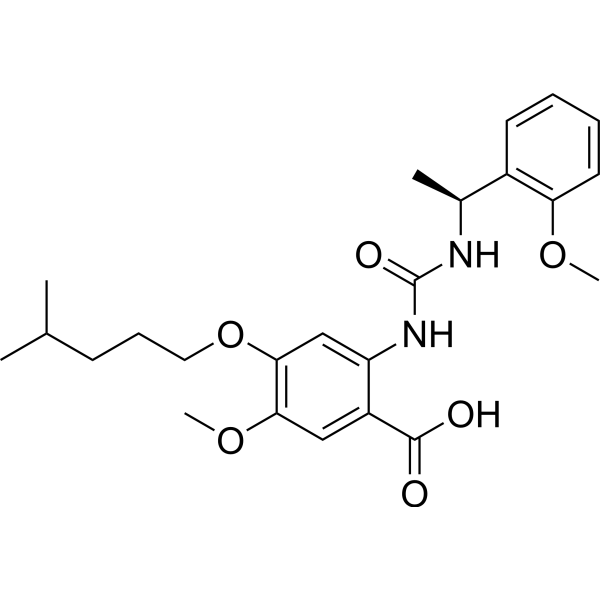
    Complement C5-IN-1
    1 Publications Verification

    Complement System Inflammation/Immunology
    Compound C5-IN-1 (Compound 7) is a selective allosteric inhibitor of complement component protein C5. Compound C5-IN-1 prevents C5 from being cleaved by C5 convertase, inhibits the cleavage of C5 into C5a and C5b, and thus blocks the formation of membrane attack complex (MAC). Compound C5-IN-1 has an IC50 of 0.77 μM and 5 nM in 50% human whole blood and 2% human serum to block MAC deposition induced by zymosan, respectively. Compound C5-IN-1 can be used to study diseases related to complement overactivation, such as paroxysmal nocturnal hemoglobinuria (PNH) and atypical hemolytic uremic syndrome (aHUS) .
    Complement C5-IN-1
  • HY-P3302

    Bacterial Infection
    Sialylglycopeptide is an orally active glycopeptide found in egg yolk. Sialylglycopeptide inhibits the binding of Salmonella enteritidis and Escherichia coli to intestinal cells, and protects mice from Salmonella infection. Sialylglycopeptide can be used in the research of Salmonella infection .
    Sialylglycopeptide
  • HY-113936

    Histamine Receptor Neurological Disease Inflammation/Immunology
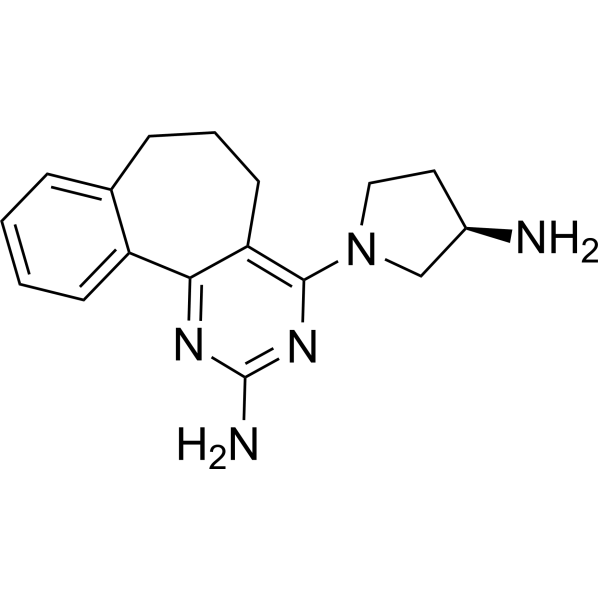
    A-943931 is a potent and selective histamine H4 receptor (H4R) antagonist with pKi values of 4.6, 3.8 nM for human and rat H4R, respectively. A-943931 shows anti-inflammatory and antinociceptive efficacy .
    A-943931
  • HY-N2478

    Autophagy Parasite Inflammation/Immunology
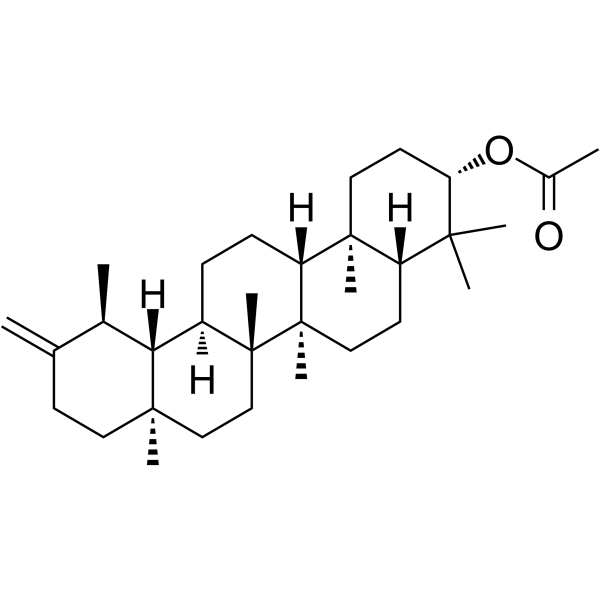
    Taraxasteryl acetate is isolated from P. sagittalis,and has a broad spectrum of anti-inflammatory activity. Taraxasterol acetate promotes RNF31 degradation by activating autophagy. Taraxasteryl acetate relieves dextran, zymosan and arachidonic acid induced rat hind-paw edema. Taraxasteryl acetate can be used for the topical inflammation treatment [1] [2] .
    Taraxasteryl acetate
  • HY-P10966A

    IKK NF-κB Inflammation/Immunology
    Tat-IKIP (46-60) TFA is the trifluoroacetic acid of Tat-IKIP (46-60) (HY-P10966). Tat-IKIP (46-60) is a IκB kinase (IKK)-targeting membrane-penetrating peptide. Tat-IKIP (46-60) inhibits IKK activation and NF-κB targeted gene expression by disrupting the IKKβ/NEMO complex. Tat-IKIP (46-60) significantly reduces DSS (HY-116282)-induced acute inflammation in inflammatory bowel disease (IBD) mice model and attenuates Zymosan-induced acute arthritis in acute arthritis model (AAM). Tat-IKIP (46-60) can be used for inflammatory diseases research, such as IBD, pancreatitis and rheumatoid arthritis .
    Tat-IKIP (46-60) TFA
  • HY-105424

    COX Inflammation/Immunology
    Florifenine is a selective cyclooxygenase (COX) inhibitor with anti-inflammatory activity. Florifenine inhibits TXB2 in human whole blood with an IC50 of 32.5 nM. Florifenine exhibits anti-inflammatory effects in ear oedema. Florifenine inhibits neutrophil migration and reduces PGE2 levles in the inflamed ears. Florifenine inhibits leukocyte migration and PGE2 levels in the air pouch inflammation induced by Zymosan (HY-159069). Florifenine can be used for anti-inflammatory research .
    Florifenine
  • HY-N2478R

    Autophagy Reference Standards Inflammation/Immunology
    Taraxasteryl acetate (Standard) is the analytical standard of Taraxasteryl acetate. This product is intended for research and analytical applications. Taraxasteryl acetate is isolated from P. sagittalis,and has a broad spectrum of anti-inflammatory activity. Taraxasterol acetate promotes RNF31 degradation by activating autophagy. Taraxasteryl acetate relieves dextran, zymosan and arachidonic acid induced rat hind-paw edema. Taraxasteryl acetate can be used for the topical inflammation treatment .
    Taraxasteryl acetate (Standard)
  • HY-N14970

    Parasite Bacterial Infection Cancer
    Hexacyclinol has moderate anti-Gram-positive bacteria activity, 4-40 μg/mL can inhibit the production of oxidants by polymorphonuclear neutrophils (PMNL) stimulated by zymosan. Hexacyclinol inhibits the growth of L-930 and K 562 cells with IC50s of 1.4 μg/mL and 0.4 μg/mL, respectively, and the IC50 of HeLa cells is 10 μg/mL. Hexacyclinol also has an anti-Plasmodium effect, and its IC50 for Plasmodium falciparum is 2.4 μg/mL .
    Hexacyclinol
  • HY-169858

    PGE synthase Inflammation/Immunology
    Prostaglandin E2 Inhibitor 3 (Compound 3) is a selectivity microsomal prostaglandin E synthase-1 (mPGES-1) inhibitor (IC50 = 0.2 µM). Prostaglandin E2 Inhibitor 3 has higher selectivity for mPGES-1 than cyclooxygenases (COX)-1/2, 5-lipoxygenase (5-LO), and soluble epoxide hydrolase (sEH). Prostaglandin E2 Inhibitor 3 has anti-inflammatory activity and can attenuate zymosan-induced peritoneal leukocyte migration in mice .
    Prostaglandin E2 Inhibitor 3
  • HY-13508R

    Histamine Receptor Inflammation/Immunology
    JNJ-7777120 (Standard) is the analytical standard of JNJ-7777120. This product is intended for research and analytical applications. JNJ-7777120 is a potent and selective histamine H4 receptor antagonist (Ki=4.5 nM). JNJ-7777120 effectively blocks histamine-induced migration of mouse tracheal mast cells from connective tissue to epithelial cells. JNJ-7777120 also significantly blocks neutrophil infiltration in a mouse Zymosan-induced peritonitis model. JNJ-7777120 has a good potential to study antipruritic and anti-inflammatory .
    JNJ-7777120 (Standard)
  • HY-P10966

    IKK NF-κB Inflammation/Immunology
    Tat-IKIP (46-60) is a IκB kinase (IKK)-targeting membrane-penetrating peptide. Tat-IKIP (46-60) inhibits IKK activation and NF-κB targeted gene expression by disrupting the IKKβ/NEMO complex. Tat-IKIP (46-60) significantly reduces DSS (HY-116282)-induced acute inflammation in inflammatory bowel disease (IBD) mice model and attenuates Zymosan-induced acute arthritis in acute arthritis model (AAM). Tat-IKIP (46-60) can be used for inflammatory diseases research, such as IBD, pancreatitis and rheumatoid arthritis .
    Tat-IKIP (46-60)

Inquiry Online

Your information is safe with us. * Required Fields.

Salutation


Country or Region *

Applicant Name *


Organization Name *

Department *


Email Address *


Product Name *

Cat. No.


Requested quantity *

Phone Number *


Remarks

Inquiry Online

Inquiry Information

Product Name:
Cat. No.:
Quantity:
MCE Japan Authorized Agent:

