



Tetrachloroauric acid
Based on 1 publication(s) in Google Scholar
Tetrachloroauric acid is an Au (III) compound and bilayer disruptor that can be used to damage red blood cells. Tetrachloroauric acid specifically disrupts the bilayer structure of representative phospholipids (dimyristoylphosphatidylcholine and dimyristoylphosphatidylethanolamine) in human red blood cell membranes, and induces morphological changes in intact human red blood cells. Tetrachloroauric acid causes downregulation of MT I-II and GFAP expression in the mouse brain following chronic treatment. Tetrachloroauric acid is being used in studies related to neurotoxicity and hematotoxicity, including analyses of human red blood cells and molecular models of red blood cell membranes, as well as immunohistochemical evaluation of the mouse brain.
Nos produits utilisent uniquement pour la recherche. Nous ne vendons pas aux patients.
- Pureté : 97%
- CAS No.: 16903-35-8
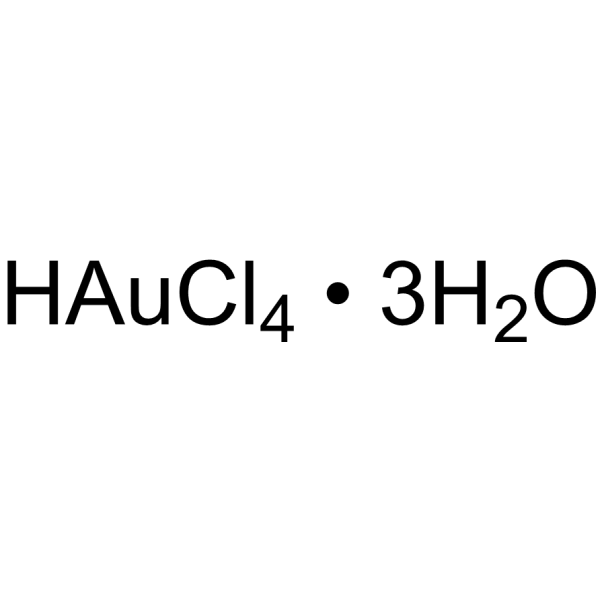
- Formule: HAuCl4
- Masse moléculaire:339.79
-
Stockage:
-20°C, stored under nitrogen
* In solvent : -80°C, 6 months; -20°C, 1 month (stored under nitrogen)


To place orders, for customer services and technical support, please contact: MedChemExpress USA
Tel: 609-228-6898 E-mail: [email protected] [email protected]


-
 Activité biologique
-
Chemical Information
-
Solvant et solubilité
- Protocole
- Pureté et documentation
- Références
-
 Help & FAQs


-
HY-W094581
Gold(III) chloride trihydrateReducing Agent -

HY-Y0344D
Sodium chloride, for cell cultureBiochemical Assay Reagent -

HY-W094511
Tetrachloroaurate(III) sodium dihydrateCatalyst -

HY-Y1673
Potassium bromide, 99%Anticonvulsant/Sedative -

HY-Y0344I
Sodium chloride, meets analytical specification of Ph. Eur. BP USP, ≤0.00002% AlBiochemical Reagent -

HY-107754
Cesium chloridePotassium Channel Blocker -

HY-Y0344J
Sodium chloride, for molecular biologyInorganic Salt -

HY-108775A
Sodium thiosulfate (99%, water≤1.0%)Antioxidant -

HY-Y1110H
Magnesium chloride anhydrous, suitable for insect cell cultureCell Culture Medium Component -

HY-N3025
Zinc sulfate heptahydrateDietary Supplement
Publications Citing Use of MedChemExpress (MCE) Tetrachloroauric acid
More

Activité biologique
Description
In Vitro
Tetrachloroauric acid (0.01-10 mM) induces concentration-dependent structural perturbations in DMPC multibilayers, disrupting bilayer structure at 0.1-3 mM and promoting reordering at 5-10 mM[1].
Tetrachloroauric acid (0.01-10 mM) induces mild, concentration-dependent structural perturbation in DMPE multibilayers, with less disruption than observed in DMPC multibilayers[1].
Tetrachloroauric acid (0.01-0.1 mM; 18 °C, 37 °C) increases lipid packing order at the polar headgroup and acyl chain regions of DMPC LUVs at 18 °C and 37 °C, with a more pronounced effect at 37 °C[1].
Tetrachloroauric acid (0.01-0.1 mM; 37 °C) induces non-monotonic changes in lipid packing order in isolated unsealed human erythrocyte membranes at 37 °C, with distinct minima and maxima at specific concentrations[1].
Tetrachloroauric acid (0.01-0.1 mM; 18 °C, 37 °C) reduces DPH fluorescence lifetime (indicating increased interchain hydration) and increases rotational correlation time (indicating reduced rotational diffusion) in DMPC LUVs at 18 °C and 37 °C, with concentration-dependent response kinetics[1].
Tetrachloroauric acid (0.01-0.07 mM; 37 °C) induces minor, non-monotonic changes in DPH fluorescence lifetime and rotational correlation time in isolated unsealed human erythrocyte membranes at 37 °C, indicating milder effects than in DMPC LUVs[1].
Tetrachloroauric acid (0.1-10 mM) induces concentration-dependent morphological changes in intact human erythrocytes, transitioning from stomatocytes/spherostomatocytes at low concentrations to elliptocytes/knizocytes at high concentrations[1].
MedChemExpress (MCE) has not independently confirmed the accuracy of these methods. They are for reference only. Further protocols information, click here.


Chemical Information
-
CAS No. 16903-35-8
-
Appearance Solid
-
Masse moléculaire 339.79
-
Formule HAuCl4
-
Color Yellow to orange
-
SMILES
Cl[AuH](Cl)(Cl)Cl
-
Livraison
Room temperature in continental US; may vary elsewhere.
-
Stockage
-20°C, stored under nitrogen
* In solvent : -80°C, 6 months; -20°C, 1 month (stored under nitrogen)


Publications (1)
-
Journal Impact Factor
-
Most Recent
-
Anal Chem
Metabolism-Driven Colorimetric "Read-to-Answer" Sensor Array for Bacterial Discrimination and Antimicrobial Susceptibility Testing. [Abstract]2025 Aug 12;97(31):17040-17049. PMID: 40737437


Solvant et solubilité
In Vitro:
DMSO : 200 mg/mL (588.60 mM; Need ultrasonic; Hygroscopic DMSO has a significant impact on the solubility of product, please use newly opened DMSO)
Please refer to the solubility information to select the appropriate solvent. Once prepared, please aliquot and store the solution to prevent product inactivation from repeated freeze-thaw cycles.
Storage method and period of stock solution: -80°C, 6 months; -20°C, 1 month (stored under nitrogen). When stored at -80°C, please use it within 6 months. When stored at -20°C, please use it within 1 month.
Please refer to the solubility information to select the appropriate solvent. Once prepared, please aliquot and store the solution to prevent product inactivation from repeated freeze-thaw cycles.
Storage method and period of stock solution: -80°C, 6 months; -20°C, 1 month (stored under nitrogen). When stored at -80°C, please use it within 6 months. When stored at -20°C, please use it within 1 month.
Concentration (start) × Volume (start) = Concentration (final) × Volume (final)

Protocole
-
RNA extraction experimental
By lysing cells, releasing RNA, and removing impurities such as proteins and DNA, high-purity RNA products are finally obtained. The commonly used traditional method is the guanidine isothiocyanate/phenol/chloroform method (Trizol), which is suitable for a variety of animal materials including animal tissues, microorganisms, cultured cells, etc., and most plant materials.
-
Neurotoxicity Study
This protocol assesses in vitro neurotoxicity by combining neuronal viability, mitochondrial/metabolic activity, neurite outgrowth, and optional neuronal network function readouts. Calcein-AM or resazurin/PrestoBlue readouts estimate viable or metabolically active cells; βIII-tubulin immunofluorescence detects neuronal morphology and neurite networks; TMRE detects mitochondrial membrane potential; and MEA recordings detect functional changes in neuronal network activity.


Pureté et documentation
-
Fiche technique (271 KB)
-
SDS (785 KB)
- English - EN (785 KB)
- Français - FR (785 KB)
- Deutsch - DE (785 KB)
- Norwegian - NO (785 KB)
- Español - ES (785 KB)
- Swedish - SV (785 KB)
- Italian - IT (785 KB)
- Korean - KR (785 KB)
- Portuguese - PT (785 KB)
-
Instruction de manipulation (2659 KB)
Références


Complete Stock Solution Preparation Table
Please refer to the solubility information to select the appropriate solvent. Once prepared, please aliquot and store the solution to prevent product inactivation from repeated freeze-thaw cycles.
Storage method and period of stock solution: -80°C, 6 months; -20°C, 1 month (stored under nitrogen). When stored at -80°C, please use it within 6 months. When stored at -20°C, please use it within 1 month.
| Optional Solvent | Concentration Solvent Mass | 1 mg | 5 mg | 10 mg | 25 mg |
|---|---|---|---|---|---|
| DMSO | 1 mM | 2.9430 mL | 14.7150 mL | 29.4299 mL | 73.5749 mL |
| 5 mM | 0.5886 mL | 2.9430 mL | 5.8860 mL | 14.7150 mL | |
| 10 mM | 0.2943 mL | 1.4715 mL | 2.9430 mL | 7.3575 mL | |
| 15 mM | 0.1962 mL | 0.9810 mL | 1.9620 mL | 4.9050 mL | |
| 20 mM | 0.1471 mL | 0.7357 mL | 1.4715 mL | 3.6787 mL | |
| 25 mM | 0.1177 mL | 0.5886 mL | 1.1772 mL | 2.9430 mL | |
| 30 mM | 0.0981 mL | 0.4905 mL | 0.9810 mL | 2.4525 mL | |
| 40 mM | 0.0736 mL | 0.3679 mL | 0.7357 mL | 1.8394 mL | |
| 50 mM | 0.0589 mL | 0.2943 mL | 0.5886 mL | 1.4715 mL | |
| 60 mM | 0.0490 mL | 0.2452 mL | 0.4905 mL | 1.2262 mL | |
| 80 mM | 0.0368 mL | 0.1839 mL | 0.3679 mL | 0.9197 mL | |
| 100 mM | 0.0294 mL | 0.1471 mL | 0.2943 mL | 0.7357 mL |


Tetrachloroauric acid Related Classifications
HY-W035091 Related Classifications
 Powered by Bioz