



Tilatamig samrotecan
Based on 1 Customer Validation
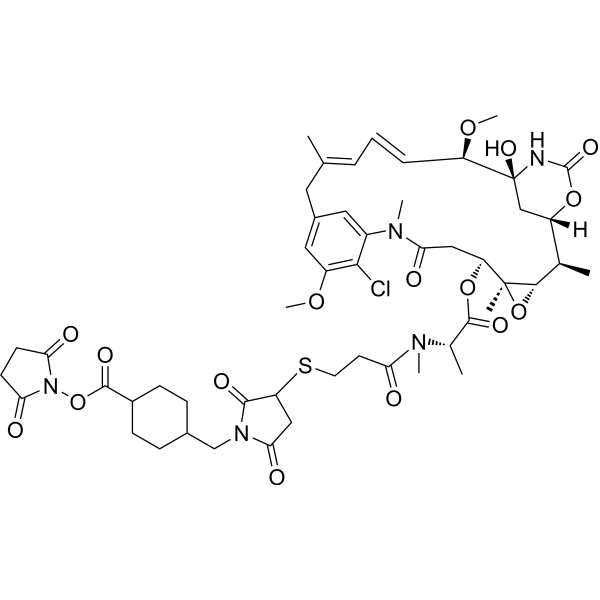
Tilatamig samrotecan (AZD9592) is an anti-EGFR/c-MET antibody-drug conjugate (ADC). Tilatamig samrotecan consists of an anti-EGFR/c-MET antibody with the drug-linker conjugate being AZ14170133 (HY-145399) (a topoisomerase I (TOP1i) inhibitor payload). Tilatamig samrotecan induces multiple DNA damage response pathway markers (like ATM, ATR, γH2AX). Tilatamig samrotecan selectively binds to EGFR and c-MET, delivering the cytotoxic payload. Tilatamig samrotecan exerts anti-tumor activity in vivo. Tilatamig samrotecan can be used for non-small cell lung cancer (NSCLC) and head and neck squamous cell carcinoma (HNSCC) research.
연구목적의 판매만을 진행합니다. 환자를 대상으로 한 판매는 하지 않습니다.
- Purity : 95.26%
- 분자량:151659 (average)
-
보관:Shipping with dry ice
-80°C, protect from light


To place orders, for customer services and technical support, please contact: MedChemExpress USA
Tel: 609-228-6898 E-mail: [email protected] [email protected]


-
 Biological Activity
-
Chemical Information
- Protocol
- 순도&문서
- References
-
 Help & FAQs







Biological Activity
제품 설명
IC50 & Target
|
Topoisomerase I |
In Vivo
Tilatamig samrotecan (8 mg/kg, once) achieves tumor growth inhibition (TGI) in 73% (16/22) of models, with tumor volume reduction ≥30% from baseline in EGFR-mutant non-small cell lung cancer (NSCLC) models (heterogeneous EGFR and c-MET expression levels, and regardless of prior EGFR tyrosine kinase inhibitor treatment)[1].
Tilatamig samrotecan (8 mg/kg, once) shows TGI in 60% (12/20) and 44% (4/9) of models in PDX models of EGFR wild-type NSCLC and head and neck squamous cell carcinoma (HNSCC), respectively[1].
MedChemExpress (MCE) has not independently confirmed the accuracy of these methods. They are for reference only.
Clinical Trial
| NCT Number | Sponsor | Condition | Start Date |
Phase

|
|---|---|---|---|---|
| NCT01329991 | 2011-05 | PHASE1 |


Chemical Information
-
Appearance Liquid
-
분자량 151659 (average)
-
Color Colorless to light yellow
-
SMILES
[Tilatamig samrotecan]
-
Synonyms
AZD9592
-
선적
Shipping with dry ice.
-
보관
-80°C, protect from light


순도&문서
-
Data Sheet (269 KB)
-
SDS (251 KB)
- English - EN (251 KB)
- Français - FR (251 KB)
- Deutsch - DE (251 KB)
- Norwegian - NO (251 KB)
- Español - ES (251 KB)
- Swedish - SV (251 KB)
- Italian - IT (251 KB)
- Korean - KR (251 KB)
- Portuguese - PT (251 KB)
-
Handling Instructions (2659 KB)
References

Calculators
Concentration (start) × Volume (start) = Concentration (final) × Volume (final)


Tilatamig samrotecan Related Classifications
HY-171124 Related Classifications
 Powered by Bioz