



Xylobiose

Based on 1 Customer Validation
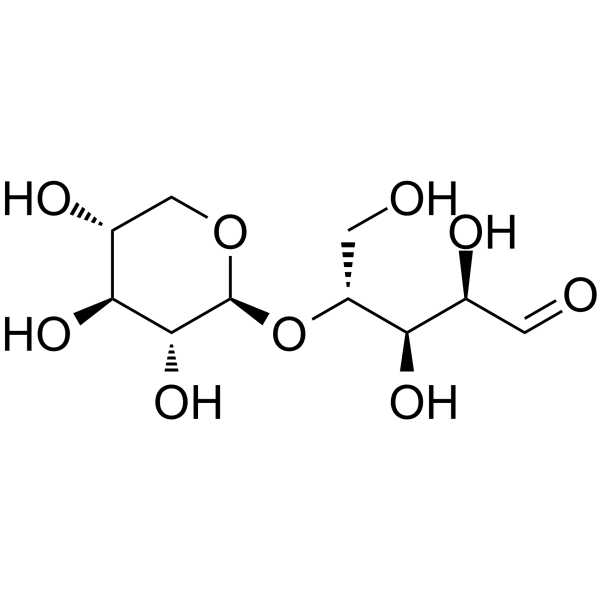
Xylobiose (1,4-β-D-Xylobiose; 1,4-D-Xylobiose) is an orally active Claudin 2/CLDN2 inhibitor and HSP27 inducer. Xylobiose works by regulating intestinal barrier function and glucose and lipid metabolism-related signaling pathways. Xylobiose inhibits CLDN2 expression to reduce intestinal permeability, induces HSP27 to enhance cell protection, and regulates the miR-122a/miR-33a axis to inhibit liver lipid synthesis and improve insulin resistance. Xylobiose can strengthen intestinal barrier integrity, reduce blood sugar and blood lipid levels, and reduce oxidative stress and inflammatory response. Xylobiose can be used in the study of type 2 diabetes and metabolic syndrome.
For research use only. We do not sell to patients.
- Purity: 98.0%
- CAS No.: 6860-47-5
- Formula: C10H18O9
- Molecular Weight:282.24
-
Storage:Powder -20°C, 3 years , 4°C, 2 years ; In solvent -80°C, 6 months , -20°C, 1 month

To place orders, for customer services and technical support, please contact: MedChemExpress USA
Tel: 609-228-6898 E-mail: [email protected] [email protected]


-
 Biological Activity
-
Chemical Information
-
Solvent & Solubility
- Purity & Documentation
- References
-
 Help & FAQs
-

Apoptosis Compound Library
HY-L003
-
Cell Cycle/DNA Damage Compound Library
HY-L004
-
Immunology/Inflammation Compound Library
HY-L007
-
Metabolism/Protease Compound Library
HY-L012
-
Natural Product Library
HY-L021
-
Anti-Aging Compound Library
HY-L034
-
Anti-diabetic Compound Library
HY-L040
-
Oxygen Sensing Compound Library
HY-L045
-
Cytoskeleton Compound Library
HY-L060
-
Orally Active Compound Library
HY-L061
-
Anti-Parkinson's Disease Compound Library
HY-L085
-
Neurodegenerative Disease-related Compound Library
HY-L086
-
Angiogenesis-Related Compound Library
HY-L088
-
Food-Sourced Compound Library
HY-L094
-
Plant-Sourced Natural Product Library
HY-L115
-
Human Metabolite Library
HY-L123
-
Heterocyclic Compound Library
HY-L138
-
Metabolic Enzyme Compound Library
HY-L146
-
Membrane Protein-targeted Compound Library
HY-L149
-
Membrane Receptor-targeted Compound Library
HY-L150
-
Autoimmune Disease Compound Library
HY-L156
-
Anti-Drug-Resistant Compound Library
HY-L169
-
Multi-Target Compound Library
HY-L176
-
Bioactive Compound Library Max
HY-L181
-
MCE Bioactive Compound Library
HY-L001V
-
Natural Product Library Plus
HY-L021P
-
Natural Product and Natural Product-Like Compound Library
HY-L021M
-
Bioactive Compound Library
HY-L001
-
High-Throughput Bioactive Compound Library
HY-L205
-
High-Throughput Natural Product Library
HY-L206
-
Mass Spectrometry Human Metabolite Library
HY-L215
-
Polysaccharides Compound Library
HY-L216
-
Cosmetic Ingredient Compound Library
HY-L221
-
Mass Spectrometry Natural Product Library
HY-L262




Biological Activity
|
Claudin-2 |
HSP27 |
Xylobiose (5-20 mg/mL; 3-24 h) down-regulates the gene and protein expression of Claudin 2 in human intestinal Caco-2 cells, up-regulates the gene and protein expression of heat shock proteins HSP27 and HSP70, and enhances the transepithelial electrical resistance (TER) of the cell monolayer, which may strengthen the intestinal barrier function by regulating signaling pathways such as PI3K[1].
MedChemExpress (MCE) has not independently confirmed the accuracy of these methods. They are for reference only.
-
Cell Line:Human intestinal Caco-2 cells
-
Concentration:5, 10, 20 mg/mL
-
Incubation Time:3, 6, 12, 24 h
-
Result:Downregulated CLDN2 expression, which is involved in paracellular permeability, and upregulated HSP27 and HSP70 expression, which are cytoprotective proteins. These changes indicated an improvement in the cell's functional state rather than a direct impact on cell viability.
MedChemExpress (MCE) has not independently confirmed the accuracy of these methods. They are for reference only.
-
Animal Model:
-
Dosage:
-
Administration:
-
Result:Animal Model: C57BL/KsJ-db/db male mice (17-24 g, 5-week-old), type 2 diabetes model induced by genetic factors[2] - Dosage (solvent): 5% xylobiose replacing sucrose in the diet (dissolved in the diet) - Administration: Dietary intake, daily, for 6 weeks - Result: Did not affect the body weight change compared with the diabetic control group, while significantly reduced food and water intake.


Chemical Information
-
CAS No. 6860-47-5
-
Appearance Solid
-
Molecular Weight 282.24
-
Formula C10H18O9
-
Color White to off-white
-
SMILES
O=C[C@H](O)[C@@H](O)[C@@H](CO)O[C@H]1[C@@H]([C@H]([C@H](O)CO1)O)O
-
Synonyms
1,4-β-D-Xylobiose; 1,4-D-Xylobiose
-
Structure Classification
-
Initial Source
-
Shipping
Room temperature in continental US; may vary elsewhere.
-
Storage
Powder -20°C 3 years 4°C 2 years In solvent -80°C 6 months -20°C 1 month


Solvent & Solubility
H2O : ≥ 125 mg/mL (442.89 mM)
* "≥" means soluble, but saturation unknown.
Please refer to the solubility information to select the appropriate solvent. Once prepared, please aliquot and store the solution to prevent product inactivation from repeated freeze-thaw cycles.
Storage method and period of stock solution: -80°C, 6 months; -20°C, 1 month. When stored at -80°C, please use it within 6 months. When stored at -20°C, please use it within 1 month.
* Note: If you choose water as the stock solution, please dilute it to the working solution, then filter and sterilize it with a 0.22 μm filter before use.
Please refer to the solubility information to select the appropriate solvent. Once prepared, please aliquot and store the solution to prevent product inactivation from repeated freeze-thaw cycles.
Storage method and period of stock solution: -80°C, 6 months; -20°C, 1 month. When stored at -80°C, please use it within 6 months. When stored at -20°C, please use it within 1 month.
* Note: If you choose water as the stock solution, please dilute it to the working solution, then filter and sterilize it with a 0.22 μm filter before use.
Concentration (start) × Volume (start) = Concentration (final) × Volume (final)
For the following dissolution methods, please prepare the working solution directly:
It is recommended to prepare fresh solutions and use them promptly within a short period of time.
The percentages shown for the solvents indicate their volumetric ratio in the final prepared solution. If precipitation or phase separation occurs during preparation, heat and/or sonication can be used to aid dissolution.
Add each solvent one by one: PBS
Solubility: 100 mg/mL (354.31 mM); Clear solution; Need ultrasonic


Purity & Documentation
-
Data Sheet (276 KB)
-
SDS (393 KB)
- English - EN (393 KB)
- Français - FR (393 KB)
- Deutsch - DE (393 KB)
- Norwegian - NO (393 KB)
- Español - ES (393 KB)
- Swedish - SV (393 KB)
- Italian - IT (393 KB)
- Korean - KR (393 KB)
- Portuguese - PT (393 KB)
-
Handling Instructions (2659 KB)
References
[1]. Rini DM, et al. Xylobiose treatment strengthens intestinal barrier function by regulating claudin 2 and heat shock protein 27 expression in human Caco-2 cells. J Sci Food Agric. 2024 Mar 15;104(4):2518-2525. [Content Brief]
[2]. Lim E, et al. Xylobiose, an Alternative Sweetener, Ameliorates Diabetes-Related Metabolic Changes by Regulating Hepatic Lipogenesis and miR-122a/33a in db/db Mice. Nutrients. 2016 Dec 5;8(12):791 [Content Brief]


Complete Stock Solution Preparation Table
Please refer to the solubility information to select the appropriate solvent. Once prepared, please aliquot and store the solution to prevent product inactivation from repeated freeze-thaw cycles.
Storage method and period of stock solution: -80°C, 6 months; -20°C, 1 month. When stored at -80°C, please use it within 6 months. When stored at -20°C, please use it within 1 month.
| Optional Solvent | Concentration Solvent Mass | 1 mg | 5 mg | 10 mg | 25 mg |
|---|---|---|---|---|---|
| H2O | 1 mM | 3.5431 mL | 17.7154 mL | 35.4308 mL | 88.5771 mL |
| 5 mM | 0.7086 mL | 3.5431 mL | 7.0862 mL | 17.7154 mL | |
| 10 mM | 0.3543 mL | 1.7715 mL | 3.5431 mL | 8.8577 mL | |
| 15 mM | 0.2362 mL | 1.1810 mL | 2.3621 mL | 5.9051 mL | |
| 20 mM | 0.1772 mL | 0.8858 mL | 1.7715 mL | 4.4289 mL | |
| 25 mM | 0.1417 mL | 0.7086 mL | 1.4172 mL | 3.5431 mL | |
| 30 mM | 0.1181 mL | 0.5905 mL | 1.1810 mL | 2.9526 mL | |
| 40 mM | 0.0886 mL | 0.4429 mL | 0.8858 mL | 2.2144 mL | |
| 50 mM | 0.0709 mL | 0.3543 mL | 0.7086 mL | 1.7715 mL | |
| 60 mM | 0.0591 mL | 0.2953 mL | 0.5905 mL | 1.4763 mL | |
| 80 mM | 0.0443 mL | 0.2214 mL | 0.4429 mL | 1.1072 mL | |
| 100 mM | 0.0354 mL | 0.1772 mL | 0.3543 mL | 0.8858 mL |
* Note: If you choose water as the stock solution, please dilute it to the working solution, then filter and sterilize it with a 0.22 μm filter before use.


Xylobiose Related Classifications
HY-N2468 Related Classifications
 Powered by Bioz