



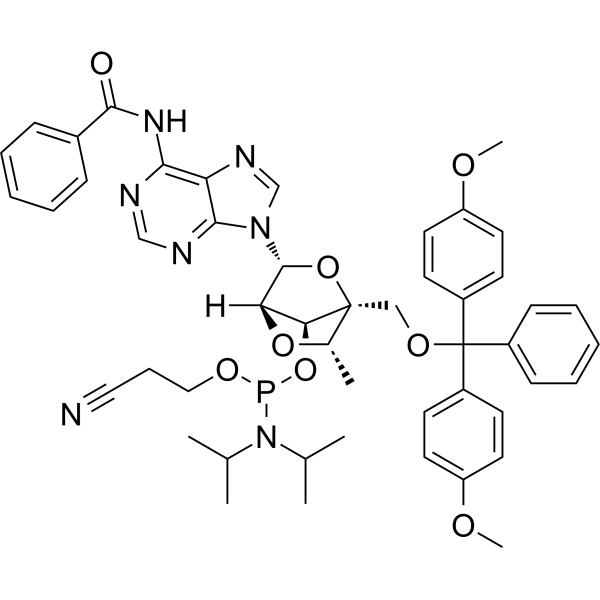
5'-ODMT cEt N-Bz A Phosphoramidite (Amidite)

Based on 1 Customer Validation
5'-ODMT cEt N-Bz A Phosphoramidite (Amidite) is a nucleoside phosphoramidite monomer used to synthesize locked nucleic acid (LNA) analog oligonucleotides. It can be used as a building block of antisense oligonucleotides (ASOs) to target complementary RNA sequences. 5'-ODMT cEt N-Bz A Phosphoramidite (Amidite) locks the furanose ring into an N-type conformation through 2',4'-constrained ethyl (cEt) modification, enhancing hybridization affinity and mismatch discrimination with RNA, while significantly improving the resistance of oligonucleotides to exonuclease digestion. 5'-ODMT cEt N-Bz A Phosphoramidite (Amidite) mediates RNase H-dependent mRNA degradation or inhibits translation by forming a stable hybrid with RNA, thereby achieving gene expression regulation. 5'-ODMT cEt N-Bz A Phosphoramidite (Amidite) is mainly used in the development of antisense drugs, gene function research and oligonucleotide synthesis related to disease treatment.
For research use only. We do not sell to patients.
- Purity : 98.55%
- CAS No.: 1197033-19-4
- Formula: C49H54N7O8P
- Molecular Weight:899.97
-
Storage:
-20°C, stored under nitrogen, away from moisture
* In solvent : -80°C, 6 months; -20°C, 1 month (stored under nitrogen, away from moisture)

To place orders, for customer services and technical support, please contact: MedChemExpress USA
Tel: 609-228-6898 E-mail: [email protected] [email protected]


-
 Biological Activity
-
Chemical Information
-
Solvent & Solubility
- Purity & Documentation
- References
-
 Help & FAQs




Biological Activity
Description
In Vitro
5'-ODMT cEt N-Bz A Phosphoramidite (Amidite) is used in oligonucleotide synthesis experiments to synthesize locked nucleic acid (LNA) analog oligonucleotides with high affinity and exonuclease resistance, which can effectively hybridize with complementary RNA sequences and regulate gene expression[1].
LNA has a wide range of applications in molecular biology, genetic research and disease treatment[1]
1. In molecular biology techniques, its nucleoside triphosphates can be used as substrates for primer extension and PCR experiments: 9°NTM DNA polymerase performs best in PCR amplification containing LNA nucleotides, and LNA-modified probes and primers can improve the melting temperature (Tm value), stability and mismatch discrimination ability of real-time PCR (qPCR), which is suitable for SNP detection, pathogen identification and multiplex analysis.
2. In terms of gene expression regulation, LNA can be used as an antisense oligonucleotide (ASO) to inhibit gene expression. LNA can mediate RNase H-dependent mRNA degradation by forming stable hybrids and is used for small RNA research and gene silencing.
3. In disease diagnosis and treatment, the high affinity and nuclease resistance of LNA make it suitable for complex samples such as FFPE tissues and biological fluids. LNA can also be used for antisense drug development and is an important tool for gene therapy. It also improves detection sensitivity and specificity in techniques such as in situ hybridization (FISH) and microarray analysis.
MedChemExpress (MCE) has not independently confirmed the accuracy of these methods. They are for reference only.


Chemical Information
-
CAS No. 1197033-19-4
-
Appearance Solid
-
Molecular Weight 899.97
-
Formula C49H54N7O8P
-
Color White to off-white
-
SMILES
COC(C=C1)=CC=C1C(C2=CC=C(C=C2)OC)(C3=CC=CC=C3)OC[C@]45[C@H]([C@](O[C@H]5C)([H])[C@H](N6C7=NC=NC(NC(C8=CC=CC=C8)=O)=C7N=C6)O4)OP(OCCC#N)N(C(C)C)C(C)C
-
Shipping
Room temperature in continental US; may vary elsewhere.
-
Storage
-20°C, stored under nitrogen, away from moisture
* In solvent : -80°C, 6 months; -20°C, 1 month (stored under nitrogen, away from moisture)


Solvent & Solubility
In Vitro:
DMSO : 100 mg/mL (111.11 mM; Need ultrasonic; Hygroscopic DMSO has a significant impact on the solubility of product, please use newly opened DMSO)
Please refer to the solubility information to select the appropriate solvent. Once prepared, please aliquot and store the solution to prevent product inactivation from repeated freeze-thaw cycles.
Storage method and period of stock solution: -80°C, 6 months; -20°C, 1 month (stored under nitrogen, away from moisture). When stored at -80°C, please use it within 6 months. When stored at -20°C, please use it within 1 month.
Please refer to the solubility information to select the appropriate solvent. Once prepared, please aliquot and store the solution to prevent product inactivation from repeated freeze-thaw cycles.
Storage method and period of stock solution: -80°C, 6 months; -20°C, 1 month (stored under nitrogen, away from moisture). When stored at -80°C, please use it within 6 months. When stored at -20°C, please use it within 1 month.
Concentration (start) × Volume (start) = Concentration (final) × Volume (final)


Purity & Documentation
-
Data Sheet (282 KB)
-
SDS (252 KB)
- English - EN (252 KB)
- Français - FR (252 KB)
- Deutsch - DE (252 KB)
- Norwegian - NO (252 KB)
- Español - ES (252 KB)
- Swedish - SV (252 KB)
- Italian - IT (252 KB)
- Korean - KR (252 KB)
- Portuguese - PT (252 KB)
-
Handling Instructions (2659 KB)
References
[1]. Seth PP, et al. Synthesis and biophysical evaluation of 2',4'-constrained 2'O-methoxyethyl and 2',4'-constrained 2'O-ethyl nucleic acid analogues. J Org Chem. 2010 Mar 5;75(5):1569-81. [Content Brief]
[2]. Vasquez G, et al. Site-specific incorporation of 5'-methyl DNA enhances the therapeutic profile of gapmer ASOs. Nucleic Acids Res. 2021 Feb 26;49(4):1828-1839. [Content Brief]


Complete Stock Solution Preparation Table
Please refer to the solubility information to select the appropriate solvent. Once prepared, please aliquot and store the solution to prevent product inactivation from repeated freeze-thaw cycles.
Storage method and period of stock solution: -80°C, 6 months; -20°C, 1 month (stored under nitrogen, away from moisture). When stored at -80°C, please use it within 6 months. When stored at -20°C, please use it within 1 month.
| Optional Solvent | Concentration Solvent Mass | 1 mg | 5 mg | 10 mg | 25 mg |
|---|---|---|---|---|---|
| DMSO | 1 mM | 1.1111 mL | 5.5557 mL | 11.1115 mL | 27.7787 mL |
| 5 mM | 0.2222 mL | 1.1111 mL | 2.2223 mL | 5.5557 mL | |
| 10 mM | 0.1111 mL | 0.5556 mL | 1.1111 mL | 2.7779 mL | |
| 15 mM | 0.0741 mL | 0.3704 mL | 0.7408 mL | 1.8519 mL | |
| 20 mM | 0.0556 mL | 0.2778 mL | 0.5556 mL | 1.3889 mL | |
| 25 mM | 0.0444 mL | 0.2222 mL | 0.4445 mL | 1.1111 mL | |
| 30 mM | 0.0370 mL | 0.1852 mL | 0.3704 mL | 0.9260 mL | |
| 40 mM | 0.0278 mL | 0.1389 mL | 0.2778 mL | 0.6945 mL | |
| 50 mM | 0.0222 mL | 0.1111 mL | 0.2222 mL | 0.5556 mL | |
| 60 mM | 0.0185 mL | 0.0926 mL | 0.1852 mL | 0.4630 mL | |
| 80 mM | 0.0139 mL | 0.0694 mL | 0.1389 mL | 0.3472 mL | |
| 100 mM | 0.0111 mL | 0.0556 mL | 0.1111 mL | 0.2778 mL |


5'-ODMT cEt N-Bz A Phosphoramidite (Amidite) Related Classifications
HY-148503 Related Classifications
 Powered by Bioz