



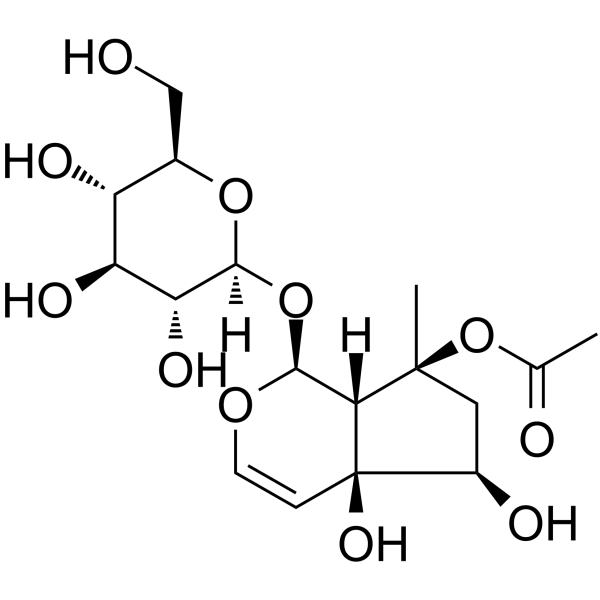
8-O-Acetylharpagide
Based on 1 publication(s) in Google Scholar
8-O-Acetylharpagide is an orally active iridoid glycoside compound. 8-O-Acetylharpagide exhibits anti-aging activity at low doses and anticancer activity at high doses. 8-O-Acetylharpagide induces late-stage apoptosis and necrosis-like death in cancer cells, and downregulates anti-apoptotic proteins such as Akt, p-Akt and Bcl-2. 8-O-Acetylharpagide is mainly metabolized in rats via demethylation, hydrolysis and glucuronidation, and its active metabolites downregulate the AKT/NF-κB/MMP9 signaling axis. 8-O-Acetylharpagide exerts vasoconstrictive effects by activating vascular α-adrenoceptor.
For research use only. We do not sell to patients.
- Purity : 99.75%
- CAS No.: 6926-14-3
- Formula: C17H26O11
- Molecular Weight:406.38
-
Storage:
4°C, protect from light
* In solvent : -80°C, 6 months; -20°C, 1 month (protect from light)

To place orders, for customer services and technical support, please contact: MedChemExpress USA
Tel: 609-228-6898 E-mail: [email protected] [email protected]


-
 Biological Activity
-
Chemical Information
-
Solvent & Solubility
- Purity & Documentation
- References
-
 Help & FAQs



Publications Citing Use of MedChemExpress (MCE) 8-O-Acetylharpagide
MoreAll Adrenergic Receptor Isoforms
More

Biological Activity
Description
Cellular Effect
|
Cell Line

|
Type | Value | Description | References |
|---|---|---|---|---|
| A-431 | ED50 |
310 μM
Compound: 2
|
Cytotoxicity against human A431 cells by MTT assay
Cytotoxicity against human A431 cells by MTT assay
|
[PMID: 12027771] |
In Vitro
8-O-acetylharpagide (0.5-10 μM; 48 h) dose-dependently inhibits the activity of senescence-associated β-galactosidase in senescent human dermal fibroblasts in vitro[1].
8-O-acetylharpagide (0.5-10 μM; 48 h) dose-dependently inhibits p53 expression in senescent human dermal fibroblasts[1].
8-O-acetylharpagide (1-10 μM) inhibits the elevated intracellular reactive oxygen species levels in dermal fibroblasts from elderly humans[1].
8-O-acetylharpagide (2.5 mg/mL; 0-24 h) undergoes metabolic transformation in an in vitro rat intestinal flora culture system, producing 2 metabolites via pathways including hydrolysis, reduction and glucuronidation[2].
8-O-acetylharpagide (0.01-1 mM; 24 h) exhibits more potent selective cytotoxicity against human hypopharyngeal carcinoma FaDu cells than against normal human PDL cells, with an IC50 of 0.88 mM for FaDu cells and 1.65 mM for PDL cells after 24 h of treatment[3].
8-O-acetylharpagide (1 mM; 24 h) induces significant cell rounding in human hypopharyngeal carcinoma FaDu cells, but exerts no such effect in normal human PDL cells[3].
8-O-acetylharpagide (1 mM; 6 days) completely inhibits the proliferation of human hypopharyngeal carcinoma FaDu cells[3].
8-O-acetylharpagide (0.5-1 mM; 24 h) induces dose-dependent G2/M phase arrest in human hypopharyngeal carcinoma FaDu cells and regulates the expression of cell cycle-related proteins, but exerts no effect on the cell cycle distribution of normal human PDL cells[3].
8-O-acetylharpagide (1 mM; 24 h) induces significant necroptotic cell death and late apoptosis in human hypopharyngeal carcinoma FaDu cells, downregulates anti-apoptotic proteins, but exerts minimal effects on normal human PDL cells[3].
8-O-acetylharpagide (1 mM; 24 h) significantly enhances the radiosensitivity of human hypopharyngeal carcinoma FaDu cells, but has no effect on that of normal human PDL cells[3].
MedChemExpress (MCE) has not independently confirmed the accuracy of these methods. They are for reference only.
-
Cell Line:old human dermal fibroblasts (HDFs)
-
Concentration:0.5 μM, 1 μM, 5 μM, 10 μM
-
Incubation Time:48 h
-
Result:Reduced p53 expression to ~90% of control at 0.5 μM.
Reduced p53 expression to ~75% of control at 1 μM.
Reduced p53 expression to ~60% of control at 5 μM.
Reduced p53 expression to ~55% of control at 10 μM, all in a dose-dependent manner.
-
Cell Line:human hypopharyngeal cancer FaDu cells, human periodontal ligament (PDL) normal cells
-
Concentration:0.01, 0.1, 0.3, 0.5, 0.7, 1 mM
-
Incubation Time:24 h
-
Result:Reduced viability of FaDu cells significantly at concentrations ≥ 0.5 mM, with an IC50 of 0.88 mM.
Reached an IC50 of 1.65 mM in PDL cells, yielding a selectivity index of ≈1.85.
Enhanced PDL cell viability at low concentrations.
-
Cell Line:human hypopharyngeal cancer FaDu cells
-
Concentration:1 mM
-
Incubation Time:6 days
-
Result:Completely suppressed the proliferation of FaDu cells over the 6-day period, while vehicle-treated cells showed continuous growth.
-
Cell Line:human hypopharyngeal cancer FaDu cells, human periodontal ligament (PDL) normal cells
-
Concentration:0.5, 1 mM
-
Incubation Time:24 h
-
Result:Induced dramatic G2/M phase arrest and an increased sub-G1 population in FaDu cells treated with 1 mM, with a dose-dependent effect from 0.5-1 mM.
Upregulated CHK1 (1.32-fold), Cyclin B (1.3-fold), and p21 (1.74-fold), and downregulated CDK1 (0.58-fold) relative to GAPDH in FaDu cells.
Showed no significant changes in cell cycle distribution or cell cycle-related protein expression in PDL cells at the same concentrations.
-
Cell Line:human hypopharyngeal cancer FaDu cells, human periodontal ligament (PDL) normal cells
-
Concentration:1 mM
-
Incubation Time:24 h
-
Result:Induced a significant increase in necrosis-like cell population and late apoptosis, with no significant change in early apoptosis in FaDu cells.
Downregulated AKT (0.56-fold), phospho-AKT (0.64-fold), and BCL-2 (0.7-fold) relative to GAPDH in FaDu cells.
Caused only a small increase in necrosis-like cells and no significant changes in apoptosis or apoptosis-related protein expression in PDL cells.
-
Cell Line:human hypopharyngeal cancer FaDu cells, human periodontal ligament (PDL) normal cells
-
Concentration:1 mM
-
Incubation Time:24 h (pre-incubation); 48 h (post-irradiation incubation)
-
Result:Enhanced the radiosensitivity of FaDu cells significantly, with cell viability decreasing more sharply with increasing radiation dose compared to vehicle-treated FaDu cells.
Showed no enhancement of radiosensitivity in PDL cells.
In Vivo
8-O-acetylharpagide (low dose; p.o.) inhibits senescent phenotypes in aged mice[3].
MedChemExpress (MCE) has not independently confirmed the accuracy of these methods. They are for reference only.
-
Animal Model:Balb-C (female, 4 weeks old, weight 22 g, subcutaneous injection of 4T1 cells)[2]
-
Dosage:75 mg/kg; 150 mg/kg
-
Administration:p.o.; once daily; 4 weeks
-
Result:Significantly reduced relative protein levels of AKT, p-AKT, NF-κB p65, and MMP9 compared to the control group.
Significantly reduced the p-AKT/AKT ratio compared to the control group.
Further significantly reduced relative protein levels of AKT, p-AKT, NF-κB p65, and MMP9 compared to the control group.


Chemical Information
-
CAS No. 6926-14-3
-
Appearance Solid
-
Molecular Weight 406.38
-
Formula C17H26O11
-
Color White to off-white
-
SMILES
O[C@@]([C@@H]1O)(C=CO2)[C@]([C@](OC(C)=O)(C)C1)([H])[C@@H]2O[C@]([C@@H]([C@@H](O)[C@@H]3O)O)([H])O[C@@H]3CO
-
Structure Classification
-
Initial Source
-
Shipping
Room temperature in continental US; may vary elsewhere.
-
Storage
4°C, protect from light
* In solvent : -80°C, 6 months; -20°C, 1 month (protect from light)


Publications (1)
-
Journal Impact Factor
-
Most Recent
-
Vet Microbiol
The Chinese medicine monomer Schisandrin C inhibits PRRSV infection by regulating the OGT-PI3K/AKT/mTOR signaling pathway. [Abstract]2026 May:316:110992. PMID: 41865607


Solvent & Solubility
In Vitro:
DMSO : 25 mg/mL (61.52 mM; Need ultrasonic; Hygroscopic DMSO has a significant impact on the solubility of product, please use newly opened DMSO)
Please refer to the solubility information to select the appropriate solvent. Once prepared, please aliquot and store the solution to prevent product inactivation from repeated freeze-thaw cycles.
Storage method and period of stock solution: -80°C, 6 months; -20°C, 1 month (protect from light). When stored at -80°C, please use it within 6 months. When stored at -20°C, please use it within 1 month.
Please refer to the solubility information to select the appropriate solvent. Once prepared, please aliquot and store the solution to prevent product inactivation from repeated freeze-thaw cycles.
Storage method and period of stock solution: -80°C, 6 months; -20°C, 1 month (protect from light). When stored at -80°C, please use it within 6 months. When stored at -20°C, please use it within 1 month.
Concentration (start) × Volume (start) = Concentration (final) × Volume (final)
In Vivo:
Select the appropriate dissolution method based on your experimental animal and administration route.
- For the following dissolution methods, please ensure to first prepare a clear stock solution using an In Vitro approach and then sequentially add co-solvents:
- To ensure reliable experimental results, the clarified stock solution can be appropriately stored based on storage conditions. As for the working solution for In Vivo experiments, it is recommended to prepare freshly and use it on the same day.
- The percentages shown for the solvents indicate their volumetric ratio in the final prepared solution. If precipitation or phase separation occurs during preparation, heat and/or sonication can be used to aid dissolution.
Add each solvent one by one: 10% DMSO 40% PEG300 5% Tween-80 45% Saline
Solubility: ≥ 2.5 mg/mL (6.15 mM); Clear solution
This protocol yields a clear solution of ≥ 2.5 mg/mL (saturation unknown).
Taking 1 mL working solution as an example, add 100 μL DMSO stock solution (25.0 mg/mL) to 400 μL PEG300, and mix evenly; then add 50 μL Tween-80 and mix evenly; then add 450 μL Saline to adjust the volume to 1 mL.
Preparation of Saline: Dissolve 0.9 g sodium chloride in ddH₂O and dilute to 100 mL to obtain a clear Saline solution.
Add each solvent one by one: 10% DMSO 90% (20% SBE-β-CD in Saline)
Solubility: ≥ 2.5 mg/mL (6.15 mM); Clear solution
This protocol yields a clear solution of ≥ 2.5 mg/mL (saturation unknown).
Taking 1 mL working solution as an example, add 100 μL DMSO stock solution (25.0 mg/mL) to 900 μL 20% SBE-β-CD in Saline, and mix evenly.
Preparation of 20% SBE-β-CD in Saline (4°C, storage for one week): 2 g SBE-β-CD powder is dissolved in 10 mL Saline, completely dissolve until clear.
In Vivo Dissolution Calculator
Please enter the basic information of animal experiments:
-
-
-
-
Recommended: Prepare an additional quantity of animals to account for potential losses during experiments.
Please enter your animal formula composition:
-
%DMSO +
Recommended: Keep the proportion of DMSO in working solution below 2% if your animal is weak.
-
%+
-
+%Tween-80 + +
-
%Saline +
The co-solvents required include: DMSO, . All of co-solvents are available by MedChemExpress (MCE). , Tween 80. All of co-solvents are available by MedChemExpress (MCE).
Working solution concentration: 0.22 mg/mL
Method for preparing stock solution: mg drug dissolved in μL DMSO. Stock solution concentration: mg/mL. * In solvent : -80°C, 6 months; -20°C, 1 month (protect from light)
1. Take μL DMSO stock solution;
2. Add μL .
μL , mix evenly;
3. Then add μL Tween 80, mix evenly;
4. Then add μL
Please ensure that the stock solution in the first step is dissolved to a clear state, and add co-solvents in sequence. You can use ultrasonic heating (ultrasonic cleaner, recommended frequency 20-40 kHz), vortexing, etc. to assist dissolution.


Purity & Documentation
-
Data Sheet (292 KB)
-
SDS (392 KB)
- English - EN (392 KB)
- Français - FR (392 KB)
- Deutsch - DE (392 KB)
- Norwegian - NO (392 KB)
- Español - ES (392 KB)
- Swedish - SV (392 KB)
- Italian - IT (392 KB)
- Korean - KR (392 KB)
- Portuguese - PT (392 KB)
-
Handling Instructions (2659 KB)
References
[1]. Hsu WH, et al. Involvement of 8-O-acetylharpagide for Ajuga taiwanensis mediated suppression of senescent phenotypes in human dermal fibroblasts. Sci Rep. 2020;10(1):19731. Published 2020 Nov 12. [Content Brief]
[2]. Zhao X, et al. Metabolism and Excretion of 8-O-Acetylharpagide in Rats and Identification of Its Potential Anti-Breast Cancer Active Metabolites. Drug Des Devel Ther. 2025;19:2795-2815. Published 2025 Apr 10. [Content Brief]
[3]. Yang WY, et al. 8-O-acetylharpagide, an active compound isolated from A. taiwanensis selectively induced G2/M phase arrest and radiosensitivity in hypopharyngeal cancer cells. Biochem Biophys Rep. 2026;45:102431. Published 2026 Jan 6. [Content Brief]
[4]. Breschi MC, et al. Vasoconstrictor activity of 8-O-acetylharpagide from Ajuga reptans. J Nat Prod. 1992;55(8):1145-1148. [Content Brief]
[5].
Hsu WH, et al. Author Correction: Involvement of 8-O-acetylharpagide for Ajuga taiwanensis mediated suppression of senescent phenotypes in human dermal fibroblasts. Sci Rep. 2025 Feb 19;15(1):6080.
[Content Brief]


Complete Stock Solution Preparation Table
Please refer to the solubility information to select the appropriate solvent. Once prepared, please aliquot and store the solution to prevent product inactivation from repeated freeze-thaw cycles.
Storage method and period of stock solution: -80°C, 6 months; -20°C, 1 month (protect from light). When stored at -80°C, please use it within 6 months. When stored at -20°C, please use it within 1 month.
| Optional Solvent | Concentration Solvent Mass | 1 mg | 5 mg | 10 mg | 25 mg |
|---|---|---|---|---|---|
| DMSO | 1 mM | 2.4608 mL | 12.3038 mL | 24.6075 mL | 61.5188 mL |
| 5 mM | 0.4922 mL | 2.4608 mL | 4.9215 mL | 12.3038 mL | |
| 10 mM | 0.2461 mL | 1.2304 mL | 2.4608 mL | 6.1519 mL | |
| 15 mM | 0.1641 mL | 0.8203 mL | 1.6405 mL | 4.1013 mL | |
| 20 mM | 0.1230 mL | 0.6152 mL | 1.2304 mL | 3.0759 mL | |
| 25 mM | 0.0984 mL | 0.4922 mL | 0.9843 mL | 2.4608 mL | |
| 30 mM | 0.0820 mL | 0.4101 mL | 0.8203 mL | 2.0506 mL | |
| 40 mM | 0.0615 mL | 0.3076 mL | 0.6152 mL | 1.5380 mL | |
| 50 mM | 0.0492 mL | 0.2461 mL | 0.4922 mL | 1.2304 mL | |
| 60 mM | 0.0410 mL | 0.2051 mL | 0.4101 mL | 1.0253 mL |


8-O-Acetylharpagide Related Classifications
HY-N0757 Related Classifications
 Powered by Bioz