



Anidulafungin
Based on 7 publication(s) in Google Scholar
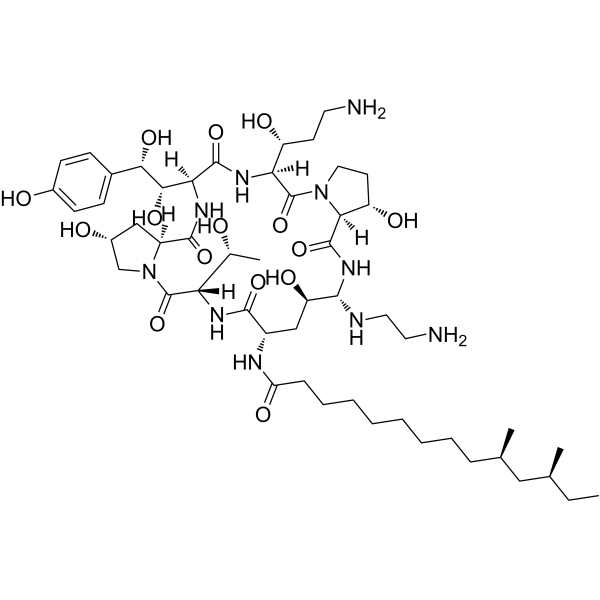
Anidulafungin is a new semisynthetic echinocandin with antifungal potency.
For research use only. We do not sell to patients.
- Purity : 98.39%
- CAS No.: 166663-25-8
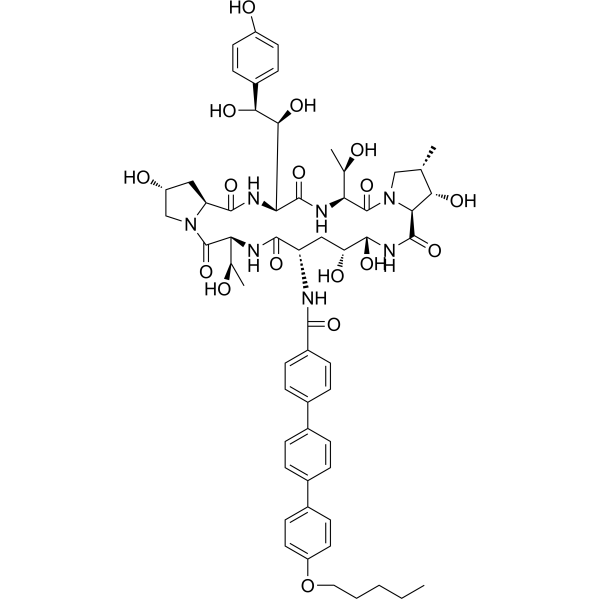
- Formula: C58H73N7O17
- Molecular Weight:1140.24
-
Storage:Powder -20°C, 3 years , 4°C, 2 years ; In solvent -80°C, 1 year , -20°C, 6 months

To place orders, for customer services and technical support, please contact: MedChemExpress USA
Tel: 609-228-6898 E-mail: [email protected] [email protected]


-
 Biological Activity
-
Chemical Information
-
Solvent & Solubility
- Purity & Documentation
- References
-
 Help & FAQs


-
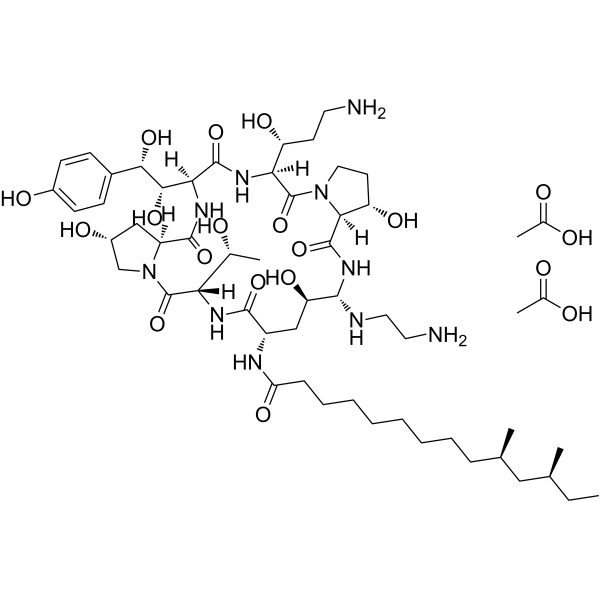
HY-17006
Caspofungin diacetateAntifungal Agent -
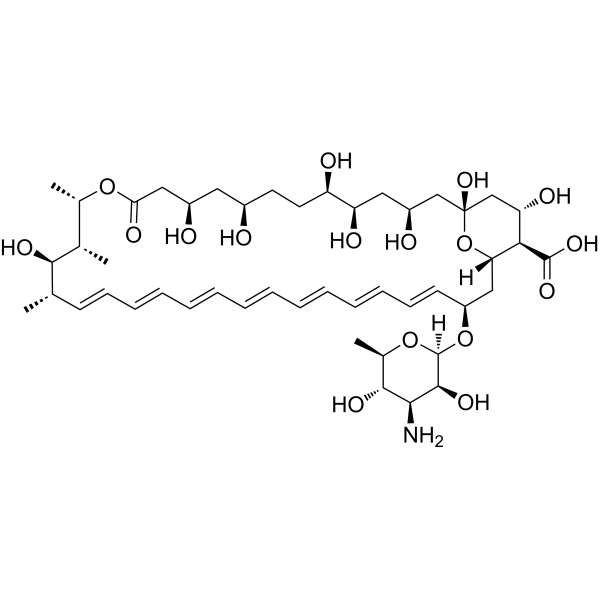
HY-B0221
Amphotericin BAntifungal Agent -
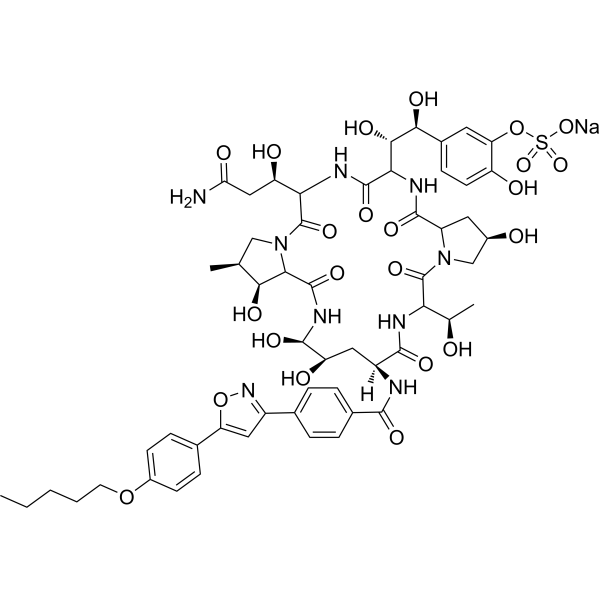
HY-16321
Micafungin sodiumAntifungal Agent -
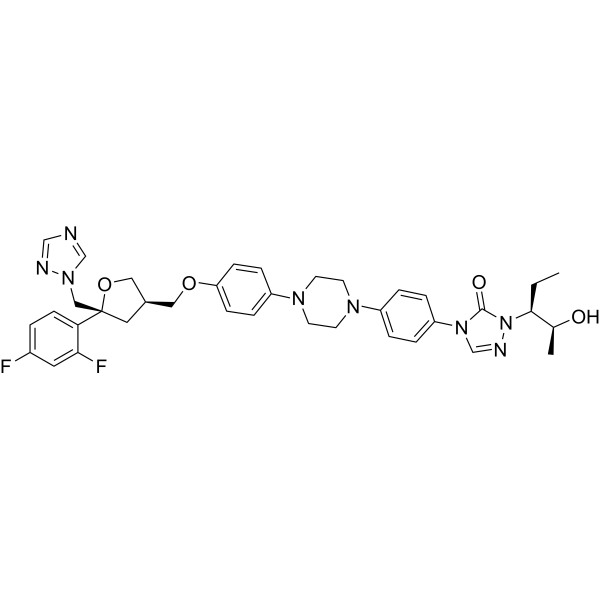
HY-17373
PosaconazoleAnti-fungal Agent -
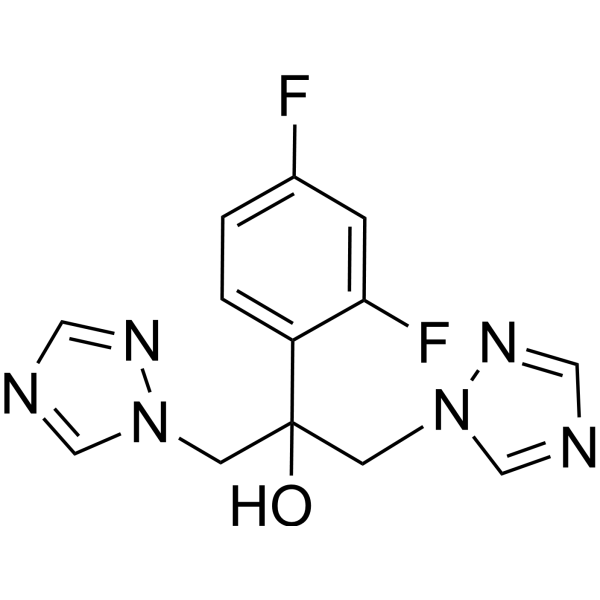
HY-B0101
FluconazoleAntifungal Agent -
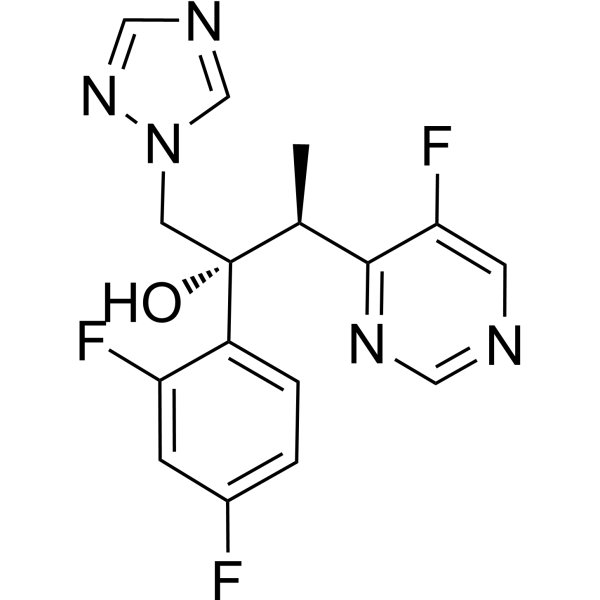
HY-76200
VoriconazoleAntifungal Agent -
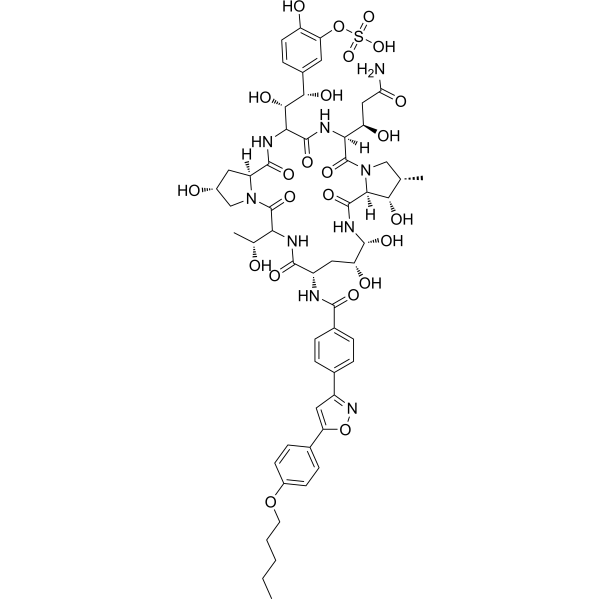
HY-17579
MicafunginAntibiotic -
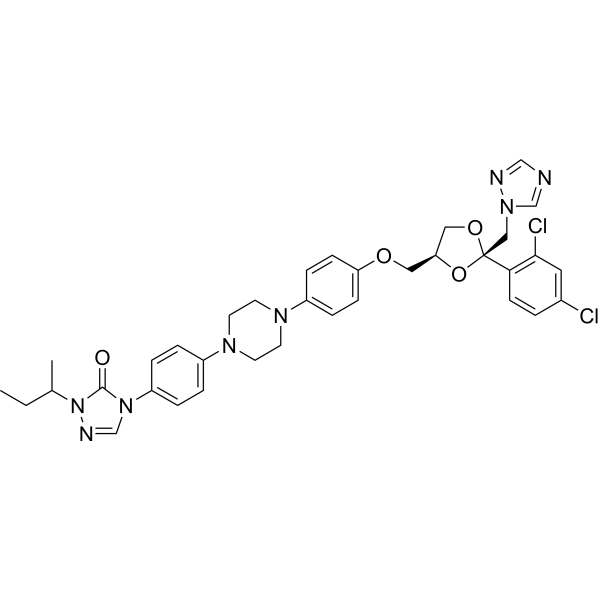
HY-17514
ItraconazoleAntifungal Agent -
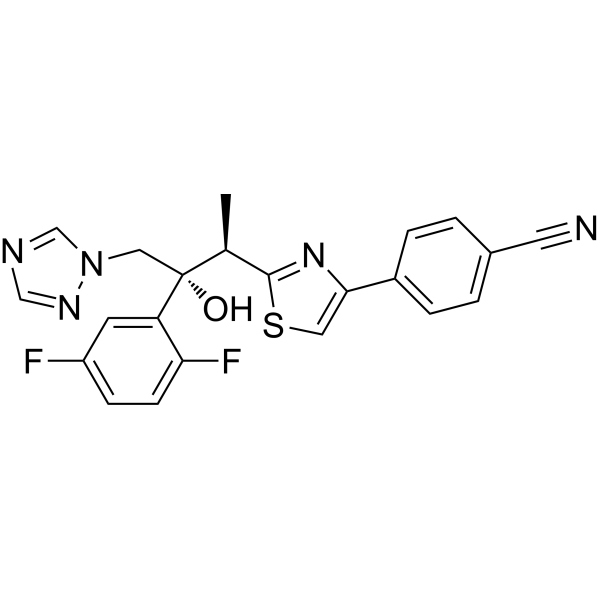
HY-14273
IsavuconazoleTriazole Antifungal -
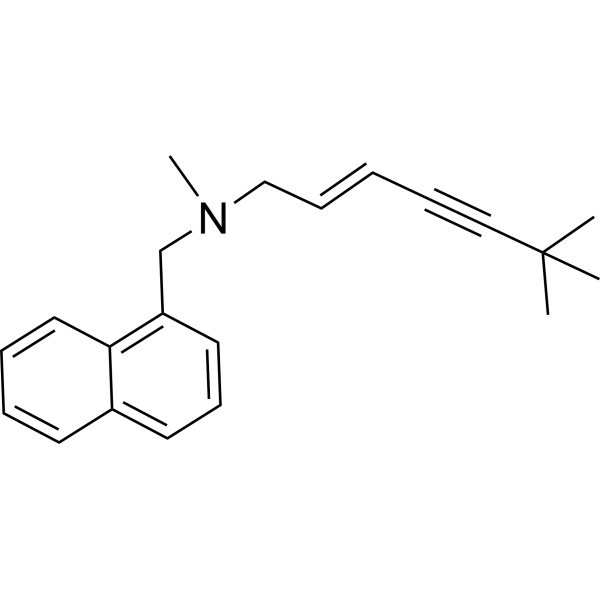
HY-17395A
TerbinafineAntimicrobial Agent -
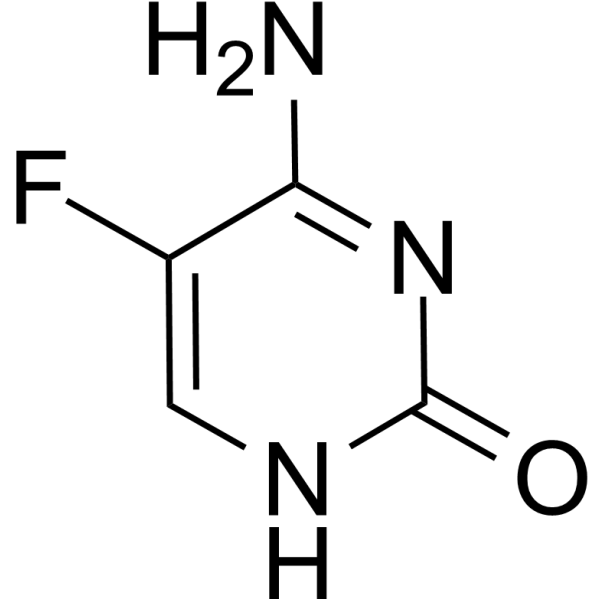
HY-B0139
FlucytosineAntifungal Agent -
HY-17006A
CaspofunginAntifungal Agent
Publications Citing Use of MedChemExpress (MCE) Anidulafungin
More- Adv Sci (Weinh). 2026 Jun 28:e76369. [Abstract]
- Adv Sci (Weinh). 2022 Dec;9(34):e2203088. [Abstract]
- J Clin Microbiol. 2017 Jun;55(6):1883-1893. [Abstract]
- J Fungi (Basel). 2024 May 31;10(6):397. [Abstract]
- mSphere. 2020 Oct 28;5(5):e00821-20. [Abstract]
- mSphere. 2018 Nov 14;3(6):e00547-18. [Abstract]
- Mycoses. 2021 Mar;64(3):282-291. [Abstract]
 Customer Validation & Images

-
Bio/Physico-chemical Assay
-
RT-PCR
-
In Vivo Efficacy Study
-
Bio/Physico-chemical Assay
-
Histological Imaging/Staining
All Antibiotic Isoforms
More

Biological Activity
Description
IC50 & Target
Antifungal[1]
Cellular Effect
|
Cell Line

|
Type | Value | Description | References |
|---|---|---|---|---|
| Vero | CC50 |
>50 μM
Compound: Anidulafungin
|
Cell viability measured by CellTiter-Glo assay in Vero cells at MOI 0.05 after 72hr
Cell viability measured by CellTiter-Glo assay in Vero cells at MOI 0.05 after 72hr
|
10.1101/2020.03.20.999730 |
| Vero | IC50 |
4.64 μM
Compound: Anidulafungin
|
Antiviral activity against SARS-CoV-2 (viral titer) measured by plaque assay in Vero cells at MOI 0.0125 after 24 hr
Antiviral activity against SARS-CoV-2 (viral titer) measured by plaque assay in Vero cells at MOI 0.0125 after 24 hr
|
10.1101/2020.03.20.999730 |
In Vitro
Anidulafungin (LY-303366) has MICs of ≤0.32 μg/mL for all Candida albicans (n=99), Candida glabrata (n=18), and Candida tropicalis (n=10) isolates tested. Anidulafungin is also active against Aspergillus species (minimum effective concentration at which 90% of the isolates are inhibited, 0.02 μg/mL) (n=20), is less active against Candida parapsilosis (MIC at which 90% of the isolates are inhibited [MIC90], 5.12 μg/mL) (n=10), and is inactive against C. neoformans (MIC90 >10.24 μg/mL) (n=15) and B. dermatitidis (MIC90, 16 μg/mL) (n=29).The MICs of Fluconazole for three strains of C. tropicalis, seven strains of C. glabrata, and two strains of Candida krusei are ≥16 μg/mL. The MICs of Anidulafungin for 11 of these 12 strains range from 0.08 to 0.32 mg/mL. The twelfth strain is a C. krusei strain (Fluconazole MIC, 32 μg/mL) for which the Anidulafungin MIC is 1.28 mg/mL. The MIC at which 90% of the isolates are inhibited (MIC90) for these 12 strains is 0.32 μg/mL. The Anidulafungin MIC90 for the remaining 18 C. glabrata isolates and C. tropicalis isolates for which the Fluconazole MICs are ≥ 8 μg/mL is also 0.32 mg/mL. Anidulafungin appeares equally active against Candida species for which the fluconazole MICs are ≥16 mg/mL and against those for which the fluconazole MICs are ≥ 8 μg/mL. Anidulafungin has significantly less activity against C. neoformans and B. dermatitidis than against C. albicans, C. glabrata, and C. tropicalis. Ketoconazole and amphotericin B are the most active antifungal agents tested for both C. neoformans and B. dermatitidis. Anidulafungin demonstrated potent in vitro activity against Aspergillus species with a MEC90 of 0.02 μg/mL. MICs of Anidulafungin for the control strain yeast isolates are 0.02 μg/mL for C. albicans ATCC 90028, 0.16 mg/mL for C. glabrata ATCC 90030, and >10.24 μg/mL for C. neoformans ATCC 90112[1]. Strains selected with CD101 that have a 2-fold or greater CD101 MIC increase also have at least a 2-fold MIC increase for Anidulafungin (ANF) and/or Caspofungin (CSF)[2].
MedChemExpress (MCE) has not independently confirmed the accuracy of these methods. They are for reference only.
Clinical Trial
| NCT Number | Sponsor | Condition | Start Date |
Phase
|
|---|---|---|---|---|
| NCT01329991 | 2011-05 | PHASE1 |


Chemical Information
-
CAS No. 166663-25-8
-
Appearance Solid
-
Molecular Weight 1140.24
-
Formula C58H73N7O17
-
Color White to off-white
-
SMILES
O[C@@H]1C[C@H](N2C1)C(N[C@@H]([C@H](O)[C@@H](O)C3=CC=C(O)C=C3)C(N[C@@H]([C@@H](C)O)C(N4[C@@H]([C@@H](O)[C@@H](C)C4)C(N[C@H](O)[C@H](O)C[C@H](NC(C5=CC=C(C6=CC=C(C7=CC=C(OCCCCC)C=C7)C=C6)C=C5)=O)C(N[C@@H]([C@H](O)C)C2=O)=O)=O)=O)=O)=O
-
Synonyms
LY303366
-
Shipping
Room temperature in continental US; may vary elsewhere.
-
Storage
Powder -20°C 3 years 4°C 2 years In solvent -80°C 1 year -20°C 6 months


Publications (7)
-
Journal Impact Factor
-
Most Recent
-
Adv Sci (Weinh)
Calcineurin-Dependent Stress Adaptation Enables Caspofungin Heteroresistance Leading to Stable Resistance in Candida Glabrata. [Abstract]2026 Jun 28:e76369. PMID: 42365577 -
Adv Sci (Weinh)
SRSF5-Mediated Alternative Splicing of M Gene is Essential for Influenza A Virus Replication: A Host-Directed Target Against Influenza Virus. [Abstract]2022 Dec;9(34):e2203088. PMID: 36257906
Anidulafungin purchased from MedChemExpress. Usage Cited in: Adv Sci (Weinh). 2022 Dec;9(34):e2203088. [Abstract]
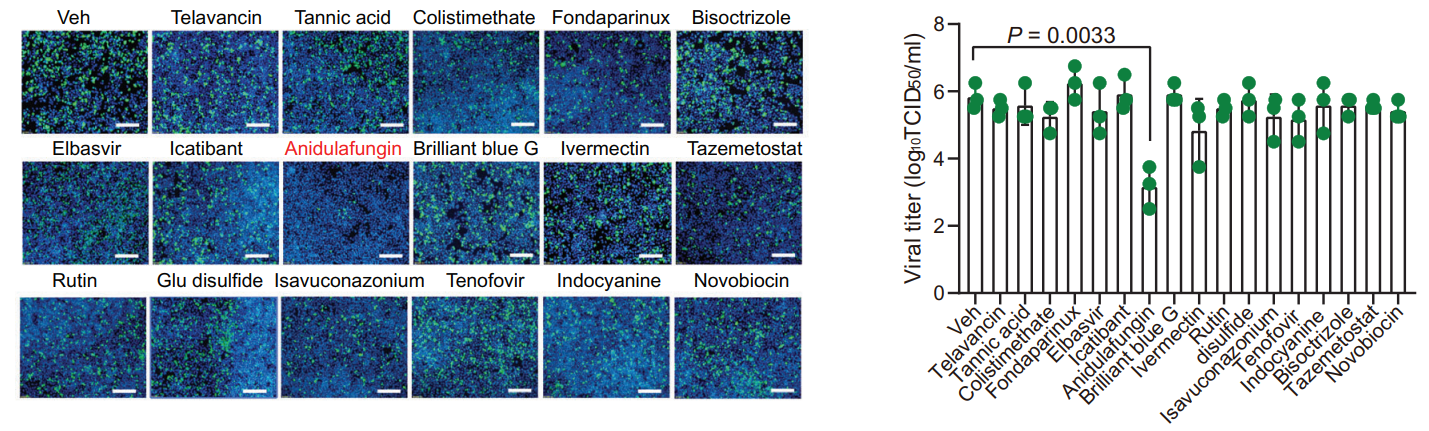
Anidulafungin (40 µM; 6 h) markedly inhibited PR8 virus replication in A549 cells.
Anidulafungin purchased from MedChemExpress. Usage Cited in: Adv Sci (Weinh). 2022 Dec;9(34):e2203088. [Abstract]
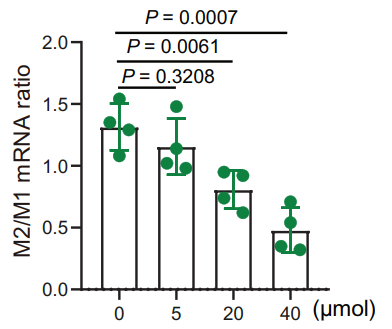
Anidulafungin (5-40 μM) significantly reduced the ratio of M2/M1 RNA during PR8 virus infection of A549 cells in a dose-dependent manner.
Anidulafungin purchased from MedChemExpress. Usage Cited in: Adv Sci (Weinh). 2022 Dec;9(34):e2203088. [Abstract]
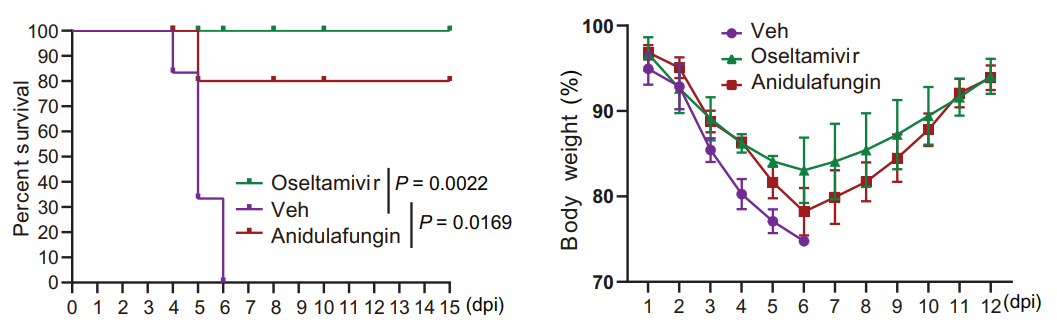
Anidulafungin (20 mg/kg; p.o.; 12 d) prolonged survival of BALB/c mice infected with PR8 virus, with 80% of mice gaining body weight from day 6 of infection.
Anidulafungin purchased from MedChemExpress. Usage Cited in: Adv Sci (Weinh). 2022 Dec;9(34):e2203088. [Abstract]
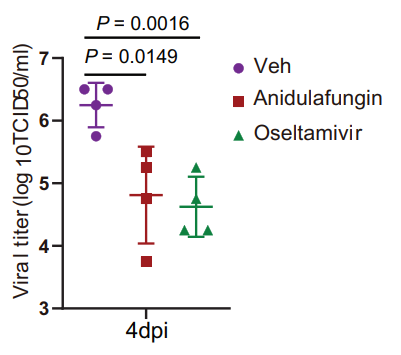
Anidulafungin (20 mg/kg; p.o.; 6 d) significantly decreased infectious progeny from lung tissues of BALB/c mice infected with PR8 virus.
Anidulafungin purchased from MedChemExpress. Usage Cited in: Adv Sci (Weinh). 2022 Dec;9(34):e2203088. [Abstract]
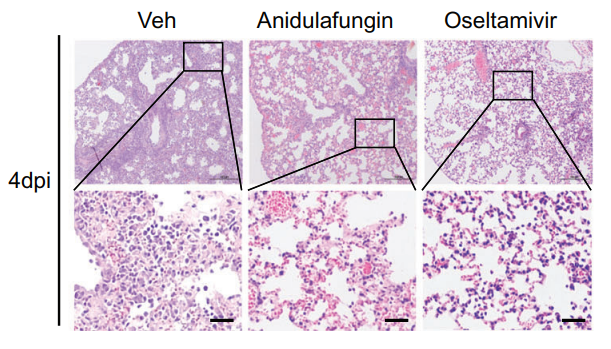
Anidulafungin (20 mg/kg; p.o.; 6 d) alleviated severe lung pathology in BALB/c mice infected with PR8 virus.
-
J Clin Microbiol
Antifungal Susceptibility Testing of Malassezia spp. with an Optimized Colorimetric Broth Microdilution Method. [Abstract]2017 Jun;55(6):1883-1893. PMID: 28381607 -
J Fungi (Basel)
In Vitro Activitiy of Rezafungin in Comparison with Anidulafungin and Caspofungin against Invasive Fungal Isolates (2017 to 2022) in China. [Abstract]2024 May 31;10(6):397. PMID: 38921383 -
mSphere
Triazole Evolution of Candida parapsilosis Results in Cross-Resistance to Other Antifungal Drugs, Influences Stress Responses, and Alters Virulence in an Antifungal Drug-Dependent Manner. [Abstract]2020 Oct 28;5(5):e00821-20. PMID: 33115837 -
mSphere
Echinocandin-Induced Microevolution of Candida parapsilosis Influences Virulence and Abiotic Stress Tolerance. [Abstract]2018 Nov 14;3(6):e00547-18. PMID: 30429225 -
Mycoses
Antifungal susceptibility testing of dermatophytes: Development and evaluation of an optimised broth microdilution method. [Abstract]2021 Mar;64(3):282-291. PMID: 33084127


Solvent & Solubility
In Vitro:
DMSO : ≥ 100 mg/mL (87.70 mM; Hygroscopic DMSO has a significant impact on the solubility of product, please use newly opened DMSO)
* "≥" means soluble, but saturation unknown.
Please refer to the solubility information to select the appropriate solvent. Once prepared, please aliquot and store the solution to prevent product inactivation from repeated freeze-thaw cycles.
Storage method and period of stock solution: -80°C, 1 year; -20°C, 6 months. When stored at -80°C, please use it within 1 year. When stored at -20°C, please use it within 6 months.
Please refer to the solubility information to select the appropriate solvent. Once prepared, please aliquot and store the solution to prevent product inactivation from repeated freeze-thaw cycles.
Storage method and period of stock solution: -80°C, 1 year; -20°C, 6 months. When stored at -80°C, please use it within 1 year. When stored at -20°C, please use it within 6 months.
Concentration (start) × Volume (start) = Concentration (final) × Volume (final)
In Vivo:
Select the appropriate dissolution method based on your experimental animal and administration route.
- For the following dissolution methods, please ensure to first prepare a clear stock solution using an In Vitro approach and then sequentially add co-solvents:
- To ensure reliable experimental results, the clarified stock solution can be appropriately stored based on storage conditions. As for the working solution for In Vivo experiments, it is recommended to prepare freshly and use it on the same day.
- The percentages shown for the solvents indicate their volumetric ratio in the final prepared solution. If precipitation or phase separation occurs during preparation, heat and/or sonication can be used to aid dissolution.
In Vivo Dissolution Calculator
Please enter the basic information of animal experiments:
-
-
-
-
Recommended: Prepare an additional quantity of animals to account for potential losses during experiments.
Please enter your animal formula composition:
-
%DMSO +
Recommended: Keep the proportion of DMSO in working solution below 2% if your animal is weak.
-
%+
-
+%Tween-80 + +
-
%Saline +
The co-solvents required include: DMSO, . All of co-solvents are available by MedChemExpress (MCE). , Tween 80. All of co-solvents are available by MedChemExpress (MCE).
Working solution concentration: 0.22 mg/mL
Method for preparing stock solution: mg drug dissolved in μL DMSO. Stock solution concentration: mg/mL.
1. Take μL DMSO stock solution;
2. Add μL .
μL , mix evenly;
3. Then add μL Tween 80, mix evenly;
4. Then add μL
Please ensure that the stock solution in the first step is dissolved to a clear state, and add co-solvents in sequence. You can use ultrasonic heating (ultrasonic cleaner, recommended frequency 20-40 kHz), vortexing, etc. to assist dissolution.


Purity & Documentation
-
Data Sheet (280 KB)
-
SDS (396 KB)
- English - EN (396 KB)
- Français - FR (396 KB)
- Deutsch - DE (396 KB)
- Norwegian - NO (396 KB)
- Español - ES (396 KB)
- Swedish - SV (396 KB)
- Italian - IT (396 KB)
- Korean - KR (396 KB)
- Portuguese - PT (396 KB)
-
Handling Instructions (2659 KB)
References
[1]. Zhanel GG, et al. In vitro activity of a new semisynthetic echinocandin, LY-303366, against systemic isolates of Candida species, Cryptococcus neoformans, Blastomyces dermatitidis, and Aspergillus species. Antimicrob Agents Chemother. 1997 Apr;41(4):863-5 [Content Brief]
[2]. Locke JB, et al. Characterization of In Vitro Resistance Development to the Novel Echinocandin CD101 in Candida Species. Antimicrob Agents Chemother. 2016 Sep 23;60(10):6100-7. [Content Brief]


Complete Stock Solution Preparation Table
Please refer to the solubility information to select the appropriate solvent. Once prepared, please aliquot and store the solution to prevent product inactivation from repeated freeze-thaw cycles.
Storage method and period of stock solution: -80°C, 1 year; -20°C, 6 months. When stored at -80°C, please use it within 1 year. When stored at -20°C, please use it within 6 months.
| Optional Solvent | Concentration Solvent Mass | 1 mg | 5 mg | 10 mg | 25 mg |
|---|---|---|---|---|---|
| DMSO | 1 mM | 0.8770 mL | 4.3850 mL | 8.7701 mL | 21.9252 mL |
| 5 mM | 0.1754 mL | 0.8770 mL | 1.7540 mL | 4.3850 mL | |
| 10 mM | 0.0877 mL | 0.4385 mL | 0.8770 mL | 2.1925 mL | |
| 15 mM | 0.0585 mL | 0.2923 mL | 0.5847 mL | 1.4617 mL | |
| 20 mM | 0.0439 mL | 0.2193 mL | 0.4385 mL | 1.0963 mL | |
| 25 mM | 0.0351 mL | 0.1754 mL | 0.3508 mL | 0.8770 mL | |
| 30 mM | 0.0292 mL | 0.1462 mL | 0.2923 mL | 0.7308 mL | |
| 40 mM | 0.0219 mL | 0.1096 mL | 0.2193 mL | 0.5481 mL | |
| 50 mM | 0.0175 mL | 0.0877 mL | 0.1754 mL | 0.4385 mL | |
| 60 mM | 0.0146 mL | 0.0731 mL | 0.1462 mL | 0.3654 mL | |
| 80 mM | 0.0110 mL | 0.0548 mL | 0.1096 mL | 0.2741 mL |


Anidulafungin Related Classifications
HY-13553 Related Classifications
 Powered by Bioz