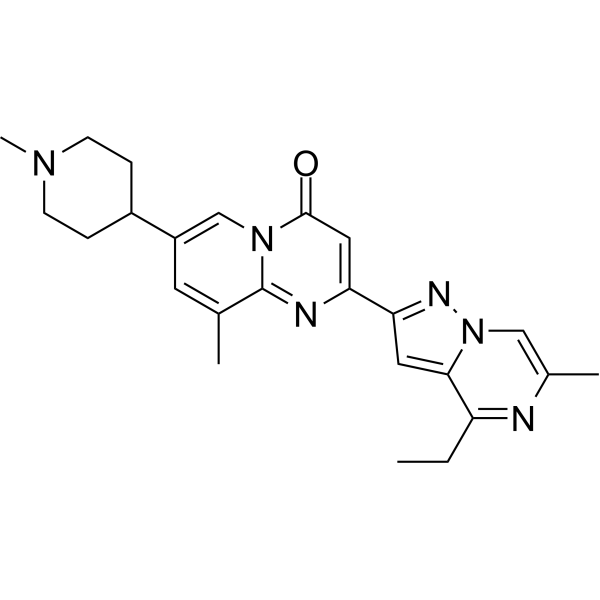
Others
-
Others Related Products (76524)
Related Products (76524)


-
NICE-01
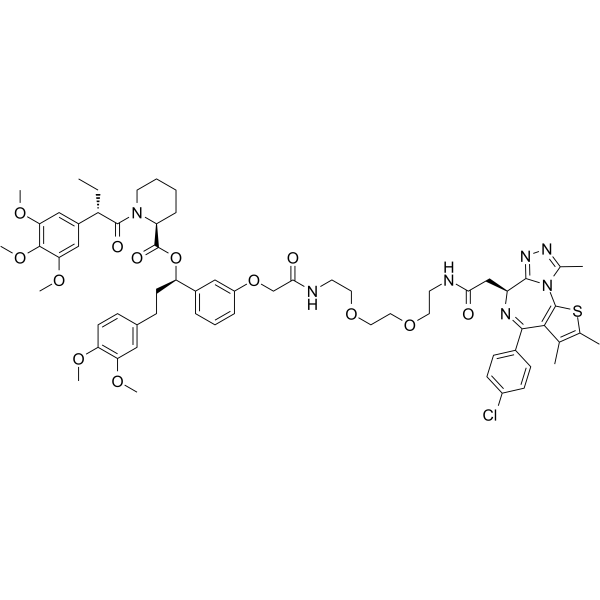 0 ImagesSynonyms: AP1867-PEG2-JQ1; AP-PEG2-JQ1
NICE-01 (AP1867-PEG2-JQ1; AP-PEG2-JQ1) is a bifunctional compound that bind to proteins in separate cellular compartments that can induce nuclear import of cytosolic cargoes, using nuclear-localized bromodomain-containing protein 4 (BRD4) as a “carrier” for co-import and nuclear trapping of cytosolic proteins.
-
BCIP
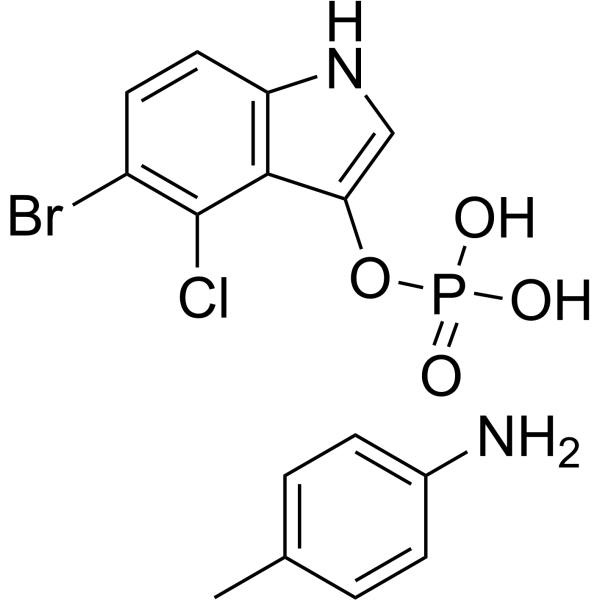 0 ImagesSynonyms: BCIP p-toluidine salt; X-phosphate p-toluidine salt
BCIP(BCIP p-toluidine salt; X-phosphate p-toluidine salt) is an artificial chromogenic substrate used for the sensitive colorimetric detection of alkaline phosphatase activity.
-
Cholesteryl-Teg azide
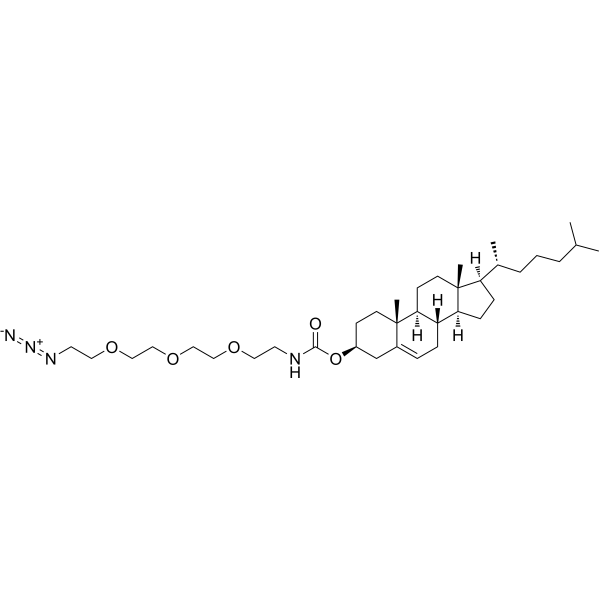 0 Images
Cholesteryl-Teg azide is a cholesterol azide and can be used as a ligand for bioconjugation. Cholesteryl-Teg azide can modify RNA strands.
-
1-(3-Methoxyphenyl)ethanamine
 0 ImagesCat. No.: HY-20143CAS No.: 62409-13-6Synonyms: Iflab-bb f2169-0860
1-(3-Methoxyphenyl)ethanamine (Iflab-bb f2169-0860) is a drug intermediate for synthesis of various active compounds.
-
(1S,5S)-3-Oxabicyclo[3.1.0]hexan-1-amine hydrochloride
![(1S,5S)-3-Oxabicyclo[3.1.0]hexan-1-amine hydrochloride](https://file.medchemexpress.com/product_pic/hy-401703.gif "Click to View (1S,5S)-3-Oxabicyclo[3.1.0]hexan-1-amine hydrochloride Product Detail") 0 Images
0 Images(1S,5S)-3-Oxabicyclo[3.1.0]hexan-1-amine hydrochloride is a drug intermediate for synthesis of various active compounds.
-
2-Acetylamino-3-(2-quinolon-4-yl)propionic acid
 0 ImagesCat. No.: HY-41638CAS No.: 681806-75-7
2-Acetylamino-3-(2-quinolon-4-yl)propionic acid is a drug intermediate for synthesis of various active compounds.
-
(S)-5-(tert-Butoxy)-4-(18-(tert-butoxy)-18-oxooctadecanamido)-5-oxopentanoic acid
 0 Images
(S)-5-(tert-Butoxy)-4-(18-(tert-butoxy)-18-oxooctadecanamido)-5-oxopentanoic acid is a pharmaceutical intermediate that can be used to synthesize the key intermediate of the smegglutinin side chain.
-
1-(Cyclopropylcarbonyl)piperazine hydrochloride
 0 Images
1-(Cyclopropylcarbonyl)piperazine hydrochloride is a drug intermediate for synthesis of various active compounds.
-
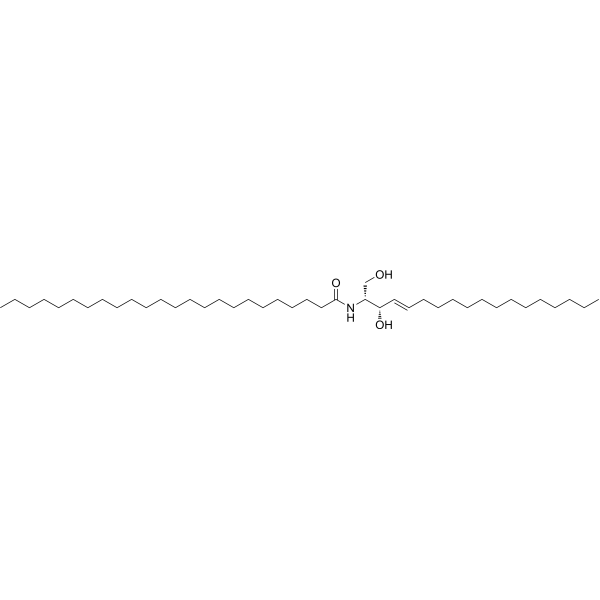
C24-Ceramide (d18:1/24:0)
 0 Images
C24-Ceramide (d18:1/24:0) is a sphingolipid that can be used for the lipid membranes composed. C24-Ceramide (d18:1/24:0) induces time-dependent changes in membrane properties. C24-Ceramide (d18:1/24:0) induces membrane reorganization.
-
Karrikin 2
 0 Images
Karrikin 2 is a seed germination stimulant identified in smoke produced by plant combustion. Karrikins induce seed germination in Arabidopsis thaliana, lettuce, E. penduliflora and S. orbiculatum. Karrikin 2 upregulates the expression of gibberellin (GA) biosynthesis genes GA3ox1, GA3ox2 and the gibberellin GA4-responsive gene CP1 in Arabidopsis thaliana seeds.
-
Cholesterol-PEG2000-MAL
 0 ImagesCat. No.: HY-W440719
Cholesterol-PEG2000-MAL is a PEG derivative and can be used to prepare liposome or nanoparticle due to its ability to self-assemble in water. The maleimide moiety is reactive with thiol molecule to form a covalent thioether bond.
-
Sodium dodecanoate, 99-100%
 0 ImagesSynonyms: Lauric acid sodium salt, 99-100%
Sodium LaurateIt is an organic compound belonging to fatty acids. It is the sodium salt of lauric acid, a medium-chain saturated fatty acid found in various animal and vegetable fats. Sodium LaurateCommonly used as surfactants, emulsifiers and cleaning agents in various industries such as cosmetics, personal care and detergent industries. It's found in a variety of products, including soaps, shampoos, toothpaste, and laundry detergent. Furthermore, it also has applications in the food industry where it is used as a food additive to improve texture and stability.
-
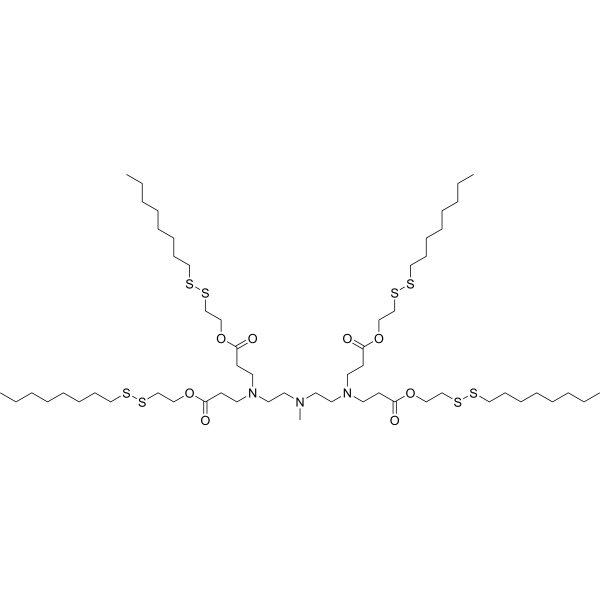
113-O12B
 0 Images
113-O12B is a disulfide bond-containing ionizable cationic lipidoid. 113-O12B can be used in that generation of lipid nanoparticles (LNPs) for the delivery of mRNA.
-
Fmoc-L-Lys[Oct-(OtBu)-Glu-(OtBu)-AEEA-AEEA]-OH
![Fmoc-L-Lys[Oct-(OtBu)-Glu-(OtBu)-AEEA-AEEA]-OH](https://file.medchemexpress.com/product_pic/hy-w615153.gif "Click to View Fmoc-L-Lys[Oct-(OtBu)-Glu-(OtBu)-AEEA-AEEA]-OH Product Detail") 0 Images
0 ImagesFmoc-L-Lys[Oct-(OtBu)-Glu-(OtBu)-AEEA-AEEA]-OH is an L-Lys (an amino acid) derivative. Fmoc protects amino acids, ensuring their accurate peptide synthesis.
-
2-(Benzyloxy)-1-ethanamine
 0 ImagesSynonyms: 2-(Benzyloxy)ethylamine
2-(Benzyloxy)-1-ethanamine (2-(Benzyloxy) ethylamine) is a biochemical reagent that can be used as a biological material or organic compound for life science-related research.
-
Silver sulfate
 0 ImagesSynonyms: Disilver sulfate, 99%
Silver sulfate acts as an ethylene inhibitor and a shoot regeneration promoter. Silver sulfate promotes shoot proliferation in explants of the cherry rootstock CAB-6P. Silver sulfate is applicable to studies on the optimization of micropropagation for cherry rootstocks.
-
6-Bromo-1-methyl-1H-benzo[d]imidazol-2(3H)-one
![6-Bromo-1-methyl-1H-benzo[d]imidazol-2(3H)-one](https://file.medchemexpress.com/product_pic/hy-w067159.gif "Click to View 6-Bromo-1-methyl-1H-benzo[d]imidazol-2(3H)-one Product Detail") 0 Images
0 Images6-Bromo-1-methyl-1H-benzo[d]imidazol-2(3H)-one is an organic compound that can be used as a catalyst and ligand in organic synthesis. 6-Bromo-1-methyl-1H-benzo[d]imidazol-2(3H)-one is a versatile small molecule scaffold.
-
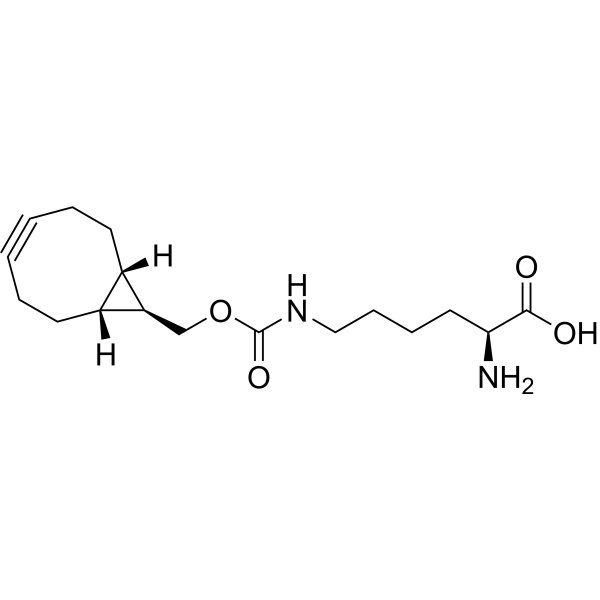
exo-BCN-L-Lysine
 0 ImagesCat. No.: HY-W754588CAS No.: 1384100-45-1