



PhosTACs
Phosphatase-Targeting Chimeric Molecules
Protein phosphorylation, which regulates many critical aspects of cell biology, is dynamically governed by kinases and phosphatases. Many diseases are associated with dysregulated hyperphosphorylation of critical proteins, such as retinoblastoma protein in cancer. Although kinase inhibitors have been widely applied in the clinic, growing evidence of off-target effects and increasing drug resistance prompts the need to develop a new generation of drugs. Here, we propose a proof-of-concept study of phosphorylation targeting chimeras (PhosTACs). Similar to PROTACs in their ability to induce ternary complexes, PhosTACs focus on recruiting a Ser/Thr phosphatase to a phosphosubstrate to mediate its dephosphorylation. However, distinct from PROTACs, PhosTACs can uniquely provide target gain-of-function opportunities to manipulate protein activity.
PhosTACs (Phosphatase-Targeting Chimeric Molecules) is a new approach different than non-discriminatorily activating phosphatase activity to effect widespread substrate dephosphorylation. PhosTACs uses heterobifunctional molecules to mediate complex formation between a phosphatase and a targeted phosphoprotein to affect focused, targeted dephosphorylation of the latter. This is an adaptation of our PROTAC technology, wherein bifunctional small molecules alter target protein ubiquitination to induce degradation[1][2].
PhosTACs (Phosphatase-Targeting Chimeric Molecules) is a new approach different than non-discriminatorily activating phosphatase activity to effect widespread substrate dephosphorylation. PhosTACs uses heterobifunctional molecules to mediate complex formation between a phosphatase and a targeted phosphoprotein to affect focused, targeted dephosphorylation of the latter. This is an adaptation of our PROTAC technology, wherein bifunctional small molecules alter target protein ubiquitination to induce degradation[1][2].
References:
- [1]. Hu Z, et, al. Targeted Dephosphorylation of Tau by Phosphorylation Targeting Chimeras (PhosTACs) as a Therapeutic Modality. J Am Chem Soc. 2023 Feb 8:10.1021/jacs.2c11706. [Content Brief]
- [2]. Hu Z, et, al. EGFR targeting PhosTACs as a dual inhibitory approach reveals differential downstream signaling. Sci Adv. 2024 Mar 29;10(13):eadj7251. [Content Brief]
- [3]. Chen PH, et, al. Modulation of Phosphoprotein Activity by Phosphorylation Targeting Chimeras (PhosTACs). ACS Chem Biol. 2021 Dec 17;16(12):2808-2815. [Content Brief]
-
PhosTACs 관련 제품 (7)
관련 제품 (7)

-
PhosTAC7
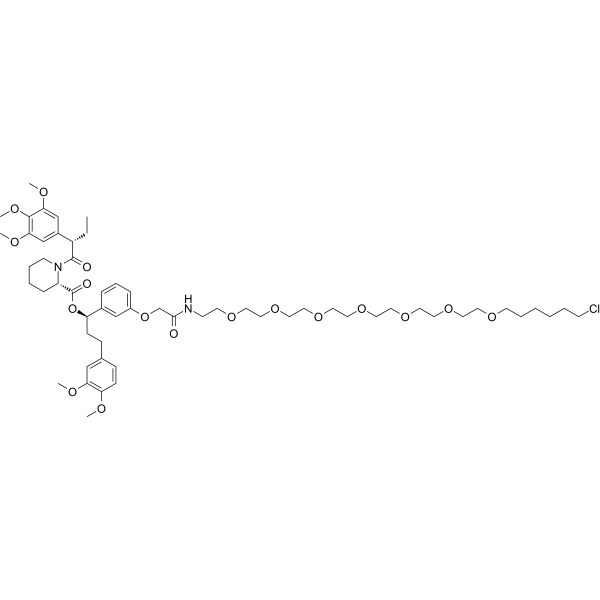 0 ImagesSynonyms: OGTAC-3PhosTAC7 is a heterobifunctional molecule named as a Phosphorylation Targeting Chimera (PhosTAC). PhosTAC7 can dephosphorylate the PDCD4 protein, FOXO3a protein, and tau protein by recruiting serine/threonine protein phosphatase 2A (PP2A). PhosTAC7 offers the advantage of selectively modulating the phosphorylation state of individual target proteins, making it a promising tool for research in cancer and tau protein-related neurodegenerative diseases (Alzheimer's disease).
-
PhosTAC5
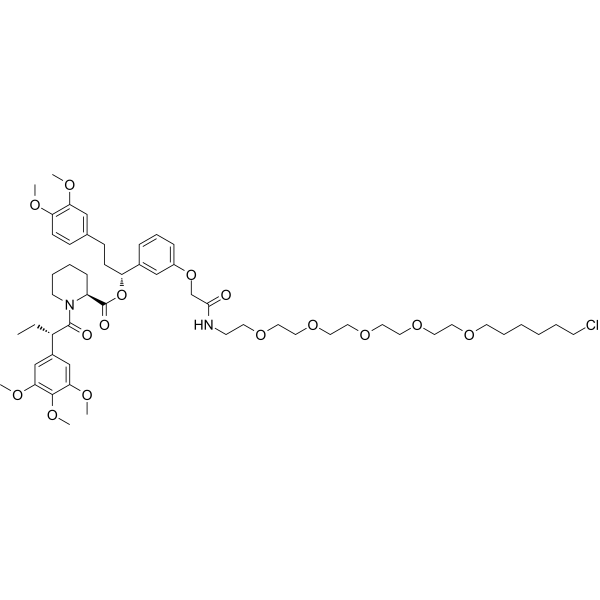 0 ImagesPhosTAC5 is a phosphorylation targeting chimera (PhosTAC) molecule composed of a linker with fivePEG groups. PhosTAC5 induces dephosphorylation of PDCD4 and FOXO3a.
-
iGePhos1
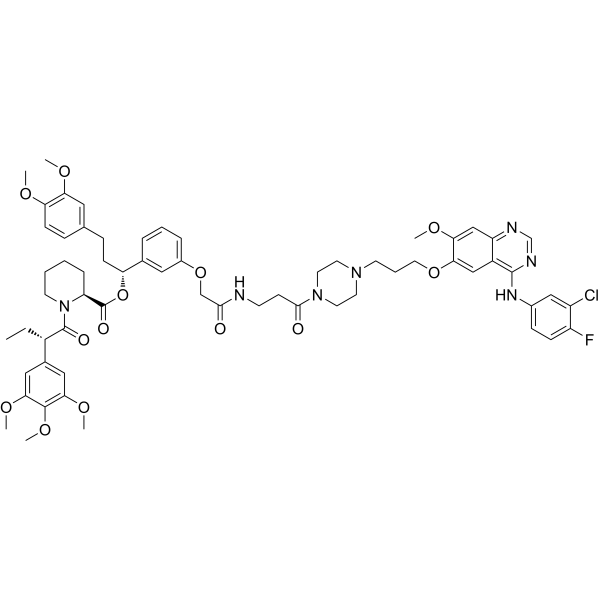
 0 ImagesCat. No.: HY-161408APurity: 98.54%iGePhos1 is an inactive GePhos1 (HY-161408) epimer used as a nonbinding negative control. iGephos1 lacks the phosphatase recruiting possibility.
-
iAfaPhos1
 0 ImagesCat. No.: HY-176938APurity: 98.27%iAfaPhos1 is a FKBP12F36V epimer ligand. iAfaPhos1 leads to reduced dephosphorylation of EGFR at pY1068 and pY845 sites. iAfaPhos1 has anticancer activity against non-small cell lung cancer.
-
AfaPhos1
 0 ImagesCat. No.: HY-176938AfaPhos1 is a new, Afatinib (HY-10261)-based EGFR PhosTAC. AfaPhos1 induces EGFR dephosphorylation at both pY1068 and pY845. AfaPhos1 induces Apoptosis. AfaPhos1 has anticancer activity against non-small cell lung cancer.



