



Flavivirus
Flavivirus
Flavivirus is a group of single-stranded positive-sense RNA viruses that are mainly transmitted by arthropods such as mosquitoes and ticks. The viral particles of the Flavivirus are spherical, with a diameter of approximately 40-60 nanometers and have an envelope. The envelope is embedded with spike glycoproteins, which play a crucial role in the recognition and binding process between the virus and host cells. Flavivirus contains a variety of viruses, such as the yellow fever virus and the dengue virus, etc., which can cause a variety of serious diseases and have a significant impact on global public health security[1].
All Product Categories
-
Flavivirus Related Products (194)
Related Products (194)

-
Antibodies (1)
-
NS2B/NS3-IN-3 dihydrochloride
 0 ImagesCat. No.: HY-144644BPurity: 99.26%NS2B/NS3-IN-3 dihydrochloride is an inhibitor of Flavivirus NS2B-NS3 protease, with an IC50 of 0.32 μM against Zika virus NS2B-NS3 protease. NS2B/NS3-IN-3 dihydrochloride also exhibits inhibitory effects on dengue virus type 2 NS2B-NS3 protease and West Nile virus NS2B-NS3 protease. NS2B/NS3-IN-3 dihydrochloride inhibits the intracellular replication of Zika virus. NS2B/NS3-IN-3 dihydrochloride can be used in studies related to flavivirus infections.
-
CHIKV-IN-4
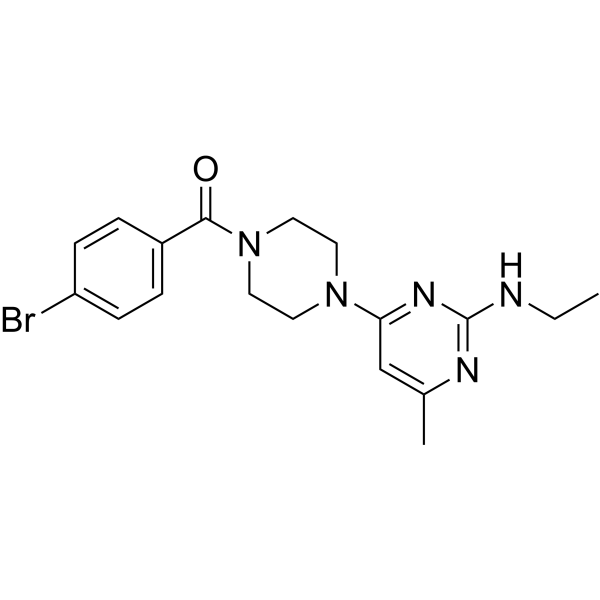 0 ImagesCat. No.: HY-163088CAS No.: 1269363-88-3CHIKV-IN-4 (compound 31b) is a potent and selective CHIKV inhibitor. CHIKV-IN-4 inhibits the Chikungunya virus with the EC50 value of 0.6 μM.
-
Loratadine-13C6
 0 ImagesCat. No.: HY-17043S3Synonyms: SCH 29851-13C6Loratadine-13C6 (SCH 29851-13C6) is 13C labeled Loratadine. Loratadine (SCH-29851) is a selective inverse peripheral histamine H1-receptor agonist with an IC50 of >32 μM. Loratadine has anti-dengue-virus (DENV) activity. Loratadine can inhibit immunologic release of inflammatory mediators.
-
JNJ-2594
 0 ImagesCat. No.: HY-187508JNJ-2594 is an inhibitor of dengue virus (DENV) NS5 RNA-dependent RNA polymerase (RdRP). JNJ-2594 inhibits the elongation activity of DENV2 and DENV3 NS5 polymerases with IC50 values of 5.8 μM and 3.2 μM, respectively, and inhibits de novo RNA synthesis of DENV2 with an IC50 of 23.5 μM. JNJ-2594 exhibits cross-inhibitory effects on human mitochondrial RNA polymerase. JNJ-2594 can be used in research on the discovery of dengue virus NS5 polymerase and DENV RdRP inhibitors.
-
D4-Ribavirin
 0 ImagesCat. No.: HY-124224CAS No.: 131922-28-6D4-Ribavirin (Compound 4) is a deoxygenated ribavirin analogue. D4-Ribavirin has antiviral property in vitro against the RNA-containing bunyaviruses–Rift Valley Fever () with an IC50 of 61 μg/mL.
-
IRBM-Z-2
 0 ImagesCat. No.: HY-181991CAS No.: 3014840-61-7IRBM-Z-2 is a non-competitive, orally active Zika virus (ZIKV) NS2B-NS3 protease inhibitor, with IC50 values of 0.04 μM and 3.1 μM against the wild-type and I156T mutant strains, respectively. IRBM-Z-2 exhibits broad-spectrum anti-flavivirus potential, with IC50 values of 2.1 μM and 0.09 μM against the NS2B-NS3 proteases of dengue virus 2 (DENV2) and West Nile virus (WNV), respectively. IRBM-Z-1 inhibits ZIKV replication and alleviates virus-induced cytopathic effects. IRBM-Z-1 can be used in studies related to ZIKV infection.
-
ZX-2401
 0 ImagesCat. No.: HY-131379CAS No.: 67410-65-5ZX-2401 (Compound 98a) is a 1,3,5-Triazine-based analogue of Purine (HY-34431). ZX-2401 has a significant antiviral activity against viruses of the Flaviviridae family, such as West Nile Virus (WNV), Hepatitis C (HCV), Yellow Fever Virus (YFV), Dengue Virus (DV), Bovine Viral Diarrhea Virus (BVDV) and Banzi Virus (BV) with EC90s of 0.6-10 μg/mL. ZX-2401 significantly reduces virus production with an EC90 of 3.3 mg/mL. ZX-2401 can be used for influenza infections research.
-
Anti-Zika virus E protein DIII-LR Antibody (ZV-67)
 0 ImagesCat. No.: HY-P991770Anti-Zika virus E protein DIII-LR Antibody (ZV-67) reacts with Zika virus envelope (E) protein at the lateral ridge of domain III (DIII-LR). Anti-Zika virus E protein DIII-LR Antibody (ZV-67) specifically detects the recombinant ZIKV E protein DIII and ZIKV E protein reporter virus particles (RVPs) in transfected cells. Recommend Isotype Controls: Mouse IgG2c kappa, Isotype Control (HY-P99981).
-
U18666A (Standard)
 0 ImagesU18666A (Standard) is the analytical standard of U18666A (HY-107433). This product is intended for research and analytical applications. U18666A, an intra-cellular cholesterol transport inhibitor, inhibits replication of Ebola virus, dengue virus, and human hepatitis C virus.
-
DDABT1
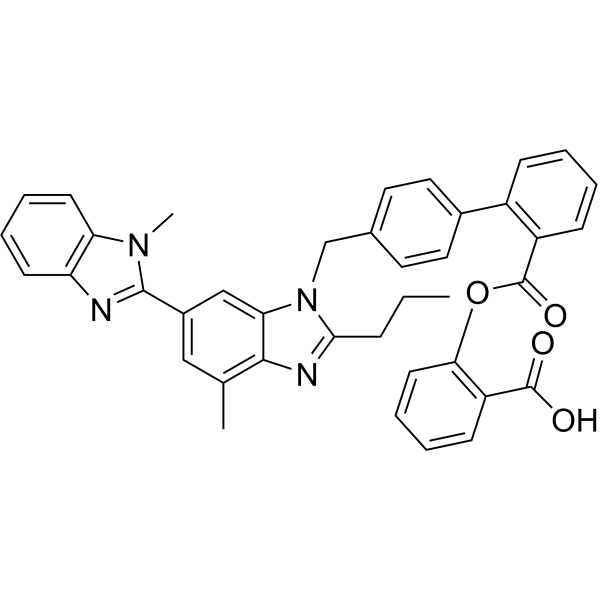 0 ImagesCat. No.: HY-163132CAS No.: 2777045-35-7DDABT1 has anti-CHIKV activity (IC50 of 14.53 μM) and the ability to reduce inflammation and arthritis.
-
DENV-IN-14
 0 ImagesCat. No.: HY-178994DENV-IN-14 (Compound 3c) is a thiazole hydrazone derivative with anti-dengue virus (DENV) activity with an EC50 of 0.01 μM and the selectivity index (SI) of 200. DENV-IN-14 exhibits rapid plasma clearance and its metabolic stability is limited. DENV-IN-14 can be used for research on dengue fever.
-
Emricasan (Standard)
 0 ImagesSynonyms: PF 03491390 (Standard); IDN-6556 (Standard)Emricasan (Standard) is the analytical standard of Emricasan. This product is intended for research and analytical applications. Emricasan (PF 03491390) is an orally active and irreversible pan-caspase inhibitor. Emricasan inhibits Zika virus (ZIKV)-induced increases in caspase-3 activity and protected human cortical neural progenitors.
-
Golgicide A-2 (Standard)
 0 ImagesCat. No.: HY-100540BRCAS No.: 1394285-50-7Synonyms: GCA-2 (Standard)Golgicide A-2 (Standard) is the analytical standard of Golgicide A-2 (HY-100540B). This product is intended for research and analytical applications. Golgicide A-2 (GCA-2), a Golgicide A (GCA) derivative, is the most active enantiomer of GCA. Golgicide A-2 displays high selectivity and efficiency in killing An. stephensi larvae and can be used for the research of dengue virus related diseases.
-
Amustaline
 0 ImagesCat. No.: HY-106991CAS No.: 878189-87-8Synonyms: S-303Amustaline (S-303) is a compound used for inactivating pathogens in blood components and belongs to the category of nucleic acid-targeted chemical decontaminants. Amustaline has the ability to inactivate viruses and is effective against mosquito-borne viruses such as Chikungunya virus (CHIKV), Dengue virus (DENV), and Zika virus (ZIKV). When combined with glutathione (Glutathione, GSH), which acts as a neutralizer to counteract adverse reactions, Amustaline ensures the stability of red blood cell membranes. Amustaline is mainly used for inactivating pathogens in red blood cell concentrates (RBCC) to reduce the risk of transfusion-transmitted infections (TTI).




