



Flavivirus
Flavivirus
Flavivirus is a group of single-stranded positive-sense RNA viruses that are mainly transmitted by arthropods such as mosquitoes and ticks. The viral particles of the Flavivirus are spherical, with a diameter of approximately 40-60 nanometers and have an envelope. The envelope is embedded with spike glycoproteins, which play a crucial role in the recognition and binding process between the virus and host cells. Flavivirus contains a variety of viruses, such as the yellow fever virus and the dengue virus, etc., which can cause a variety of serious diseases and have a significant impact on global public health security[1].
All Product Categories
-
Flavivirus Related Products (194)
Related Products (194)

-
Antibodies (1)
-
Quinine hydrochloride dihydrate (Standard)
 0 ImagesCat. No.: HY-B0433ARCAS No.: 6119-47-7Quinine (hydrochloride dihydrate) (Standard) is the analytical standard of Quinine (hydrochloride dihydrate). This product is intended for research and analytical applications. Quinine hydrochloride dihydrate (Qualaquin) is an orally active and can be used in anti-malarial studies. Quinine hydrochloride dihydrate is a potassium channel inhibitor that inhibits WT mouse Slo3 (KCa5.1) channel currents evoked by voltage pulses to +100?mV with an IC50 of 169 μM.
-
(Rac)-Modipafant (Standard)
 0 ImagesCat. No.: HY-108908RCAS No.: 122956-68-7Synonyms: UK-74505 (Standard)(Rac)-Modipafant (Standard) is the analytical standard of (Rac)-Modipafant (HY-108908). This product is intended for research and analytical applications. (Rac)-Modipafant (UK-74505) is an orally active, selective, long-acting irreversible platelet activating factor receptor (PAFR) antagonist. (Rac)-Modipafant prevents dengue infection.
-
HeE1-2Tyr (Standard)
 0 ImagesCat. No.: HY-100749RCAS No.: 2245195-67-7HeE1-2Tyr (Standard) is the analytical standard of HeE1-2Tyr (HY-100749). This product is intended for research and analytical applications. HeE1-2Tyr, a pyridobenzothiazole compound, is a flavivirus RNA dependent RNA polymerases (RdRp) inhibitor. HeE1-2Tyr significantly inhibits West Nile, Dengue and SARS-CoV-2 RdRps (IC50 of 27.6 μM) activity in vitro.
-
Loratadine-d4-1
 0 ImagesCat. No.: HY-17043S2CAS No.: 2748435-73-4Synonyms: Loratidine-d4-1; SCH 29851-d4-1Loratadine-d4-1 (Loratidine-d4-1) is deuterium labeled Loratadine. Loratadine (SCH-29851) is a selective inverse peripheral histamine H1-receptor agonist with an IC50 of >32 μM. Loratadine has anti-dengue-virus (DENV) activity. Loratadine can inhibit immunologic release of inflammatory mediators.
-
NS2B/NS3-IN-9
 0 ImagesCat. No.: HY-179013CAS No.: 812683-94-6NS2B/NS3-IN-9 (Compound 73) is a broad-spectrum, non-competitive anti-Orthoflavivirus lipopeptide inhibitor targeting the NS2B-NS3 protease. NS2B/NS3-IN-9 exhibits IC50 values for Dengue virus DENV2 NS2B-NS3, West Nile virus WNV NS2B-NS3, and Zika virus ZIKV NS2B-NS3 of 2.4, 7.2, and 1.9 μM, respectively. NS2B/NS3-IN-9 also exhibits antiviral activity at the cellular level against DENV2, WNV, and ZIKV, with EC50 values of 4.1, 4.9, and 5.0 μM, respectively. NS2B/NS3-IN-9 has no significant toxicity to cells. NS2B/NS3-IN-9 can be used for the study of anti-Orthoflavivirus.
-
SGC-NSP2hel-1
 0 ImagesCat. No.: HY-176268Synonyms: RA-0188293; RA-NSP2-1SGC-NSP2hel-1 (RA-0188293), a chemical probe, is a potent, specific and orally active nsP2 inhibitor. SGC-NSP2hel-1 has broad spectrum activity against multiple alphaviruses of the nsP2 helicase with a CC50 > 250 μM. SGC-NSP2hel-1 (RA-0188293) shows selectivity index > 4000 against human RNA helicases. SGC-NSP2hel-1 reduces virus replication and limited virus-induced pathology by forming a stable complex with nsP2 and ATP in a preclinical small animal model of CHIKV disease.
-
Galidesivir dihydrochloride
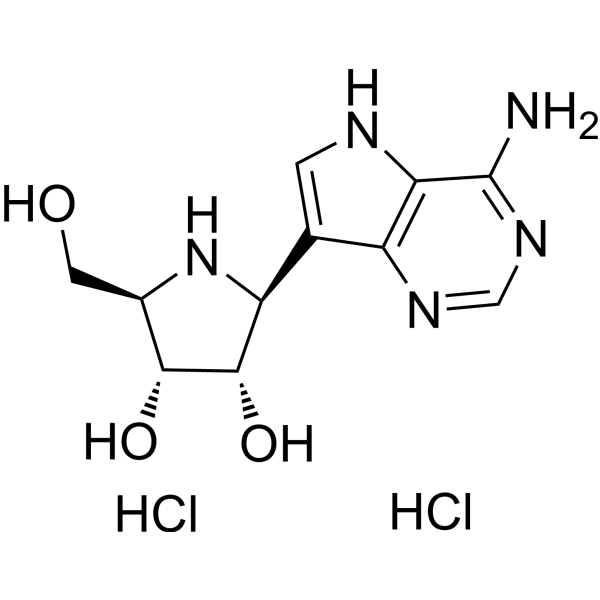 0 ImagesCat. No.: HY-18649BCAS No.: 1373208-51-5Synonyms: BCX4430 dihydrochloride; Immucillin-A dihydrochlorideGalidesivir (BCX4430; Immucillin-A) dihydrochloride is a broad-spectrum RNA virus inhibitor that can inhibit Ebola and yellow fever virus (Flavivirus) infections. Galidesivir has potent antiviral activity against tick-borne encephalitis virus (TBEV) and also inhibits the proliferation of many other medically important flaviviruses.
-
Palonosetron hydrochloride (Standard)
 0 ImagesPalonosetron hydrochloride (Standard) is the analytical standard of Palonosetron hydrochloride (HY-A0021). This product is intended for research and analytical applications. Palonosetron hydrochloride is a 5-HT3 antagonist primarily used to prevent acute, delayed, and overall chemotherapy-induced nausea and vomiting. In addition, Palonosetron hydrochloride exhibits moderate anti-flavivirus activity and potent anti-Zika virus activity in mammalian cells. Palonosetron hydrochloride also possesses antidepressant activity.
-
CN-716 dihydrochloride
 0 ImagesCat. No.: HY-156052CAS No.: 2077164-48-6CN-716 dihydrochloride is a reversible covalent flavivirus NS2B·NS3 protease inhibitor with antiviral activity. CN-716 dihydrochloride effectively inhibits the replication of dengue virus (DENV2), West Nile virus (WNV) and Zika virus (ZIKV). The IC50 values of CN-716 dihydrochloride against the proteases of the above three viruses are 0.066 μM, 0.11 μM and 0.25 μM, respectively, while the Ki values against the same proteases are 0.051 μM, 0.082 μM and 0.04 μM, respectively. CN-716 dihydrochloride can be used to study the infection mechanisms of dengue fever, West Nile fever and Zika virus infection.
-
ML-SA1 (Standard)
 0 ImagesCat. No.: HY-108462RCAS No.: 332382-54-4ML-SA1 (Standard) is the analytical standard of ML-SA1 (HY-108462). This product is intended for research and analytical applications. ML-SA1, as a selective TRPML agonist, inhibits Dengue virus 2 (DENV2) and Zika virus (ZIKV) by promoting lysosomal acidification and protease activity. The IC50 value of ML-SA1 against DENV2 RNA and ZIKV RNA is 8.3 μM and 52.99 μM, respectively. ML-SA1 induces autophagy. ML-SA1 can be used for the research of broad-spectrum antiviral.
-
Tiratricol (Standard)
 0 ImagesTiratricol (Standard) is the analytical standard of Tiratricol. This product is intended for research and analytical applications. Tiratricol is an orally available thyroid hormone analog that inhibits pituitary thyroid-stimulating hormone secretion. Tiratricol is an intracellular toxin neutralizer that inhibits LPS and lipid A cytotoxicity with IC50s of 20 μM and 32 μM, respectively. Tiratricol reduces TNF production in lipopolysaccharide-stimulated macrophages. Tiratricol also has antiviral activity and is an inhibitor of yellow fever virus (Flavivirus). It can bind to the RdRp domain of the viral NS5 protein to hinder YFV replication..
-
Ac-EVKKQR-pNA
 0 ImagesCat. No.: HY-P10668CAS No.: 410532-54-6Ac-EVKKQR-pNA is a competitive chromogenic para-nitroanilide substrate corresponding to the P6-P1 segment amino-terminal to the NS2B-NS3 cleavage site but with a more reactive, hydrolytically cleavable, para-nitroanilide at the P1’ position. Ac-EVKKQR-pNA is promising for research of dengue 2 virus and flavivirus virus infection.
-
Erythromycin propionate
 0 ImagesErythromycin propionate, erythromycin (HY-B0220) derivative, is a macrolide antibiotic used in the treatment of a wide variety of bacterial infections. Erythromycin propionate causes several cases of liver injury which mostly include cholestatic hepatitis. Erythromycin propionate toxicity is related to its inhibitory effect on bile acid transport.
-
N-Nonyldeoxynojirimycin (Standard)
 0 ImagesCat. No.: HY-107532RCAS No.: 81117-35-3Synonyms: NN-DNJ (Standard); Nonyl-DNJ (Standard)N-Nonyldeoxynojirimycin (Standard) is the analytical standard of N-Nonyldeoxynojirimycin (HY-107532). This product is intended for research and analytical applications. N-Nonyldeoxynojirimycin (NN-DNJ) is a deoxynojirimycin derivative with a hydrophobic long chain. N-Nonyldeoxynojirimycin is an orally active inhibitor of acid α-glucosidase (IC50: 0.42 μM) and α-1,6-glucosidase (IC50: 8.4 μM). N-Nonyldeoxynojirimycin has activities of inhibiting glycogen breaKdown, anti-virus and anti-tumor. N-Nonyldeoxynojirimycin also has insecticidal effects, with an LD50 of 5 mM for adults of Bemisia tabaci.
-
Cyclofenil (Standard)
 0 ImagesCat. No.: HY-W011100RCAS No.: 2624-43-3Cyclofenil (Standard) is the analytical standard of Cyclofenil. This product is intended for research and analytical applications. Cyclofenil is a selective estrogen receptor modulator and an ovulation-inducing agent. Cyclofenil shows an inhibitory effect on dengue virus replication in Vero cells with an EC50 of 1.62 μM. Cyclofenil has anti-dengue-virus activity.
-
CHIKV-IN-5
 0 ImagesCat. No.: HY-169429CAS No.: 2568903-91-1CHIKV-IN-5 (Compound 26) is a CHIKV inhibitor (EC90 = 0.45 μM). CHIKV-IN-5 inhibits CHIKV replication at a late stage in the virus life cycle by blocking structural protein translation. CHIKV-IN-5 has great in vitro mouse microsomal stability. CHIKV-IN-5 reduces footpad swelling and decreases virus dissemination to other tissues in mice infected with CHIKV.
-
GNF-2-acid
 0 ImagesCat. No.: HY-161805CAS No.: 714962-05-7
-
Quinine hydrochloride (Standard)
 0 ImagesCat. No.: HY-110082RCAS No.: 130-89-2Quinine hydrochloride (Standard) is the analytical standard of Quinine (hydrochloride) (HY-110082). This product is intended for research and analytical applications. Quinine (hydrochloride) is an alkaloid derived from the bark of the cinchona tree, acts as an anti-malaria agent. Quinine (hydrochloride) is a potassium channel inhibitor that inhibits WT mouse Slo3 (KCa5.1) channel currents evoked by voltage pulses to +100 mV with an IC50 of 169 μM.
-
Temephos (Standard)
 0 ImagesTemephos (Standard) is the analytical standard of Temephos. This product is intended for research and analytical applications. Temephos (Temefos) is an orally active, blood-brain barrier-permeable organophosphate insecticide and AChE inhibitor. By irreversibly inhibiting AChE to induce cholinergic overactivation, Temephos effectively blocks larval development of Aedes aegypti (yellow fever mosquito) and Aedes albopictus (Asian tiger mosquito), and is commonly used in studies related to Dengue Virus, Zika Virus and other relevant pathogens. Temephos exhibits genotoxicity and neurodevelopmental toxicity, and may also cause liver injury, reproductive system abnormalities and cholinergic poisoning symptoms in mammals. Temephos tends to accumulate in adipose tissues and aquatic organisms, and is excreted via feces after metabolism through oxidation and hydrolysis. Note that CYP-mediated metabolic detoxification may reduce the actual larvicidal efficacy of Temephos against some mosquito species. Temephos can be used in research related to dengue fever, Zika virus disease, chikungunya and dracunculiasis.
-
Anti-West Nile/dengue virus E protein Antibody (E60)
 0 ImagesCat. No.: HY-P990817Anti-West Nile/dengue virus E protein Antibody (E60) is mouse-derived IgG2a κ type antibody inhibitor, targeting to West Nile/dengue virus E protein. Anti-West Nile/dengue virus E protein Antibody (E60) can cross-neutralize West Nile virus (WNV) and dengue virus (DENV) envelope (E) protein. Anti-West Nile/dengue virus E protein Antibody (E60) can be used for the researches of WNV and DENV infection.




