



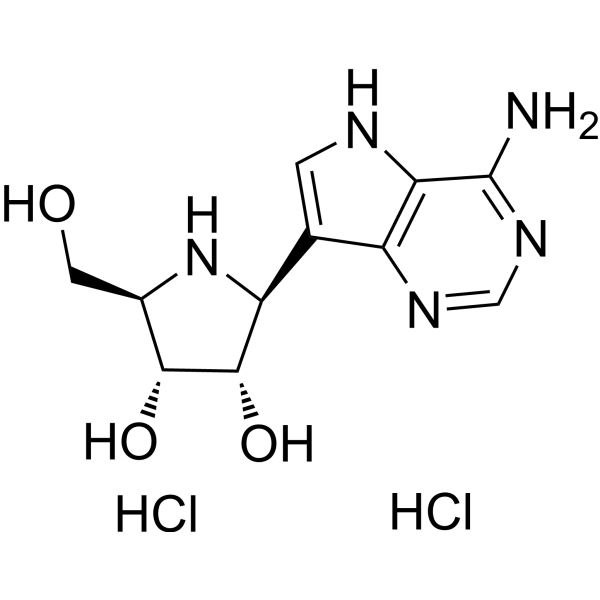
Galidesivir dihydrochloride
Based on 12 publication(s) in Google Scholar
Galidesivir (BCX4430; Immucillin-A) dihydrochloride is a broad-spectrum RNA virus inhibitor that can inhibit Ebola and yellow fever virus (Flavivirus) infections. Galidesivir has potent antiviral activity against tick-borne encephalitis virus (TBEV) and also inhibits the proliferation of many other medically important flaviviruses.
For research use only. We do not sell to patients.
- CAS No.: 1373208-51-5
- Formula: C11H17Cl2N5O3
- Molecular Weight:338.19
-
Storage:
Please store the product under the recommended conditions in the Certificate of Analysis.

To place orders, for customer services and technical support, please contact: MedChemExpress USA
Tel: 609-228-6898 E-mail: [email protected] [email protected]


-
 Biological Activity
-
Chemical Information
- Protocols
- Purity & Documentation
- References
-
 Help & FAQs


Publications Citing Use of MedChemExpress (MCE) Galidesivir dihydrochloride
More- Nucleic Acids Res. 2021 Jan 8;49(D1):D1113-D1121. [Abstract]
- Microorganisms. 2021 Mar 31;9(4):734. [Abstract]
- Antiviral Res. 2017 Jun:142:63-67. [Abstract]
- Antimicrob Agents Chemother. 2019 Feb 26;63(3):e02093-18. [Abstract]
- Viruses. 2020 Jun 10;12(6):628. [Abstract]
- Virology. 2023 Aug:585:21-31. [Abstract]
- Exp Ther Med. 2016 Sep;12(3):1812-1816. [Abstract]
- J AOAC Int. 2024 Oct 1;107(5):727-734. [Abstract]
- bioRxiv. 2025 Sep 22.
- Biomed Pharmacother. 2025 Jun:187:118104. [Abstract]
- bioRxiv. 2025 April 22.
- bioRxiv. 2025 January 29.


Biological Activity
Description
Clinical Trial
| NCT Number | Sponsor | Condition | Start Date |
Phase

|
|---|---|---|---|---|
| NCT01329991 | Plexxikon| | 2011-05 | PHASE1 |


Chemical Information
-
CAS No. 1373208-51-5
-
Molecular Weight 338.19
-
Formula C11H17Cl2N5O3
-
SMILES
O[C@H]1[C@H](C2=CNC3=C2N=CN=C3N)N[C@H](CO)[C@H]1O.Cl.Cl
-
Synonyms
BCX4430 dihydrochloride; Immucillin-A dihydrochloride
-
Shipping
Room temperature in continental US; may vary elsewhere.
-
Storage
Please store the product under the recommended conditions in the Certificate of Analysis.


Publications (12)
-
Journal Impact Factor
-
Most Recent
-
Nucleic Acids Res
COVID19 Drug Repository: text-mining the literature in search of putative COVID19 therapeutics. [Abstract]2021 Jan 8;49(D1):D1113-D1121. PMID: 33166390 -
Microorganisms
Repurposing Drugs for Mayaro Virus: Identification of EIDD-1931, Favipiravir and Suramin as Mayaro Virus Inhibitors. [Abstract]2021 Mar 31;9(4):734. PMID: 33807492 -
Antiviral Res
Antiviral activity of the adenosine analogue BCX4430 against West Nile virus and tick-borne flaviviruses. [Abstract]2017 Jun:142:63-67. PMID: 28336346 -
Antimicrob Agents Chemother
Viral RNA-Dependent RNA Polymerase Inhibitor 7-Deaza-2'- C-Methyladenosine Prevents Death in a Mouse Model of West Nile Virus Infection. [Abstract]2019 Feb 26;63(3):e02093-18. PMID: 30642926 -
Viruses
Broad-Spectrum Host-Based Antivirals Targeting the Interferon and Lipogenesis Pathways as Potential Treatment Options for the Pandemic Coronavirus Disease 2019 (COVID-19). [Abstract]2020 Jun 10;12(6):628. PMID: 32532085 -
Virology
BCX4430 inhibits the replication of rabies virus by suppressing mTOR-dependent autophagy invitro. [Abstract]2023 Aug:585:21-31. PMID: 37267717 -
Exp Ther Med
Separation of cordycepin from Cordyceps militaris fermentation supernatant using preparative HPLC and evaluation of its antibacterial activity as an NAD+-dependent DNA ligase inhibitor. [Abstract]2016 Sep;12(3):1812-1816. PMID: 27588098 -
J AOAC Int
Green and Versatile High Throughput Microwell Oxidation-Based Spectrophotometric Methods for Determination of Galidesivir in Capsules. [Abstract]2024 Oct 1;107(5):727-734. PMID: 38870529 -
-
Biomed Pharmacother
Drug repositioning: Identification of potent inhibitors of NS3 protease and NS5 RdRp for control of DENV infection. [Abstract]2025 Jun:187:118104. PMID: 40300391 -
-

Protocols
-
Research Protocol for Infectious Diseases
Infectious-disease experiments test how pathogens interact with host barriers, innate immune receptors, inflammatory signaling, pathogen replication, and tissue injury; pattern-recognition receptors such as TLRs, RIG-I-like receptors, NOD-like receptors, and inflammasomes detect microbial molecules and activate NF-κB, interferon, and cytokine responses. The central hypothesis is that infection severity reflects the balance between pathogen burden and host response: protective inflammation restricts pathogen growth, whereas excessive or mislocalized inflammation contributes to tissue damage and disease phenotype. Unresolved questions include which host pathways are protective versus pathogenic, why some infection models fail to translate to human disease, and which combined readouts best predict clinically relevant infection outcomes.
-
Cell Viability Determination by MTT Colorimetric Assay
The following protocol uses the MTT colorimetric assay as a classic literature-established method for assessing cell viability/metabolic activity in cultured mammalian cells. MTT[3-(4,5-dimethylthiazol-2-yl)-2,5-diphenyltetrazolium bromide] is reduced by metabolically active cells to a colored formazan product; the amount of formazan is quantified spectrophotometrically and provides an indirect measure of metabolically active viable cells. Importantly, MTT reduction reflects cellular oxidoreductase/metabolic activity rather than an absolute direct count of living cells, so changes in cellular metabolism can alter the signal independently of cell number.


Purity & Documentation
References

Calculators
Concentration (start) × Volume (start) = Concentration (final) × Volume (final)


Galidesivir dihydrochloride Related Classifications
HY-18649B Related Classifications
 Powered by Bioz