



HPPD
4-Hydroxyphenylpyruvate dioxygenase
4-Hydroxyphenylpyruvate dioxygenase (HPPD) is an Fe(II)-dependent, non-heme oxygenase that catalyzes the conversion of 4-hydroxyphenylpyruvate to homogentisate. HPPD catalyzes the second step in the pathway for the catabolism of tyrosine, that is common to essentially all aerobic forms of life. In plants this pathway has an anabolic branch from homogentisate that forms essential isoprenoid redox cofactors such as plastoquinone and tocopherol.he transformation catalyzed by HPPD has both agricultural and therapeutic significance
All Product Categories
-
HPPD Related Products (42)
Related Products (42)

-
HPPD-IN-1
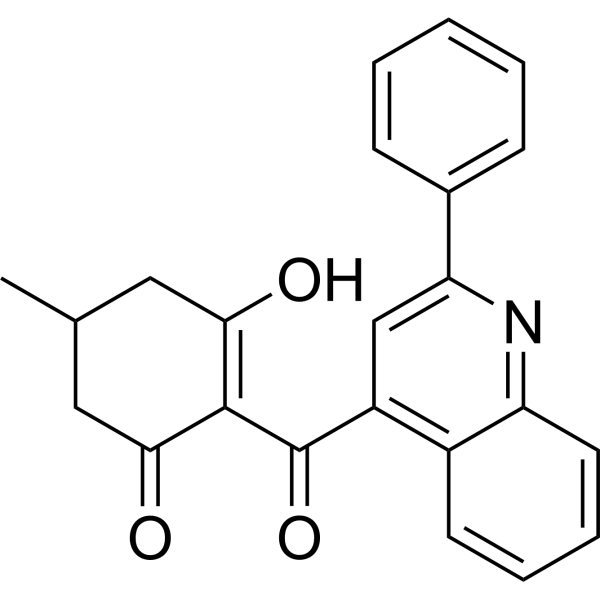
 0 ImagesCat. No.: HY-155135CAS No.: 2950190-99-3HPPD-IN-1 (compound II-3) is a HPPD inhibitor. HPPD-IN-1 shows inhibitory activity of Arabidopsis thaliana HPPD (AtHPPD) with an IC50 value of 0.248 μM, which was superior to that of mesotrione (HY-12853) (0.283 μM) in vitro. HPPD-IN-1 shows excellent herbicidal activity against broadleaf and monocotyledonous weeds.

-
Bicyclopyrone (Standard)
 0 ImagesCat. No.: HY-135767RCAS No.: 352010-68-5Bicyclopyrone (Standard) is the analytical standard of Bicyclopyrone. This product is intended for research and analytical applications. Bicyclopyrone is an inhibitor of 4-hydroxyphenylpyruvate dioxygenase (Hpd).

-
HPPD-IN-6
 0 ImagesCat. No.: HY-175641CAS No.: 3050609-32-7HPPD-IN-6 (Compound IIy) is a HPPD inhibitor with high rice selectivity. HPPD-IN-6 has potent herbicidal activities against Echinochloa crus-galli and Leymus chinensis, including the herbicide-resistant biotypes with EC50s of 19.62-33.26 g of ai/ha. HPPD-IN-6 effectively controls the weeds in rice fields at 90-150 g of ai/ha. HPPD-IN-6 can be used for the development of herbicide.
-
Isoxaflutole (Standard)
 0 ImagesCat. No.: HY-116139RCAS No.: 141112-29-0Synonyms: Merlin (Standard); RP-201772 (Standard)Isoxaflutole (Standard) is the analytical standard of Isoxaflutole. This product is intended for research and analytical applications. Isoxaflutole (Merlin) is the inhibitor for HPPD that blocks benzoquinone biosynthesis, and results in the bleaching of weeds.

-
Biscarfentrazone
 0 ImagesCat. No.: HY-W753723CAS No.: 1622908-18-2
-
Nitisinone-d3
 0 ImagesCat. No.: HY-B0607SSynonyms: NTBC-d3; Nitisone-d3; SC0735-d3Nitisinone-d3 (NTBC-d3) is deuterium labeled Nitisinone. Nitisinone is an orally active, competitive and reversible 4-hydroxyphenylpyruvate dioxygenase (4-HPPD) inhibitor with an IC50 of 173 nM. Nitisinone promotes tyrosine accumulation in a dose-dependent manner. nitisinone can be used in studies of hereditary tyrosinemia type 1 (HT-1) (a rare genetic disorder) and albinism.
-
Benzobicyclon (Standard)
 0 ImagesBenzobicyclon (Standard) is the analytical standard of Benzobicyclon. This product is intended for research and analytical applications. Benzobicyclon is a 4-HPPD inhibitor and herbicide that reacts with water to form a hydrolysate of the active herbicide benzobicycline, causing bleaching and death of weeds. Benzobicyclon is effective against grass, sedge and broadleaf weeds. Benzobicyclon effectively targets sulfonylurea herbicide-resistant biotypes as well as wild-type weeds.
-
Tembotrione (Standard)
 0 ImagesTembotrione (Standard) is the analytical standard of Tembotrione. This product is intended for research and analytical applications. Tembotrione is a drug that may reduce the productivity of carrots. Tembotrione has the activity of reducing carrot stem mass. Tembotrione can be used to study the total productivity of carrot . Tembotrione is a herbicide belonging to the HPPD (dioxygenase) inhibitor class with crop selectivity. Tembotrione effectively controls a variety of weeds including broadleaf and gramineous species by disrupting carotenoid synthesis, which leads to chlorophyll degradation and leaf whitening. Mixing Tembotrione with isoxaflutole or adding surfactants optimizes its efficacy and reduces phytotoxicity, with no residual impact on subsequent cruciferous crops, thus helping to increase maize grain yield. The activity of Tembotrione decreases under drought conditions, and under specific conditions (such as double-dose treatment), it may cause reversible yellowing and even yield reduction in crops such as poppy.
-
HPPD-IN-11
 0 ImagesCat. No.: HY-187374HPPD-IN-11 is an inhibitor of Arabidopsis thaliana 4-hydroxyphenylpyruvate dioxygenase (AtHPPD), with a Ki value of 0.016 μM, and exhibits herbicidal activity. HPPD-IN-11 enhances π-π interactions with Phe360 and Phe403 in the active site of AtHPPD, thereby strengthening its enzyme-binding ability. HPPD-IN-11 can be used in studies related to weed damage.
-
HPPD-IN-12
 0 ImagesCat. No.: HY-187378CAS No.: 3124322-98-8HPPD-IN-12 is an inhibitor of Arabidopsis thaliana 4-hydroxyphenylpyruvate dioxygenase (AtHPPD), with an IC50 of 27.8 μM and a Kd of 1.535 μM. HPPD-IN-12 binds to AtHPPD via Fe2+ coordination, π-π interactions and hydrogen bonds. HPPD-IN-12 can be used in herbicide-related research.
-
Fenpyrazone
 0 ImagesCat. No.: HY-W727532CAS No.: 1992017-55-6Fenpyrazone is a 4-hydroxyphenylpyruvate dioxygenase (HPPD) inhibitor as well as a post-emergence herbicide. By inhibiting the activity of HPPD, Fenpyrazone indirectly blocks carotenoid biosynthesis in plants, causing bleaching of new tissues in sensitive plants, followed by necrosis and eventual death. Fenpyrazone is used in studies on controlling annual monocotyledonous and dicotyledonous weeds in summer maize fields.
-
RPA 202248
 0 ImagesCat. No.: HY-W705486CAS No.: 143701-75-1RPA 202248 is a p-hydroxy phenyl pyruvate dioxygenase (HPPD) inhibitor and degradation product of Isoxaflutole (HY-116139). RPA 202248 demonstrates environmental persistence and undergoes transport through soil matrix and macropores to subsurface drain flow in agricultural field settings.

-
Flusulfinam
 0 ImagesCat. No.: HY-W1115537CAS No.: 2428458-82-4Flusulfinam is a HPPD inhibitor and herbicide, with an IC50 of 0.0181 μM against Arabidopsis thaliana HPPD. Flusulfinam inhibits the catalytic activity of recombinant Arabidopsis thaliana HPPD. Flusulfinam exhibits potent herbicidal activity against barnyard grass (Echinochloa crus-galli). Flusulfinam inhibits the growth of Digitaria sanguinalis.
-
Tolpyralate
 0 ImagesCat. No.: HY-W753209CAS No.: 1101132-67-5




