



ADAM10 Antibody (YA3292)
(Synonyms: CDw156; CD156c; ADAM10; KUZ; MADM)
Based on 1 Customer Validation
ADAM10 Antibody (YA3292) is a Rabbit-derived and non-conjugated IgG monoclonal antibody, targeting to ADAM10.
-
Host:
Rabbit
-
Isotype:
IgG
-
Application:
WB, IP
-
Reactivity :
Human, Mouse, Rat
-
Formulation:
Supplied in Rabbit IgG in PBS(pH 7.4), 150mM sodium chloride, 0.05% BSA, 0.02% sodium azide and 50% glycerol.
-
Conjugation:
Non-conjugated


To place orders, for customer services and technical support, please contact: MedChemExpress USA
Tel: 609-228-6898 E-mail: [email protected] [email protected]





Applications
| Application |
WB

WB: Western Blot
|
IP
IP: Immunoprecipitation
|
|---|---|---|
| Dilution Ratio | 1:1000-1:2000 | 1:50 |


Product Details
ADAM10 Antibody (YA3292) is a Rabbit-derived and non-conjugated IgG monoclonal antibody, targeting to ADAM10.
-
Host Rabbit

-
Clonality Recombinant,Monoclonal

-
Species ReactivityHuman, Mouse, Rat
-
Observed Molecular WeightObserved band size: 84 kDa
Note: Due to possible protein modifications or aggregation, the molecular weight should be confirmed by actual measurement, and the predicted value is for reference only.

-
Calculated Molecular Weight Predicted band size: 84 kDa

Entrez Gene: 102 Human ; 11487 Mouse ; 29650 Rat
SwissProt: O14672 Human ; O35598 Mouse ; Q10743 Rat
OMIM: 615537 Human
A synthesized peptide derived from human ADAM10 aa700-748/748.
Endogenous
Affinity Chromatography
Non-conjugated
Unmodified
IgG


Product Properties
-
Appearance
Solution
-
Formulation
Supplied in Rabbit IgG in PBS(pH 7.4), 150mM sodium chloride, 0.05% BSA, 0.02% sodium azide and 50% glycerol.
-
Concentration
Batch-dependent, Please check the COA for the concentration of each lot. Check Lot Concentration
-
Storage & Stability
Stored at -20°C for 1 year. Avoid repeated freeze / thaw cycles.
-
Shipping
Shipping with blue ice.


Verification Images
-
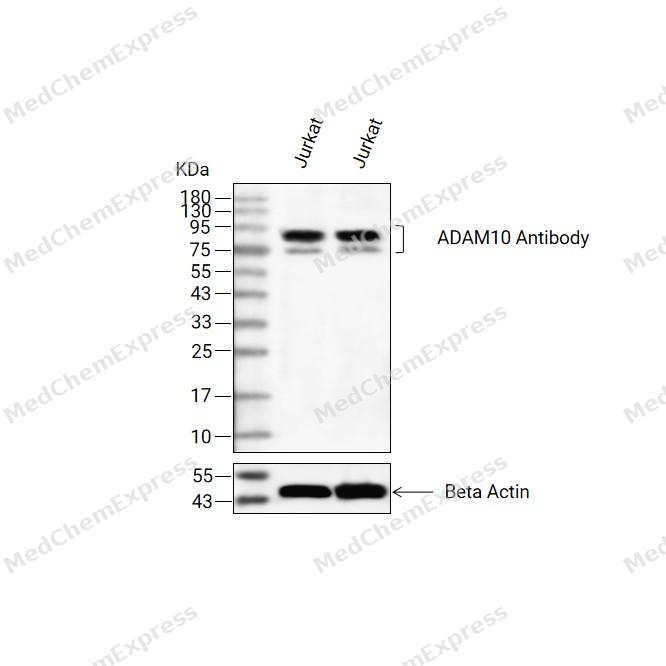 Western blot analysis of extracts from Jurkat(lane 2(20ug) and Jurkat(lane 3(40ug) using ADAM10 Antibody (HY-P83547) Rabbit mAb. Proteins were transferred to a PVDF membrane and blocked with 5% non-fat milk in TBST for 2 hour at room temperature. The primary antibody (1/1000) and Loading control antibody (Beta Actin, HY-P83730, 1/10000) was used in 5% non-fat milk in TBST at 4°C overnight. Goat Anti-Mouse/Rabbit IgG-HRP Secondary Antibody (1/10000) was used for 1 hour at room temperature.


Background
-
Function
ADAM10 is a membrane-bound ectodomain sheddase that cleaves cell-surface proteins and regulates signaling, adhesion, and proteolytic release of soluble ectodomains[1]. Mechanistically, ADAM10 drives ligand-dependent Notch activation, and Adam10-deficient mice show embryonic defects resembling impaired Notch signaling[2]. In primary neurons, ADAM10 acts as the physiologically relevant constitutive α-secretase for amyloid precursor protein, linking its activity to non-amyloidogenic APP processing[3]. In disease models, ADAM10 substrates connect the enzyme to neurodegeneration, inflammation, autoimmunity, and cancer biology[1][4]. Compared with ADAM17, ADAM10 shows distinct substrate use: ligand-induced Notch1 cleavage depends on ADAM10, whereas EDTA-induced ligand-independent Notch1 processing depends on ADAM17[5]. This isoform distinction supports experimental designs that combine genetic loss-of-function with selective inhibitors to separate ADAM10-mediated shedding from overlapping ADAM17 activity[4][6]. For pharmacological studies, GI254023X preferentially inhibits ADAM10 over ADAM17 and blocks ADAM10-mediated shedding of substrates including CX3CL1, CXCL16, IL-6R, and Notch[4][6]. Newer exosite inhibitors such as CID 3117694 provide substrate-selective ADAM10 inhibition without zinc binding, offering tools to dissect ADAM10 biology beyond broad active-site blockade[7].
-
Subcellular Localization
Cell membrane; Single-pass type I membrane protein; Golgi apparatus membrane; Single-pass type I membrane protein; Cytoplasmic vesicle, clathrin-coated vesicle; Cell projection, axon; Cell projection, dendrite; Cell junction, adherens junction; Cytoplasm
-
Expression
Tissue_specificity:Expression in brain tissue (protein level) (PubMed:23676497) . Expression in spleen, lymph nodes, thymus, peripheral blood leukocytes, bone marrow, cartilage, chondrocytes, and fetal liver (PubMed:11511685, PubMed:9016778) .
Induction:In osteoarthritis affected-cartilage -
Isoforms & Post-Translational Modification
O14672 has 2 isomers: O14672-1: 84142 Da (predicted); O14672-2: 49047 Da (predicted).
The precursor is cleaved by furin and PCSK7 -
Subunit
Forms a ternary EFNA5-EPHA3-ADAM10 complex mediating EFNA5 extracellular domain shedding by ADAM10 which regulates the EFNA5-EPHA3 complex internalization and function, the cleavage occurs in trans, with ADAM10 and its substrate being on the membranes of opposing cells (PubMed:16239146). Interacts with the clathrin adapter AP2 complex subunits AP2A1, AP2A2, AP2B1, and AP2M1; this interaction facilitates ADAM10 endocytosis from the plasma membrane during long-term potentiation in hippocampal neurons (PubMed:23676497). Forms a ternary complex composed of ADAM10, EPHA4 and CADH1; within the complex, ADAM10 cleaves CADH1 which disrupts adherens junctions (By similarity). Interacts with EPHA2 (By similarity). Interacts with NGF in a divalent cation-dependent manner (PubMed:20164177). Interacts with TSPAN14; the interaction promotes ADAM10 maturation and cell surface expression (PubMed:26668317, PubMed:26686862). Interacts with TSPAN5, TSPAN10, TSPAN14, TSPAN15, TSPAN17 and TSPAN33; these interactions regulate ADAM10 substrate specificity, endocytosis and turnover (PubMed:26668317, PubMed:26686862, PubMed:34739841, PubMed:37516108). Interacts (via extracellular domain) with TSPAN33 (via extracellular domain) and (via cytoplasmic domain) with AFDN; interaction with TSPAN33 allows the docking of ADAM10 to zonula adherens through a PDZ11-dependent interaction between TSPAN33 and PLEKHA7 while interaction with AFDN locks ADAM10 at zonula adherens (PubMed:30463011). Interacts with DLG1; this interaction recruits ADAM10 to the cell membrane during long-term depression in hippocampal neurons (PubMed:23676497). Interacts (via extracellular domain) with BACE1 (via extracellular domain) (By similarity). Interacts with FAM171A1 (PubMed:30312582)
-
SwissProt ID
-
Synonyms
CDw156; CD156c; ADAM10; KUZ; MADM
-
Research Field
Cell Biology


Documentation
-
Data Sheet (262 KB)
-
SDS (251 KB)
- English - EN (251 KB)
- Français - FR (251 KB)
- Deutsch - DE (251 KB)
- Norwegian - NO (251 KB)
- Español - ES (251 KB)
- Swedish - SV (251 KB)
- Italian - IT (251 KB)
- Korean - KR (251 KB)
- Portuguese - PT (251 KB)
-
User Guide for Antibodies (1077 KB)
References
[1]. Rosenbaum D, et al. New insights into the function and pathophysiology of the ectodomain sheddase A Disintegrin And Metalloproteinase 10 (ADAM10). FEBS J. 2024 Jul;291(13):2733-2766. [Content Brief]
[2]. Hartmann D, et al. The disintegrin/metalloprotease ADAM 10 is essential for Notch signalling but not for alpha-secretase activity in fibroblasts. Hum Mol Genet. 2002 Oct 1;11(21):2615-24. [Content Brief]
[3]. Kuhn PH, et al. ADAM10 is the physiologically relevant, constitutive alpha-secretase of the amyloid precursor protein in primary neurons. EMBO J. 2010 Sep 1;29(17):3020-32. [Content Brief]
[4]. McLaren JE, et al. Interferon gamma: a master regulator of atherosclerosis. Cytokine Growth Factor Rev. 2009 Apr;20(2):125-35. [Content Brief]
[5]. Alabi RO, et al. Analysis of the Conditions That Affect the Selective Processing of Endogenous Notch1 by ADAM10 and ADAM17. Int J Mol Sci. 2021 Feb 12;22(4):1846. [Content Brief]
[6]. Seifert A, et al. The metalloproteinase ADAM10 requires its activity to sustain surface expression. Cell Mol Life Sci. 2021 Jan;78(2):715-732. [Content Brief]
[7]. Yuan HY, et al. Skyrmion Creation and Manipulation by Nano-Second Current Pulses. Sci Rep. 2016 Mar 3;6:22638. [Content Brief]

 Powered by Bioz
