



ANGPTL3 Antibody (YA2016)
(Synonyms: ANG5; Angiopoietin 5; Angiopoietin like 3; ANGPT5; ANGPTL3; ANL3; FHBL2)
Based on 1 Customer Validation
ANGPTL3 Antibody (YA2016) is a Rabbit-derived and non-conjugated IgG monoclonal antibody, targeting to ANGPTL3.
-
Host:
Rabbit
-
Isotype:
IgG
-
Application:
WB, ICC/IF
-
Reactivity :
Human, Mouse, Rat
-
Formulation:
Supplied in 10mM PBS, pH 7.4, 150mM sodium chloride, 0.05% BSA, 0.02% sodium azide and 50% glycerol.
-
Conjugation:
Non-conjugated


To place orders, for customer services and technical support, please contact: MedChemExpress USA
Tel: 609-228-6898 E-mail: [email protected] [email protected]





Applications
| Application |
WB

WB: Western Blot
|
ICC/IF
ICC/IF: Immunocytochemistry/
Immunofluorescence |
|---|---|---|
| Dilution Ratio | 1:1000-1:2000 | 1:50-1:200 |


Product Details
ANGPTL3 Antibody (YA2016) is a Rabbit-derived and non-conjugated IgG monoclonal antibody, targeting to ANGPTL3.
-
Host Rabbit

-
Clonality Recombinant,Monoclonal

-
Species ReactivityHuman, Mouse, Rat
-
Observed Molecular WeightObserved band size: 54 kDa
Note: Due to possible protein modifications or aggregation, the molecular weight should be confirmed by actual measurement, and the predicted value is for reference only.

-
Calculated Molecular Weight Predicted band size: 54 kDa

Entrez Gene: 27329 Human ; 30924 Mouse ; 502970 Rat
SwissProt: Q9Y5C1 Human ; Q9R182 Mouse ;
OMIM: 605019 Human
A synthesized peptide derived from human ANGPTL3 aa17-93.
Endogenous
Affinity Purified
Non-conjugated
Unmodified
IgG


Product Properties
-
Appearance
Solution
-
Formulation
Supplied in 10mM PBS, pH 7.4, 150mM sodium chloride, 0.05% BSA, 0.02% sodium azide and 50% glycerol.
-
Concentration
Batch-dependent, Please check the COA for the concentration of each lot. Check Lot Concentration
-
Storage & Stability
Stored at -20°C for 1 year. Avoid repeated freeze / thaw cycles.
-
Shipping
Shipping with blue ice.


Verification Images
-
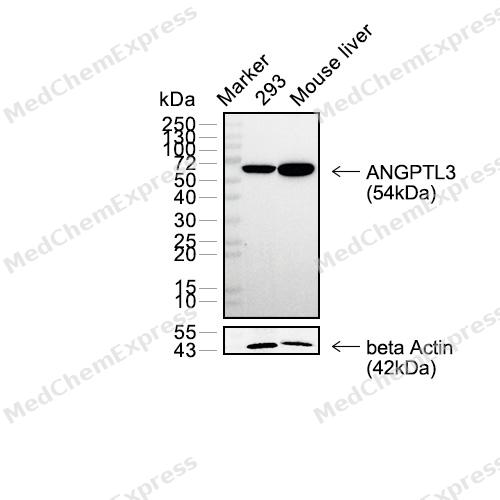 Western blot analysis of extracts from 293 (lane 2(20μg)) and Mouse liver (lane 3(20μg)) using ANGPTL3 Rabbit mAb. Proteins were transferred to a PVDF membrane and blocked with 5% non-fat milk in TBST for 2 hour at room temperature. The primary antibody (1/1000) and Loading control antibody (beta Actin, HY-P83730, 1/5000) was used in 5% non-fat milk in TBST at 4°C overnight. Goat Anti-Rabbit/Mouse IgG-HRP Secondary Antibody (1/10000) was used for 1 hour at room temperature.


Background
-
Function
ANGPTL3 (angiopoietin-like protein 3) is a liver-derived secreted protein that functions as a central regulator of plasma lipid metabolism through inhibition of lipoprotein lipase (LPL) and endothelial lipase (EL), thereby controlling triglyceride-rich lipoprotein processing and systemic lipid homeostasis[1][2]. Mechanistically, ANGPTL3 participates in the ANGPTL3-ANGPTL4-ANGPTL8 regulatory axis, which coordinates tissue-specific triglyceride trafficking according to nutritional status by modulating LPL activity in cardiac muscle, skeletal muscle, and adipose tissue[3]. ANGPTL8 enhances the ability of ANGPTL3 to bind and inhibit LPL, whereas ANGPTL4 primarily regulates LPL activity through tissue-dependent and nutritional-state-dependent mechanisms, establishing complementary but distinct functions within this pathway[3][4]. In human genetics and disease studies, loss-of-function variants in ANGPTL3 are associated with markedly reduced plasma triglyceride, low-density lipoprotein cholesterol (LDL-C), and high-density lipoprotein cholesterol (HDL-C) concentrations, supporting a critical role in lipoprotein metabolism and atherosclerotic cardiovascular disease risk modulation[2][1]. Compared with related isoforms, ANGPTL3 is predominantly expressed in the liver and exerts broader effects on multiple lipoprotein fractions, whereas ANGPTL4 displays stronger tissue-specific regulation and ANGPTL8 functions mainly as a cofactor that potentiates ANGPTL3-mediated LPL inhibition[3][4]. Therefore, ANGPTL3 has emerged as a prominent therapeutic target, and monoclonal antibodies as well as antisense oligonucleotide approaches have demonstrated activation of LPL and substantial reductions in circulating triglyceride-rich lipoproteins in preclinical and clinical studies[2][5].
-
Subcellular Localization
Secreted; Cell projection, lamellipodium
-
Expression
Tissue_specificity:Expressed principally in liver. Weakly expressed in kidney. Binds to adipocytes. Increased expression and colocalization with activated ITGB3 in glomeruli of with nephrotic syndrome showing effaced podocyte foot processes (at protein level)
Induction:Down-regulated by insulin -
Subunit
Interacts with ANGPTL8. Interacts with ITGB3 (By similarity)
-
SwissProt ID
-
Synonyms
ANG5; Angiopoietin 5; Angiopoietin like 3; ANGPT5; ANGPTL3; ANL3; FHBL2
-
Research Field
Cardiovascular


Documentation
-
Data Sheet (262 KB)
-
SDS (251 KB)
- English - EN (251 KB)
- Français - FR (251 KB)
- Deutsch - DE (251 KB)
- Norwegian - NO (251 KB)
- Español - ES (251 KB)
- Swedish - SV (251 KB)
- Italian - IT (251 KB)
- Korean - KR (251 KB)
- Portuguese - PT (251 KB)
-
User Guide for Antibodies (1077 KB)
References
[2]. Ruscica M, et al. Pharmacological aspects of ANGPTL3 and ANGPTL4 inhibitors: New therapeutic approaches for the treatment of atherogenic dyslipidemia. Pharmacol Res. 2020 Mar;153:104653. [Content Brief]
[3]. Zhang R. The ANGPTL3-4-8 model, et al. The ANGPTL3-4-8 model, a molecular mechanism for triglyceride trafficking. Open Biol. 2016 Apr;6(4):150272. [Content Brief]
[5]. Kosmas CE, et al. Angiopoietin-like Protein 3 (ANGPTL3) Targeting in the Management of Dyslipidemias. Int J Mol Sci. 2026 Jan 16;27(2):921. [Content Brief]

 Powered by Bioz
