



ATF5 Antibody (YA2184)
(Synonyms: ATF5; ATFX; Cyclic AMP-dependent transcription factor ATF-5; cAMP-dependent transcription factor ATF-5; Activating transcription factor 5; Transcription factor ATFx)
Based on 1 Customer Validation
ATF5 Antibody (YA2184) is a Rabbit-derived and non-conjugated IgG monoclonal antibody, targeting to ATF5.
-
Host:
Rabbit
-
Isotype:
IgG
-
Application:
WB, IHC-P, IP
-
Reactivity :
Human, Mouse, Rat
-
Formulation:
Supplied in 50mM Tris-Glycine(pH 7.4), 0.15M NaCl, 40% Glycerol, 0.01% Sodium azide and 0.05% BSA
-
Conjugation:
Non-conjugated


To place orders, for customer services and technical support, please contact: MedChemExpress USA
Tel: 609-228-6898 E-mail: [email protected] [email protected]





Applications
| Application |
WB

WB: Western Blot
|
IHC-P
IHC-P: Immunohistochemistry-Paraffin
|
IP
IP: Immunoprecipitation
|
|---|---|---|---|
| Dilution Ratio | 1:500-1:1000 | 1:50-1:100 | 1:20 |


Product Details
ATF5 Antibody (YA2184) is a Rabbit-derived and non-conjugated IgG monoclonal antibody, targeting to ATF5.
-
Host Rabbit

-
Clonality Recombinant, Monoclonal

-
Species ReactivityHuman, Mouse, Rat
-
Observed Molecular WeightObserved band size: 31 kDa
Note: Due to possible protein modifications or aggregation, the molecular weight should be confirmed by actual measurement, and the predicted value is for reference only.

-
Calculated Molecular Weight Predicted band size: 31 kDa

A synthetic peptide of human ATF5 aa207-224.
Endogenous
Affinity Purified
Non-conjugated
Unmodified
IgG


Product Properties
-
Appearance
Liquid
-
Formulation
Supplied in 50mM Tris-Glycine(pH 7.4), 0.15M NaCl, 40% Glycerol, 0.01% Sodium azide and 0.05% BSA
-
Concentration
Batch-dependent, Please check the COA for the concentration of each lot. Check Lot Concentration
-
Storage & Stability
Stored at -20°C for 1 year. Avoid repeated freeze / thaw cycles.
-
Shipping
Shipping with blue ice.


Verification Images
-
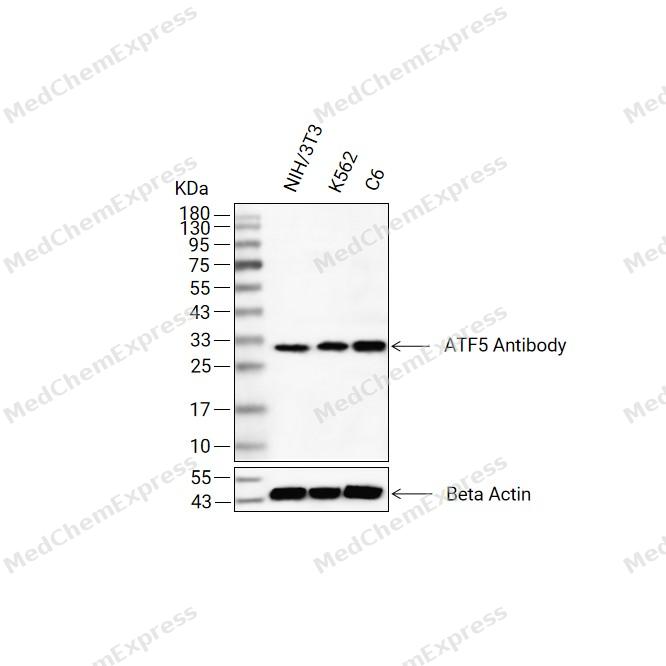 Western blot analysis of extracts from NIH/3T3(lane 2(20ug) , K562(lane 3(20ug) and C6(lane 4(20ug) using ATF5 Antibody (HY-P82439) Rabbit mAb. Proteins were transferred to a PVDF membrane and blocked with 5% non-fat milk in TBST for 2 hour at room temperature. The primary antibody (1/1000) and Loading control antibody (Beta Actin, HY-P83730, 1/10000) was used in 5% non-fat milk in TBST at 4°C overnight. Goat Anti-Mouse/Rabbit IgG-HRP Secondary Antibody (1/10000) was used for 1 hour at room temperature.
 -
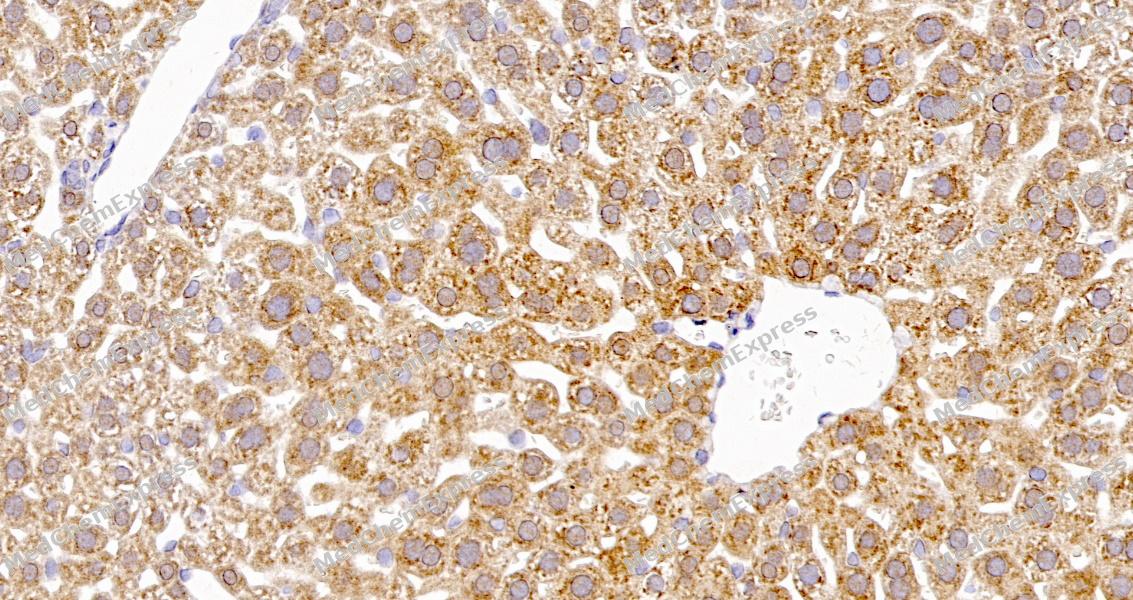 Immunohistochemical analysis of paraffin-embedded mouse liver tissue using ATF5 Antibody. The section was pre-treated using heat mediated antigen retrieval with sodium citrate buffer (pH 6.0) for 8 minutes. The tissues were blocked in QuickBlock for 20 minutes at room temperature, washed with ddH2O and PBS, and then probed with the primary antibody at 1/100 dilution in 4℃ overnight. The detection was performed using an HRP conjugated compact polymer system. DAB was used as the chromogen. Tissues were counterstained with hematoxylin and mounted with DPX.
 -
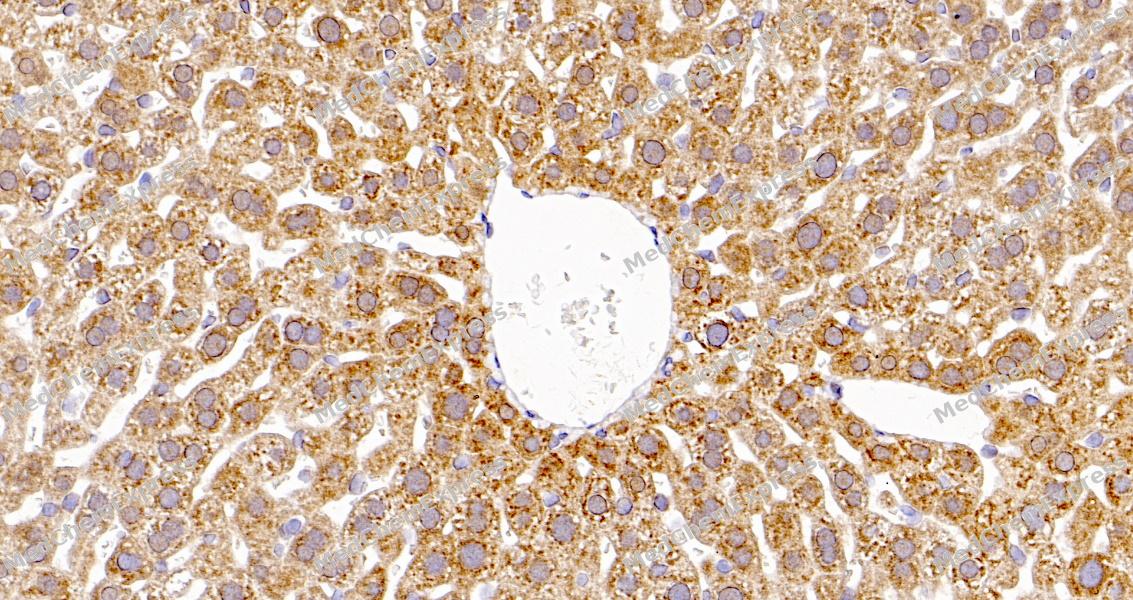 Immunohistochemical analysis of paraffin-embedded mouse liver tissue using ATF5 Antibody. The section was pre-treated using heat mediated antigen retrieval with sodium citrate buffer (pH 6.0) for 8 minutes. The tissues were blocked in QuickBlock for 20 minutes at room temperature, washed with ddH2O and PBS, and then probed with the primary antibody at 1/100 dilution in 4℃ overnight. The detection was performed using an HRP conjugated compact polymer system. DAB was used as the chromogen. Tissues were counterstained with hematoxylin and mounted with DPX.


Background
-
Function
ATF5 transcription factor that either stimulates or represses gene transcription through binding of different DNA regulatory elements such as cAMP response element (CRE) (consensus: 5'-GTGACGT[AC][AG]-3'), ATF5-specific response element (ARE) (consensus: 5'-C[CT]TCT[CT]CCTT[AT]-3') but also the amino acid response element (AARE), present in many viral and cellular promoters. Critically involved, often in a cell type-dependent manner, in cell survival, proliferation, and differentiation. Its transcriptional activity is enhanced by CCND3 and slightly inhibited by CDK4. Important regulator of the cerebral cortex formation, functions in cerebral cortical neuroprogenitor cells to maintain proliferation and to block differentiation into neurons. Must be down-regulated in order for such cells to exit the cycle and differentiate. Participates in the pathways by which SHH promotes cerebellar granule neuron progenitor cells proliferation. Critical for survival of mature olfactory sensory neurons (OSN), directs expression of OSN-specific genes. May be involved in osteogenic differentiation. Promotes cell proliferation and survival by inducing the expression of EGR1 sinergistically with ELK1. Once acetylated by EP300, binds to ARE sequences on target genes promoters, such as BCL2 and EGR1. Plays an anti-apoptotic role through the transcriptional regulation of BCL2, this function seems to be cell type-dependent. Cooperates with NR1I3/CAR in the transcriptional activation of CYP2B6 in liver. In hepatic cells, represses CRE-dependent transcription and inhibits proliferation by blocking at G2/M phase. May act as a negative regulator of IL1B transduction pathway in liver. Upon IL1B stimulus, cooperates with NLK to activate the transactivation activity of C/EBP subfamily members. Besides its function of transcription factor, acts as a cofactor of CEBPB to activate CEBPA and promote adipocyte differentiation. Regulates centrosome dynamics in a cell-cycle- and centriole-age-dependent manner. Forms 9-foci symmetrical ring scaffold around the mother centriole to control centrosome function and the interaction between centrioles and pericentriolar material[1][2][3][4][5][6][7][8][9][10][11][12][13].
-
Subcellular Localization
Cytoplasm; Nucleus; Cytoplasm, cytoskeleton, microtubule organizing center, centrosome
-
Expression
Tissue_specificity:Widely expressed with higher expression levels in liver
Induction:Down-regulated by pro-apoptotic stimuli (PubMed:21212266) . However, the pro-apoptotic cisplatin increases protein levels by inhibiting polyubiquitination (PubMed:18458088) . IL1B increases protein levels through protein stabilization and increase of translation efficiency (PubMed:24379400) -
Subunit
Binds DNA as a dimer. Interacts with PTP4A1/PRL-1 (By similarity). Interacts with CCND3, but not with CCND1 or CCND2 (PubMed:15358120). Interacts with HSPA1A or HSPA1B; the interaction protects ATF5 from degradation via proteasome-dependent and caspase-dependent processes. Interacts (via C-terminal region) with NPM1 (via C-terminal region); the interaction leads to loss of association between HSPA1A or HSPA1B and ATF5 and promotes ATF5 degradation via proteasome-dependent and caspase-dependent processes (PubMed:22528486, PubMed:24379400). Interacts with NLK; the interaction stabilizes ATF5 at the protein level in a kinase-independent manner (PubMed:25512613). Interacts with alpha-tubulin, gamma-tubulin members TUBGCP2 and TUBGCP4, PCNT; the ATF5:PCNT:polyglutamylated tubulin (PGT) tripartite unites the mother centriole and the pericentriolar material (PCM) in the centrosome (PubMed:26213385). Interacts with CEBPB and EP300; EP300 is required for ATF5 and CEBPB interaction and DNA binding (By similarity)
-
SwissProt ID
-
Synonyms
ATF5; ATFX; Cyclic AMP-dependent transcription factor ATF-5; cAMP-dependent transcription factor ATF-5; Activating transcription factor 5; Transcription factor ATFx
-
Research Field
Epigenetics and Nuclear Signaling


Documentation
-
Data Sheet (235 KB)
-
SDS (251 KB)
- English - EN (251 KB)
- Français - FR (251 KB)
- Deutsch - DE (251 KB)
- Norwegian - NO (251 KB)
- Español - ES (251 KB)
- Swedish - SV (251 KB)
- Italian - IT (251 KB)
- Korean - KR (251 KB)
- Portuguese - PT (251 KB)
-
User Guide for Antibodies (1077 KB)

 Powered by Bioz
