



ATG9A Antibody (YA3081)
(Synonyms: ATG9A; APG9-like 1; Autophagy 9-like 1 protein; Autophagy-related protein 9A; MGD3208; MATG9; APG9 autophagy 9-like 1; APG9L1; Autophagy related 9A)
Based on 1 Customer Validation
ATG9A Antibody (YA3081) is a Rabbit-derived and non-conjugated IgG monoclonal antibody, targeting to ATG9A.
-
Host:
Rabbit
-
Isotype:
IgG
-
Application:
WB, IHC-P, ICC/IF, IP
-
Reactivity :
Human, Mouse, Rat
-
Formulation:
Supplied in 50mM Tris-Glycine(pH 7.4), 0.15M NaCl, 40%Glycerol, 0.01% sodium azide and 0.05% BSA.
-
Conjugation:
Non-conjugated


To place orders, for customer services and technical support, please contact: MedChemExpress USA
Tel: 609-228-6898 E-mail: [email protected] [email protected]





Applications
| Application |
WB

WB: Western Blot
|
IHC-P
IHC-P: Immunohistochemistry-Paraffin
|
ICC/IF
ICC/IF: Immunocytochemistry/
Immunofluorescence |
IP
IP: Immunoprecipitation
|
|---|---|---|---|---|
| Dilution Ratio | 1:500-1:1000 | 1:50-1:100 | 1:50-1:200 | 1:50 |


Product Details
ATG9A Antibody (YA3081) is a Rabbit-derived and non-conjugated IgG monoclonal antibody, targeting to ATG9A.
-
Host Rabbit

-
Clonality Recombinant, Monoclonal

-
Species ReactivityHuman, Mouse, Rat
-
Observed Molecular WeightObserved band size: 94 kDa
Note: Due to possible protein modifications or aggregation, the molecular weight should be confirmed by actual measurement, and the predicted value is for reference only.

-
Calculated Molecular Weight Predicted band size: 94 kDa

Entrez Gene: 79065 Human ; 245860 Mouse ; 363254 Rat
SwissProt: Q7Z3C6 Human ; Q68FE2 Mouse ; Q5FWU3 Rat
OMIM: 612204 Human
A synthesized peptide derived from human ATG9A aa812-839.
Endogenous
Affinity Chromatography
Non-conjugated
Unmodified
IgG


Product Properties
-
Appearance
Liquid
-
Formulation
Supplied in 50mM Tris-Glycine(pH 7.4), 0.15M NaCl, 40%Glycerol, 0.01% sodium azide and 0.05% BSA.
-
Concentration
Batch-dependent, Please check the COA for the concentration of each lot. Check Lot Concentration
-
Storage & Stability
Stored at -20°C for 1 year. Avoid repeated freeze / thaw cycles.
-
Shipping
Shipping with blue ice.


Verification Images
-
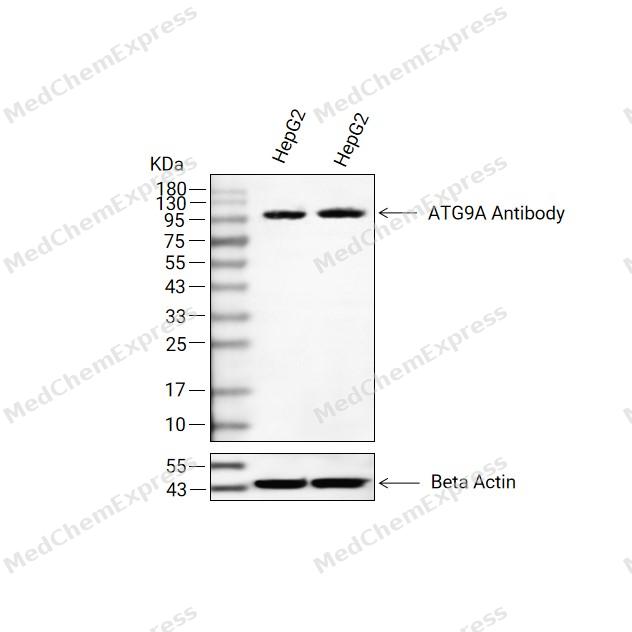 Western blot analysis of extracts from HepG2(lane 2(20ug) and HepG2(lane 3(40ug) using ATG9A Antibody (HY-P83336) Rabbit mAb. Proteins were transferred to a PVDF membrane and blocked with 5% non-fat milk in TBST for 2 hour at room temperature. The primary antibody (1/1000) and Loading control antibody (Beta Actin, HY-P83730, 1/10000) was used in 5% non-fat milk in TBST at 4°C overnight. Goat Anti-Mouse/Rabbit IgG-HRP Secondary Antibody (1/10000) was used for 1 hour at room temperature.
 -
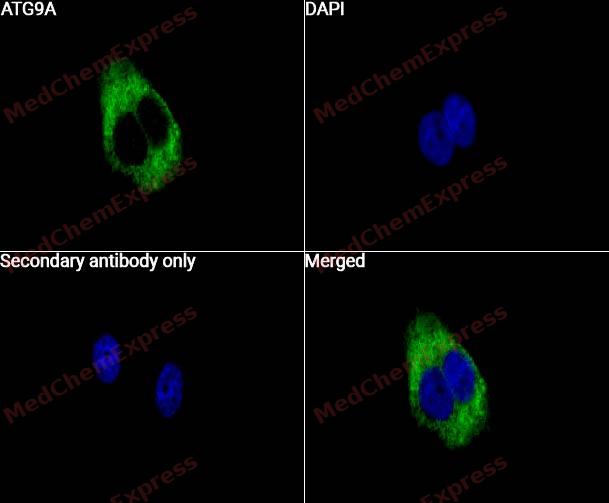 Immunocytochemistry analysis of Hela cells labeling ATG9A with ATG9A Antibody (HY-P83336) at 1/50 dilution. Cells were fixed in 4% paraformaldehyde for 15 minutes at room temperature, permeabilized with 0.1% Triton X-100 for 10 minutes at room temperature, then blocked with QuickBlock™ Blocking Buffer for Immunol Staining for 10 min at room temperature. Cells were then incubated with ATG9A Antibody (HY-P83336) at 1/50 dilution in QuickBlock™ Blocking Buffer for Immunol Staining at 4 ℃. Alexa Fluor® 488-conjugated AffiniPure Goat Anti-Rabbit IgG H&L(HY-P8002, Green) was used as the secondary antibody at 1/1,000 dilution. PBS instead of the primary antibody was used as the secondary antibody only control. The Nuclear counterstain was DAPI (Blue).
 -
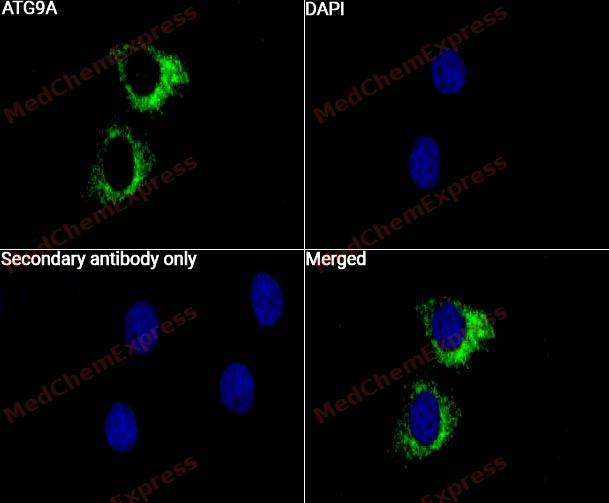 Immunocytochemistry analysis of HepG2 cells labeling ATG9A with ATG9A Antibody (HY-P83336) at 1/50 dilution. Cells were fixed in 4% paraformaldehyde for 15 minutes at room temperature, permeabilized with 0.1% Triton X-100 for 10 minutes at room temperature, then blocked with QuickBlock™ Blocking Buffer for Immunol Staining for 10 min at room temperature. Cells were then incubated with ATG9A Antibody (HY-P83336) at 1/50 dilution in QuickBlock™ Blocking Buffer for Immunol Staining at 4 ℃. Alexa Fluor® 488-conjugated AffiniPure Goat Anti-Rabbit IgG H&L(HY-P8002, Green) was used as the secondary antibody at 1/1,000 dilution. PBS instead of the primary antibody was used as the secondary antibody only control. The Nuclear counterstain was DAPI (Blue).


Background
-
Function
ATG9A is a Phospholipid scramblase involved in autophagy by mediating autophagosomal membrane expansion. Cycles between the preautophagosomal structure/phagophore assembly site (PAS) and the cytoplasmic vesicle pool and supplies membrane for the growing autophagosome. Lipid scramblase activity plays a key role in preautophagosomal structure/phagophore assembly by distributing the phospholipids that arrive through ATG2 (ATG2A or ATG2B) from the cytoplasmic to the luminal leaflet of the bilayer, thereby driving autophagosomal membrane expansion. Also required to supply phosphatidylinositol 4-phosphate to the autophagosome initiation site by recruiting the phosphatidylinositol 4-kinase beta (PI4KB) in a process dependent on ARFIP2, but not ARFIP1. In addition to autophagy, also plays a role in necrotic cell death[1][2][3][4][5][6][7][8][9][10].
-
Subcellular Localization
Preautophagosomal structure membrane; Multi-pass membrane protein; Cytoplasmic vesicle, autophagosome membrane; Multi-pass membrane protein; Golgi apparatus, trans-Golgi network membrane; Multi-pass membrane protein; Late endosome membrane; Multi-pass membrane protein; Recycling endosome membrane; Multi-pass membrane protein; Endoplasmic reticulum membrane; Multi-pass membrane protein; Mitochondrion membrane; Multi-pass membrane protein
-
Isoforms & Post-Translational Modification
Q7Z3C6 has 3 isomers: Q7Z3C6-1: 94447 Da (predicted); Q7Z3C6-2: 87379 Da (predicted); Q7Z3C6-3: 60694 Da (predicted).
Ufmylated in a DDRGK1 dependent manner -
Subunit
Homotrimer; forms a homotrimer with a central pore that forms a path between the two membrane leaflets (PubMed:32610138, PubMed:33106659). Interacts (via cytoplasmic its C-terminus) with ATG2A (PubMed:32610138, PubMed:33106659). Interacts with SUPT20H (PubMed:19893488). Interacts (via the tyrosine-based sorting signal motif) with AP4M1; promoting association with the AP-4 complex (PubMed:29180427). Interacts with ARFIP1 and ARFIP2 (PubMed:30917996). Interacts with PI4K2A and PI4KB (PubMed:30917996). Interacts with ATG4A; the interaction is direct and promotes ATG9A trafficking (PubMed:33773106)
-
SwissProt ID
-
Synonyms
ATG9A; APG9-like 1; Autophagy 9-like 1 protein; Autophagy-related protein 9A; MGD3208; MATG9; APG9 autophagy 9-like 1; APG9L1; Autophagy related 9A
-
Research Field
Cell Biology


Documentation
-
Data Sheet (235 KB)
-
SDS (252 KB)
- English - EN (252 KB)
- Français - FR (252 KB)
- Deutsch - DE (252 KB)
- Norwegian - NO (252 KB)
- Español - ES (252 KB)
- Swedish - SV (252 KB)
- Italian - IT (252 KB)
- Korean - KR (252 KB)
- Portuguese - PT (252 KB)
-
User Guide for Antibodies (1077 KB)

 Powered by Bioz
