



BMP-4 Antibody (YA2285)
(Synonyms: BMP4; BMP2B; DVR4; Bone morphogenetic protein 4; BMP-4; Bone morphogenetic protein 2B; BMP-2B)Based on 1 Customer Validation
BMP-4 Antibody (YA2285) is a Rabbit-derived and non-conjugated IgG monoclonal antibody, targeting to BMP-4.
-
Host:
Rabbit
-
Isotype:
IgG
-
Application:
WB, ICC/IF, IP
-
Reactivity :
Human
-
Formulation:
Supplied in 50mM Tris-Glycine(pH 7.4), 0.15M NaCl, 40% Glycerol, 0.01% Sodium azide and 0.05% BSA
-
Conjugation:
Non-conjugated


To place orders, for customer services and technical support, please contact: MedChemExpress USA
Tel: 609-228-6898 E-mail: [email protected] [email protected]





Applications
| Application |
WB

WB: Western Blot
|
ICC/IF
ICC/IF: Immunocytochemistry/
Immunofluorescence |
IP
IP: Immunoprecipitation
|
|---|---|---|---|
| Dilution Ratio | 1:500-1:1000 | 1:50-1:200 | 1:20 |


Product Details
BMP-4 Antibody (YA2285) is a Rabbit-derived and non-conjugated IgG monoclonal antibody, targeting to BMP-4.
-
Host Rabbit

-
Clonality Recombinant,Monoclonal

-
Species ReactivityHuman
-
Observed Molecular WeightObserved band size: 47 kDa
Note: Due to possible protein modifications or aggregation, the molecular weight should be confirmed by actual measurement, and the predicted value is for reference only.

-
Calculated Molecular Weight Predicted band size: 47 kDa

A synthetic peptide of human BMP4
Endogenous
Affinity Purified
Non-conjugated
Unmodified
IgG


Product Properties
-
Appearance
Solution
-
Formulation
Supplied in 50mM Tris-Glycine(pH 7.4), 0.15M NaCl, 40% Glycerol, 0.01% Sodium azide and 0.05% BSA
-
Concentration
Batch-dependent, Please check the COA for the concentration of each lot. Check Lot Concentration
-
Storage & Stability
Stored at -20°C for 1 year. Avoid repeated freeze / thaw cycles.
-
Shipping
Shipping with blue ice.


Verification Images
-
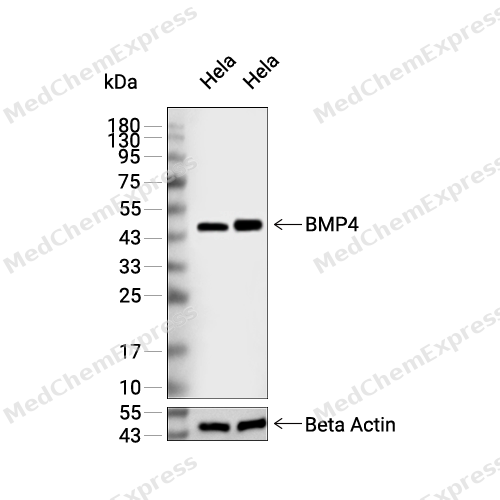 Western blot analysis of extracts from Hela (lane 2(20μg), Hela (lane 3(40μg), using BMP4 Antibody. Proteins were transferred to a PVDF membrane and blocked with 5% BSA in TBST for 2 hour at room temperature. The primary antibody and Loading control antibody (Beta Actin, HY-P80438, 1/3000) was used in 5% BSA in TBST at 4°C overnight. Goat Anti-Mouse/Rabbit IgG-HRP Secondary Antibody (HY-P8004/HY-P8001, 1/10,000) was used for 1 hour at room temperature.
 -
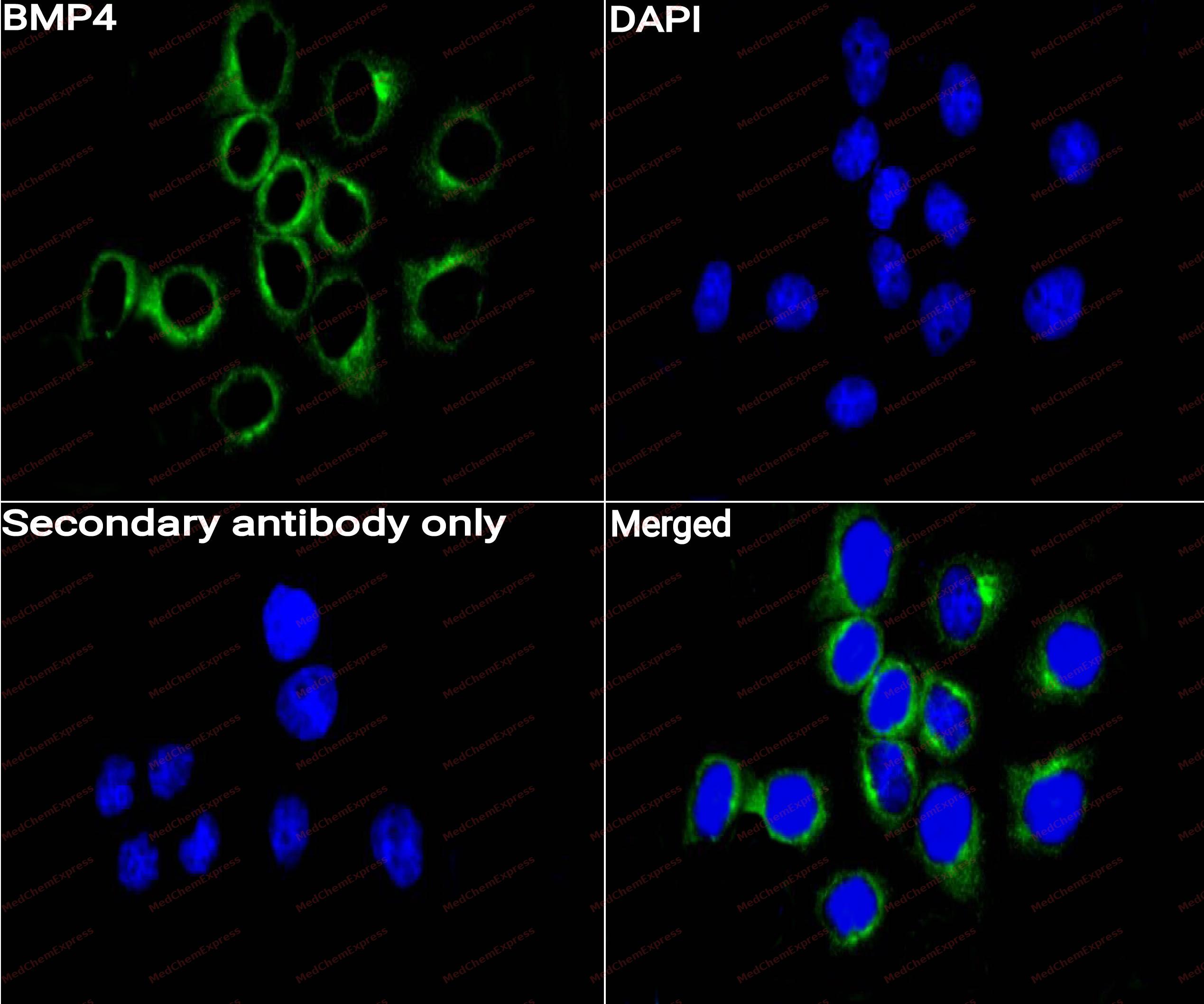 Immunocytochemistry analysis of Hela cells labeling BMP4 with BMP4 Antibody (HY-P82540) at 1/50 dilution. Cells were fixed in 4% paraformaldehyde for 15 minutes at room temperature, permeabilized with 0.1% Triton X-100 for 10 minutes at room temperature, then blocked with QuickBlock™ Blocking Buffer for Immunol Staining for 10 min at room temperature. Cells were then incubated with BMP4 Antibody (HY-P82540) at 1/50 dilution in QuickBlock™ Blocking Buffer for Immunol Staining at 4 ℃. Alexa Fluor® 488-conjugated AffiniPure Goat Anti-Rabbit IgG H&L(HY-P8002, Green) was used as the secondary antibody at 1/1,000 dilution. PBS instead of the primary antibody was used as the secondary antibody only control. The Nuclear counterstain was DAPI (Blue).
 -
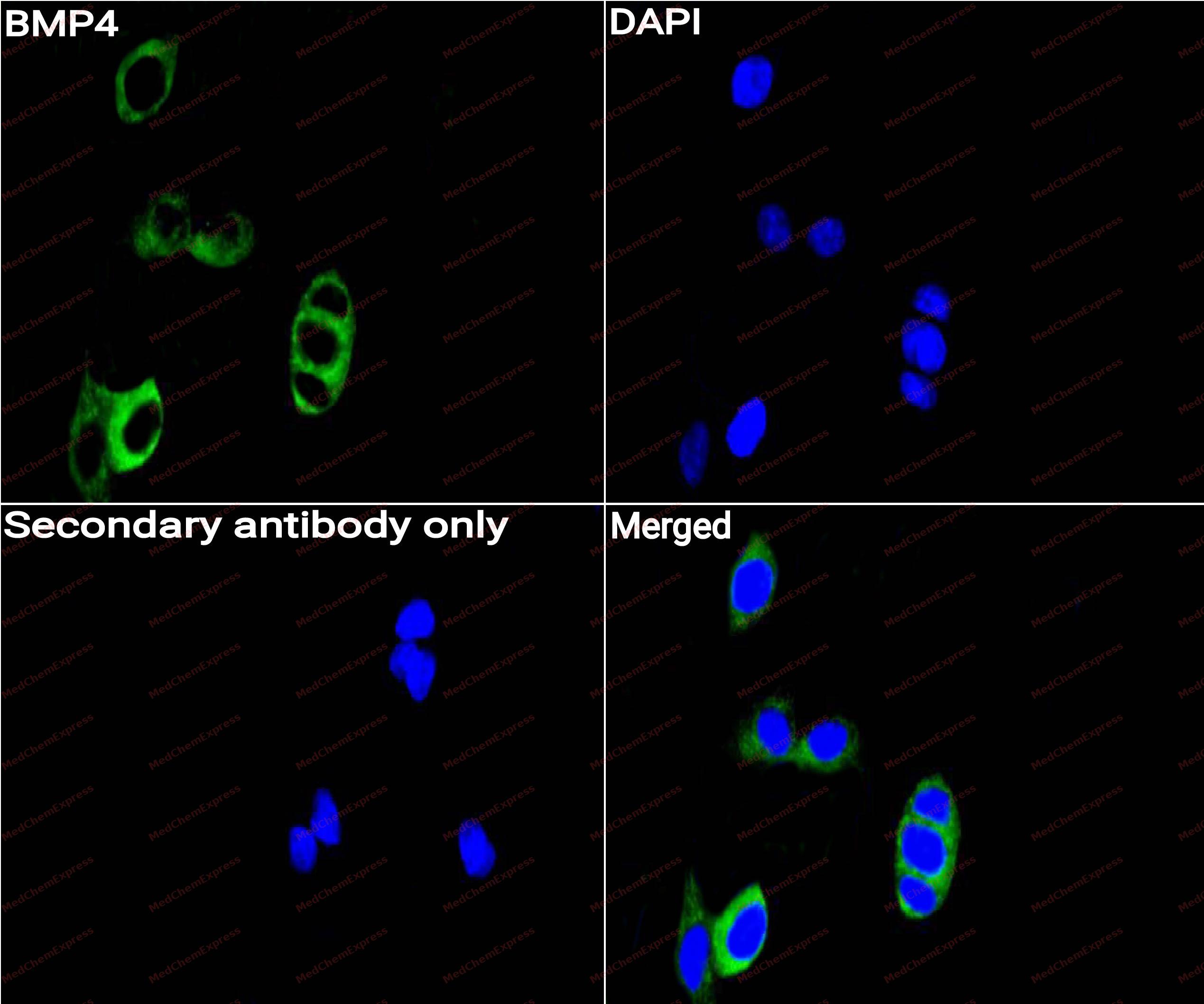 Immunocytochemistry analysis of HepG2 cells labeling BMP4 with BMP4 Antibody (HY-P82540) at 1/50 dilution. Cells were fixed in 4% paraformaldehyde for 15 minutes at room temperature, permeabilized with 0.1% Triton X-100 for 10 minutes at room temperature, then blocked with QuickBlock™ Blocking Buffer for Immunol Staining for 10 min at room temperature. Cells were then incubated with BMP4 Antibody (HY-P82540)at 1/50 dilution in QuickBlock™ Blocking Buffer for Immunol Staining at 4 ℃. Alexa Fluor® 488-conjugated AffiniPure Goat Anti-Rabbit IgG H&L(HY-P8002,Green) was used as the secondary antibody at 1/1,000 dilution. PBS instead of the primary antibody was used as the secondary antibody only control. The Nuclear counterstain was DAPI (Blue).


Background
-
Function
Bone Morphogenetic Protein 4 (BMP-4) is a ligand protein with pleiotropic, belongs to TGFβ family. BMP-4 involves in the vasculature circulation and can activate receptors on vascular cells[1]. BMP/TGFβ signaling to involve in vascular and valvular homeostasis, which is a critical process of embryonic development[2]. The signaling can be terminated by inhibitory SMADs including SMAD6 and SMAD7, which are activated and induced by BMP signaling and switch off BMP signaling via multiple mechanisms[3]. BMP-4 is widely found in different animals, while the sequence in human is highly similar to Rat (96.81%), and mouse (97.54%) . BMP-4 is expressed by endothelial cells (ECs) in response to hypoxia and promotes vascular SMC proliferation. Therefore it inhibits the proliferation of smooth muscle cells (SMCs) isolated from the proximal pulmonary artery while induces proliferation of SMCs isolated from distal pulmonary arteries[4]. BMP-4 appears to be a marker and driver of vascular calcification, particularly in atherosclerosis[5]. BMP-4 induces angiogenesis, endothelial cells (ECs) proliferation, and migration[6]. BMP-4 is differentially expressed in calcified atherosclerotic plaques[7], serves as the linkers between atherosclerotic vascular calcification with mechanisms of normal bone formation[8]. BMP-4 increases plaque formation via their pro-inflammatory and pro-atherogenic effects, promoting oxidative stress, endothelial dysfunction and osteogenic differentiation[9].
-
Subcellular Localization
Secreted, extracellular space, extracellular matrix
-
Expression
Tissue_specificity:It is expressed in the lungs, with lower levels in the kidneys. It is also present in normal and neoplastic prostate tissues, as well as prostate cancer cell lines. -
Subunit
Homodimer; disulfide-linked (By similarity). Interacts with GREM2. Part of a complex consisting of TWSG1 and CHRD. Interacts with the serine proteases, HTRA1 and HTRA3; the interaction with either inhibits BMP4-mediated signaling. The HTRA protease activity is required for this inhibition (By similarity). Interacts with SOSTDC1. Interacts with FBN1 (via N-terminal domain) and FBN2 (PubMed:18339631). Interacts with type I receptor BMPR1A (PubMed:8006002). Interacts with type II receptor BMPR2 (PubMed:29212066). Interacts with FSTL1; this interaction inhibits the activation of the BMP4/Smad1/5/8 signaling pathway (PubMed:29212066). Interacts with SCUBE3 (PubMed:33308444). Interacts with TGFBR3 (PubMed:18184661)
-
SwissProt ID
-
Synonyms
BMP4; BMP2B; DVR4; Bone morphogenetic protein 4; BMP-4; Bone morphogenetic protein 2B; BMP-2B
-
Research Field
Cardiovascular


Documentation
-
Data Sheet (262 KB)
-
SDS (252 KB)
- English - EN (252 KB)
- Français - FR (252 KB)
- Deutsch - DE (252 KB)
- Norwegian - NO (252 KB)
- Español - ES (252 KB)
- Swedish - SV (252 KB)
- Italian - IT (252 KB)
- Korean - KR (252 KB)
- Portuguese - PT (252 KB)
-
User Guide for Antibodies (1077 KB)
References
[1]. Herrera B, et al. A rapid and sensitive bioassay for the simultaneous measurement of multiple bone morphogenetic proteins. Identification and quantification of BMP4, BMP6 and BMP9 in bovine and human serum. BMC Cell Biol. 2009 Mar 19;10:20. [Content Brief]
[2]. Yang P, et al. The role of bone morphogenetic protein signaling in vascular calcification. Bone. 2020 Dec;141:115542. [Content Brief]
[3]. Miyazawa K, et al. Regulation of TGF-β Family Signaling by Inhibitory Smads. Cold Spring Harb Perspect Biol. 2017 Mar 1;9(3):a022095. [Content Brief]
[4]. Yang X, et al. Dysfunctional Smad signaling contributes to abnormal smooth muscle cell proliferation in familial pulmonary arterial hypertension. Circ Res. 2005 May 27;96(10):1053-63. [Content Brief]
[5]. Scimeca M, et al. Plaque calcification is driven by different mechanisms of mineralization associated with specific cardiovascular risk factors. Nutr Metab Cardiovasc Dis. 2019 Dec;29(12):1330-1336. [Content Brief]
[6]. David L, et al. Emerging role of bone morphogenetic proteins in angiogenesis. Cytokine Growth Factor Rev. 2009 Jun;20(3):203-12. [Content Brief]
[7]. Dhore CR, et al. Differential expression of bone matrix regulatory proteins in human atherosclerotic plaques. Arterioscler Thromb Vasc Biol. 2001 Dec;21(12):1998-2003. [Content Brief]
[8]. Demer LL, et al. Mechanism of calcification in atherosclerosis. Trends Cardiovasc Med. 1994 Jan-Feb;4(1):45-9. [Content Brief]
[9]. Boström K, et al. Bone morphogenetic protein expression in human atherosclerotic lesions. J Clin Invest. 1993 Apr;91(4):1800-9. [Content Brief]

 Powered by Bioz
