



BMP7 Antibody (YA2555)
(Synonyms: Bmp7; Bone morphogenetic protein 7; Eptotermin alfa; OP 1; Osteogenic protein 1)
Based on 1 Customer Validation
BMP7 Antibody (YA2555) is a Rabbit-derived and non-conjugated IgG monoclonal antibody, targeting to BMP7.
-
Host:
Rabbit
-
Isotype:
IgG
-
Application:
WB, IP
-
Reactivity :
Human, Mouse, Rat
-
Formulation:
Supplied in 50mM Tris-Glycine(pH 7.4), 0.15M NaCl, 40%Glycerol, 0.01% sodium azide and 0.05% BSA.
-
Conjugation:
Non-conjugated


To place orders, for customer services and technical support, please contact: MedChemExpress USA
Tel: 609-228-6898 E-mail: [email protected] [email protected]





Applications
| Application |
WB

WB: Western Blot
|
IP
IP: Immunoprecipitation
|
|---|---|---|
| Dilution Ratio | 1:500-1:1000 | 1:50 |


Product Details
BMP7 Antibody (YA2555) is a Rabbit-derived and non-conjugated IgG monoclonal antibody, targeting to BMP7.
-
Host Rabbit

-
Clonality Recombinant,Monoclonal

-
Species ReactivityHuman, Mouse, Rat
-
Observed Molecular WeightObserved band size: 49 kDa
Note: Due to possible protein modifications or aggregation, the molecular weight should be confirmed by actual measurement, and the predicted value is for reference only.

-
Calculated Molecular Weight Predicted band size: 49 kDa

Entrez Gene: 655 Human ; 12162 Mouse ; 85272 Rat
SwissProt: P18075 Human ; P23359 Mouse ;
OMIM: 112267 Human
A synthesized peptide derived from human BMP7 aa300-350/431.
Endogenous
Affinity Chromatography
Non-conjugated
Unmodified
IgG


Product Properties
-
Appearance
Solution
-
Formulation
Supplied in 50mM Tris-Glycine(pH 7.4), 0.15M NaCl, 40%Glycerol, 0.01% sodium azide and 0.05% BSA.
-
Concentration
Batch-dependent, Please check the COA for the concentration of each lot. Check Lot Concentration
-
Storage & Stability
Stored at -20°C for 1 year. Avoid repeated freeze / thaw cycles.
-
Shipping
Shipping with blue ice.


Verification Images
-
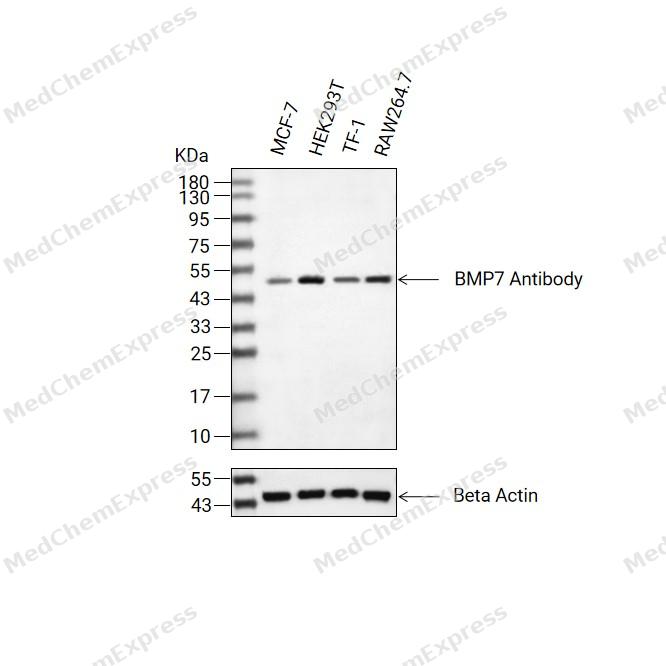 Western blot analysis of extracts from MCF-7(lane 2(20ug) , HEK293T(lane 3(20ug) and TF-1(lane 4(20ug) , RAW264.7(lane 5(20ug) using BMP7 Antibody (HY-P82810) Rabbit mAb. Proteins were transferred to a PVDF membrane and blocked with 5% non-fat milk in TBST for 2 hour at room temperature. The primary antibody (1/1000) and Loading control antibody (Beta Actin, HY-P83730, 1/10000) was used in 5% non-fat milk in TBST at 4°C overnight. Goat Anti-Mouse/Rabbit IgG-HRP Secondary Antibody (1/10000) was used for 1 hour at room temperature.


Background
-
Function
Bone Morphogenetic Protein 7 (BMP-7) is a ligand protein with pleiotropic, belongs to TGFβ family. BMP-7 is involved in regulating the proliferation, invasion and migration of cancer cells, associated with a variety of human tumors[1]. BMP-7 also appears to exhibit anti-inflammatory effects on the vasculature, and may function to maintain vascular integrity[2]. BMP-7 attenuates vascular calcification, but also corrects hyperphosphatemia associated with uremia, and stimulates orthotopic skeletal phosphate deposition while simultaneously preventing vascular calcification by direct action on vascular smooth muscle cells[3]. BMP/TGFβ signaling to involve in vascular and valvular homeostasis, which is a critical process of embryonic development[4]. BMP-7 inhibits primary human aortic smooth muscle cells (SMCs) proliferation due to stimulation with serum, platelet-derived growth factor subunit BB (PDGF-BB) or TGFβ1, and maintains the expression of the vascular SMC phenotype[2]. BMP-7 binds ALK2 or ACVR2A/BMPR2 to signal, and can be terminated by inhibitory SMADs including SMAD6 and SMAD7, which are activated and induced by BMP signaling and switch off BMP signaling via multiple mechanisms[5]. However, BMP-7 knockdown results the expression of p-Smad1/5/9 significantly decreased, accompanied with BMP-7-Smad1/5/9 signaling pathway inactive and epithelial-mesenchymal transition (EMT) process reverse[1]. In lung cancer, BMP-7 inhibits bone metastasis, and induces apoptosis and cell cycle arrest. In malignant melanoma, BMP-7 can induce mesenchymal-epithelial transformation and inhibit the metastasis of cancer cells. BMP-7 inhibit epithelial-mesenchymal transition (EMT) -related genes and cell invasion, inhibit telomerase, shorten telomeres, and induce the aging and apoptosis of breast cancer cells. BMP-7 increases the cell proliferation and migration potential in a model of metastatic breast cancer in the bone and prostate cancer[1]. BMP-7 is widely found in different animals, while the sequence in human is highly similar to Rat (98.08%), and Mouse (97.67%) .
-
Subcellular Localization
Secreted
-
Expression
Tissue_specificity:Expressed in the kidney and bladder. Lower levels seen in the brain -
Subunit
Homodimer; disulfide-linked (PubMed:8570652). Interacts with SOSTDC1 (PubMed:15020244). Interacts with TWSG1 (By similarity). Interacts with FBN1 (via N-terminal domain) and FBN2 (PubMed:18339631). Interacts with type I receptor ACVR1 (PubMed:9748228). Interacts with type II receptor ACVR2A (PubMed:12667445). Interacts with NOG; this interaction inhibits canonical BMP signaling (PubMed:12478285). Interacts with SCUBE3 (PubMed:33308444). Interacts with ERFE; the interaction inhibits BMP-induced transcription of HAMP (PubMed:30097509). Interacts with TGFBR3 (By similarity)
-
SwissProt ID
-
Synonyms
Bmp7; Bone morphogenetic protein 7; Eptotermin alfa; OP 1; Osteogenic protein 1
-
Research Field
Cell Biology


Documentation
-
Data Sheet (262 KB)
-
SDS (251 KB)
- English - EN (251 KB)
- Français - FR (251 KB)
- Deutsch - DE (251 KB)
- Norwegian - NO (251 KB)
- Español - ES (251 KB)
- Swedish - SV (251 KB)
- Italian - IT (251 KB)
- Korean - KR (251 KB)
- Portuguese - PT (251 KB)
-
User Guide for Antibodies (1077 KB)
References
[1]. Sun R, et al. Expression of BMP-7 in cervical cancer and inhibition of epithelial‑mesenchymal transition by BMP-7 knockdown in HeLa cells. Int J Mol Med. 2020 May;45(5):1417-1424. [Content Brief]
[2]. Dorai H, et al. Bone morphogenetic protein-7 (osteogenic protein-1) inhibits smooth muscle cell proliferation and stimulates the expression of markers that are characteristic of SMC phenotype in vitro. J Cell Physiol. 2000 Jul;184(1):37-45. [Content Brief]
[3]. Mathew S, et al. Function and effect of bone morphogenetic protein-7 in kidney bone and the bone-vascular links in chronic kidney disease. Eur J Clin Invest. 2006 Aug;36 Suppl 2:43-50. [Content Brief]
[4]. Yang P, et al. The role of bone morphogenetic protein signaling in vascular calcification. Bone. 2020 Dec;141:115542. [Content Brief]
[5]. Miyazawa K, et al. Regulation of TGF-β Family Signaling by Inhibitory Smads. Cold Spring Harb Perspect Biol. 2017 Mar 1;9(3):a022095. [Content Brief]

 Powered by Bioz
