



CD26 Antibody (YA2511)
(Synonyms: DPP4; ADCP2; CD26; Dipeptidyl peptidase 4; ADABP; Adenosine deaminase complexing protein 2; ADCP-2; Dipeptidyl peptidase IV; DPP IV; T-cell activation antigen CD26; TP103; CD26)Based on 1 publication(s) in Google Scholar
CD26 Antibody (YA2511) is a Rabbit-derived and non-conjugated IgG monoclonal antibody, targeting to CD26.
-
Host:
Rabbit
-
Isotype:
IgG
-
Application:
WB
-
Reactivity :
Human, Mouse, Rat
-
Formulation:
Supplied in 50mM Tris-Glycine(pH 7.4), 0.15M NaCl, 40%Glycerol, 0.01% sodium azide and 0.05% BSA.
-
Conjugation:
Non-conjugated


To place orders, for customer services and technical support, please contact: MedChemExpress USA
Tel: 609-228-6898 E-mail: [email protected] [email protected]



Publications Citing Use of MedChemExpress (MCE) CD26 Antibody (YA2511)
More

Applications
| Application |
WB

WB: Western Blot
|
|---|---|
| Dilution Ratio | 1:500-1:1000 |


Product Details
CD26 Antibody (YA2511) is a Rabbit-derived and non-conjugated IgG monoclonal antibody, targeting to CD26.
-
Host Rabbit

-
Clonality Recombinant, Monoclonal

-
Species ReactivityHuman, Mouse, Rat
-
Observed Molecular WeightObserved band size: 110 kDa
Note: Due to possible protein modifications or aggregation, the molecular weight should be confirmed by actual measurement, and the predicted value is for reference only.

-
Calculated Molecular Weight Predicted band size: 88 kDa

Entrez Gene: 1803 Human ; 13482 Mouse ; 25253 Rat
SwissProt: P27487 Human ; P28843 Mouse ; P14740 Rat
OMIM: 102720 Human
A synthesized peptide derived from human CD26 aa721-766.
Endogenous
Affinity Chromatography
Non-conjugated
Unmodified
IgG


Product Properties
-
Appearance
Liquid
-
Formulation
Supplied in 50mM Tris-Glycine(pH 7.4), 0.15M NaCl, 40%Glycerol, 0.01% sodium azide and 0.05% BSA.
-
Concentration
Batch-dependent, Please check the COA for the concentration of each lot. Check Lot Concentration
-
Storage & Stability
Stored at -20°C for 1 year. Avoid repeated freeze / thaw cycles.
-
Shipping
Shipping with blue ice.


Publications (1)
-
Journal Impact Factor
-
Most Recent


Verification Images
-
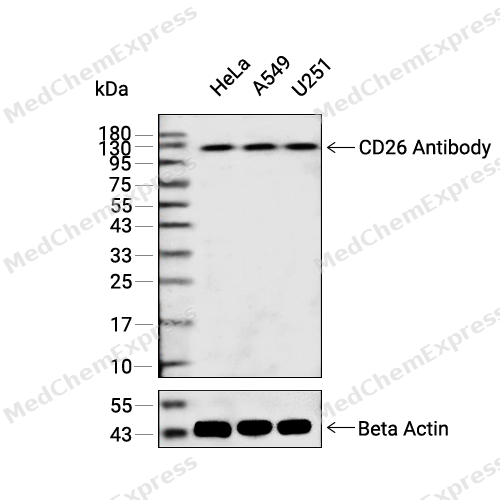 Western blot analysis of extracts from Hela(lane 2(20ug) ,A549(lane 3(20ug) and U251(lane 4(20ug) using CD26 Antibody (HY-P82766) Rabbit mAb. Proteins were transferred to a PVDF membrane and blocked with 5% non-fat milk in TBST for 2 hour at room temperature. The primary antibody (1/1000) and Loading control antibody (Beta Actin, HY-P80438, 1/10000) was used in 5% non-fat milk in TBST at 4°C overnight. Goat Anti-Mouse/Rabbit IgG-HRP Secondary Antibody (1/10000) was used for 1 hour at room temperature.


Background
-
Function
CD26 cell surface glycoprotein receptor involved in the costimulatory signal essential for T-cell receptor (TCR)-mediated T-cell activation. Acts as a positive regulator of T-cell coactivation, by binding at least ADA, CAV1, IGF2R, and PTPRC. Its binding to CAV1 and CARD11 induces T-cell proliferation and NF-kappa-B activation in a T-cell receptor/CD3-dependent manner. Its interaction with ADA also regulates lymphocyte-epithelial cell adhesion. In association with FAP is involved in the pericellular proteolysis of the extracellular matrix (ECM), the migration and invasion of endothelial cells into the ECM. May be involved in the promotion of lymphatic endothelial cells adhesion, migration and tube formation. When overexpressed, enhanced cell proliferation, a process inhibited by GPC3. Also acts as a serine exopeptidase with a dipeptidyl peptidase activity that regulates various physiological processes by cleaving peptides in the circulation, including many chemokines, mitogenic growth factors, neuropeptides and peptide hormones such as brain natriuretic peptide 32. Removes N-terminal dipeptides sequentially from polypeptides having unsubstituted N-termini provided that the penultimate residue is proline; (Microbial infection) Acts as a receptor for human coronavirus MERS-CoV-2[1][2][3][4][5][6][7][8][9][10][11].
-
Subcellular Localization
Secreted; Cell membrane; Single-pass type II membrane protein; Apical cell membrane; Single-pass type II membrane protein; Cell projection, invadopodium membrane; Single-pass type II membrane protein; Cell projection, lamellipodium membrane; Single-pass type II membrane protein; Cell junction; Membrane raft
-
Expression
Tissue_specificity:This protein is specifically expressed in lymphatic vessels, but not in the blood vessels of the skin, small intestine, esophagus, ovary, breast, and prostate. It was not detected (protein level) in the lymphatic vessels of the lungs, kidneys, uterus, liver, and stomach. It is expressed in both poorly differentiated crypt cells and mature villi cells of the small intestine. Expression levels are extremely low in the colon.
Induction:Up-regulated by IL12/interleukin-12 on activated T-cells. IL12-activated cells expressed enhanced levels of DPP4 but not mRNAs. Down-regulated by TNF. Up-regulated in migratory endothelial cells and in the invasive endothelial cells in tumors. Induced by hypoxia (PubMed:16670267) -
Subunit
Monomer. Homodimer (PubMed:12483204, PubMed:12646248, PubMed:12832764, PubMed:12906826, PubMed:15448155, PubMed:17287217). Heterodimer with Seprase (FAP) (PubMed:16651416). Requires homodimerization for optimal dipeptidyl peptidase activity and T-cell costimulation. Found in a membrane raft complex, at least composed of BCL10, CARD11, DPP4 and IKBKB (PubMed:17287217). Associates with collagen (PubMed:8526932). Interacts with PTPRC; the interaction is enhanced in an interleukin-12-dependent manner in activated lymphocytes (PubMed:12676959). Interacts (via extracellular domain) with ADA; does not inhibit its dipeptidyl peptidase activity (PubMed:10951221, PubMed:14691230, PubMed:15016824, PubMed:7907293, PubMed:8101391). Interacts with CAV1 (via the N-terminus); the interaction is direct (PubMed:17287217). Interacts (via cytoplasmic tail) with CARD11 (via PDZ domain); its homodimerization is necessary for interaction with CARD11 (PubMed:17287217). Interacts with IGF2R; the interaction is direct (PubMed:10900005). Interacts with GPC3 (PubMed:17549790). Interacts with human coronavirus-EMC spike protein and acts as a receptor for this virus (PubMed:23486063)
-
SwissProt ID
-
Synonyms
DPP4; ADCP2; CD26; Dipeptidyl peptidase 4; ADABP; Adenosine deaminase complexing protein 2; ADCP-2; Dipeptidyl peptidase IV; DPP IV; T-cell activation antigen CD26; TP103; CD26
-
Research Field
Immunology
Documentation
-
Data Sheet (234 KB)
-
SDS (252 KB)
- English - EN (252 KB)
- Français - FR (252 KB)
- Deutsch - DE (252 KB)
- Norwegian - NO (252 KB)
- Español - ES (252 KB)
- Swedish - SV (252 KB)
- Italian - IT (252 KB)
- Korean - KR (252 KB)
- Portuguese - PT (252 KB)
-
User Guide for Antibodies (1077 KB)

 Powered by Bioz
