



CD3D Antibody (YA3639)
(Synonyms: T3D; IMD19; CD3-DELTA)Based on 1 Customer Validation
CD3D Antibody (YA3639) is a Mouse-derived and non-conjugated IgG2b monoclonal antibody, targeting to CD3D.
-
Host:
Mouse
-
Isotype:
IgG2b
-
Application:
WB, FC, ELISA
-
Reactivity :
Human
-
Formulation:
Supplied in PBS with 0.05% sodium azide
-
Conjugation:
Non-conjugated


To place orders, for customer services and technical support, please contact: MedChemExpress USA
Tel: 609-228-6898 E-mail: [email protected] [email protected]





Applications
| Application |
WB

WB: Western Blot
|
FC
FC: Flow Cytometry
|
ELISA
ELISA: Enzyme Linked Immunosorbent Assay
|
|---|---|---|---|
| Dilution Ratio | 1:500-1:2000 | 1:200-1:400 | 1:10000 |


Product Details
CD3D Antibody (YA3639) is a Mouse-derived and non-conjugated IgG2b monoclonal antibody, targeting to CD3D.
-
Host Mouse

-
Clonality Monoclonal

-
Species ReactivityHuman
-
Observed Molecular WeightObserved band size: 23 kDa
Note: Due to possible protein modifications or aggregation, the molecular weight should be confirmed by actual measurement, and the predicted value is for reference only.

-
Calculated Molecular Weight Predicted band size: 19 kDa

Purified recombinant fragment of human CD3D (AA: 127-171) expressed in E. Coli.
affinity purified.
Non-conjugated
Unmodified
IgG2b


Product Properties
-
Appearance
Liquid
-
Formulation
Supplied in PBS with 0.05% sodium azide
-
Concentration
Batch-dependent, Please check the COA for the concentration of each lot. Check Lot Concentration
-
Storage & Stability
Stored at -20°C for 1 year. Avoid repeated freeze / thaw cycles.
-
Shipping
Shipping with blue ice.


Verification Images
-
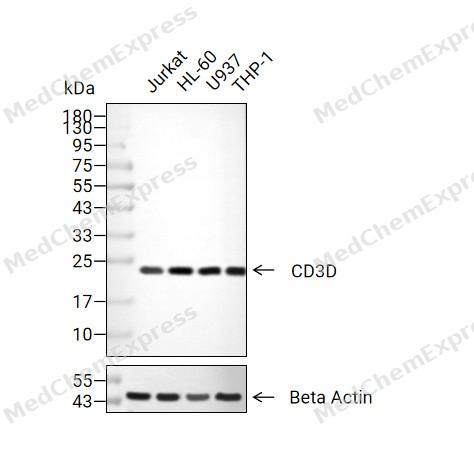 Western blot analysis of extracts from Jurkat (lane 2(20μg), HL-60 (lane 3(20μg), U937 (lane 4(20μg), THP-1 (lane 5(20μg) using CD3D Antibody(HY-P83942). Proteins were transferred to a PVDF membrane and blocked with 5% non-fat milk in TBST for 2 hour at room temperature. The primary antibody (1/1000) and Loading control antibody (Beta Actin, HY-P80993, 1/10,000) was used in 5% non-fat milk in TBST at 4°C overnight. Goat Anti-Mouse IgG-HRP Secondary Antibody (HY-P8004 ,1/10,000) was used for 1 hour at room temperature.


Background
-
Function
CD3D is a Part of the TCR-CD3 complex present on T-lymphocyte cell surface that plays an essential role in adaptive immune response. When antigen presenting cells (APCs) activate T-cell receptor (TCR), TCR-mediated signals are transmitted across the cell membrane by the CD3 chains CD3D, CD3E, CD3G and CD3Z. All CD3 chains contain immunoreceptor tyrosine-based activation motifs (ITAMs) in their cytoplasmic domain. Upon TCR engagement, these motifs become phosphorylated by Src family protein tyrosine kinases LCK and FYN, resulting in the activation of downstream signaling pathways. In addition of this role of signal transduction in T-cell activation, CD3D plays an essential role in thymocyte differentiation. Indeed, participates in correct intracellular TCR-CD3 complex assembly and surface expression. In absence of a functional TCR-CD3 complex, thymocytes are unable to differentiate properly. Interacts with CD4 and CD8 and thus serves to establish a functional link between the TCR and coreceptors CD4 and CD8, which is needed for activation and positive selection of CD4 or CD8 T-cells[1][2].
-
Subcellular Localization
Cell membrane; Single-pass type I membrane protein
-
Expression
Tissue_specificity:CD3D is mainly found on T lymphocytes and binds to its TCR-CD3 chaperone protein. CD3D is also present in fetal NK cells. -
Isoforms & Post-Translational Modification
P04234 has 2 isomers: P04234-1: 18930 Da (predicted); P04234-2: 14484 Da (predicted).
Phosphorylated on Tyr residues after T-cell receptor triggering by LCK in association with CD4/CD8 -
Subunit
The TCR-CD3 complex is composed of a CD3D/CD3E and a CD3G/CD3E heterodimers that preferentially associate with TCRalpha and TCRbeta, respectively, to form TCRalpha/CD3E/CD3G and TCRbeta/CD3G/CD3E trimers. In turn, the hexamer interacts with CD3Z homodimer to form the TCR-CD3 complex. Alternatively, TCRalpha and TCRbeta can be replaced by TCRgamma and TCRdelta. Interacts with coreceptors CD4 and CD8 (PubMed:12215456, PubMed:1396954)
-
SwissProt ID
-
Synonyms
T3D; IMD19; CD3-DELTA


Documentation
-
Data Sheet (235 KB)
-
SDS (251 KB)
- English - EN (251 KB)
- Français - FR (251 KB)
- Deutsch - DE (251 KB)
- Norwegian - NO (251 KB)
- Español - ES (251 KB)
- Swedish - SV (251 KB)
- Italian - IT (251 KB)
- Korean - KR (251 KB)
- Portuguese - PT (251 KB)
-
User Guide for Antibodies (1077 KB)

 Powered by Bioz
