



CENPA Antibody (YA1325)
(Synonyms: CENPA)
Based on 1 Customer Validation
CENPA Antibody (YA1325) is a Rabbit-derived and non-conjugated IgG monoclonal antibody, targeting to CENPA.
-
Host:
Rabbit
-
Isotype:
IgG
-
Application:
WB, ICC/IF
-
Reactivity :
Human
-
Formulation:
Supplied in PBS (pH7.4), 0.1% BSA, 40% Glycerol. Preservative: 0.05% Sodium Azide.
-
Conjugation:
Non-conjugated


To place orders, for customer services and technical support, please contact: MedChemExpress USA
Tel: 609-228-6898 E-mail: [email protected] [email protected]





Applications
| Application |
WB

WB: Western Blot
|
ICC/IF
ICC/IF: Immunocytochemistry/
Immunofluorescence |
|---|---|---|
| Dilution Ratio | 1:500-1:2000 | 1:100 |


Product Details
CENPA Antibody (YA1325) is a Rabbit-derived and non-conjugated IgG monoclonal antibody, targeting to CENPA.
-
Host Rabbit

-
Clonality Recombinant,Monoclonal

-
Species ReactivityHuman
-
Observed Molecular WeightObserved band size:18 kDa
Note: Due to possible protein modifications or aggregation, the molecular weight should be confirmed by actual measurement, and the predicted value is for reference only.

-
Calculated Molecular Weight Predicted band size: 16 kDa

Synthetic peptide within human CENPA aa 21-70 / 140.
Endogenous
Protein A
Non-conjugated
Unmodified
IgG


Product Properties
-
Appearance
Liquid
-
Formulation
Supplied in PBS (pH7.4), 0.1% BSA, 40% Glycerol. Preservative: 0.05% Sodium Azide.
-
Concentration
Batch-dependent, Please check the COA for the concentration of each lot. Check Lot Concentration
-
Storage & Stability
Stored at -20°C for 1 year. Avoid repeated freeze / thaw cycles.
-
Shipping
Shipping with blue ice.


Verification Images
-
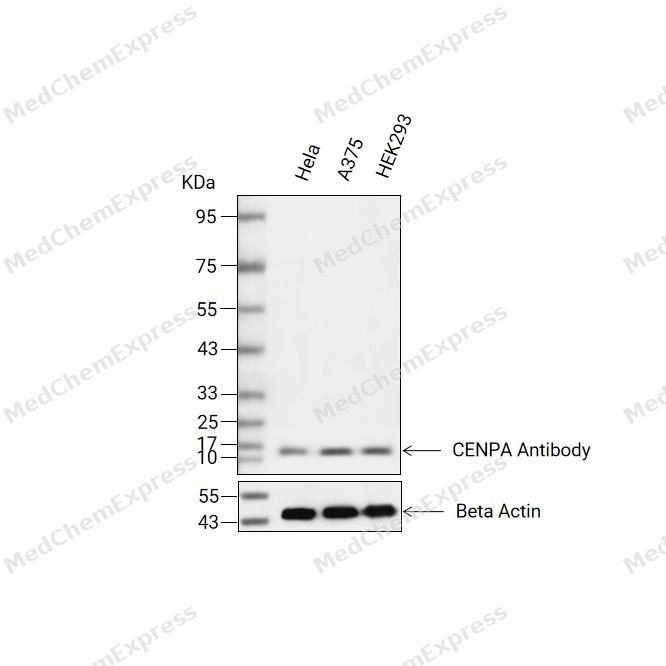 Western blot analysis of extracts from Hela(lane 2(20ug) , A375(lane 3(20ug) and HEK293(lane 4(20ug) using CENPA Antibody (HY-P81580) Rabbit mAb. Proteins were transferred to a PVDF membrane and blocked with 5% non-fat milk in TBST for 2 hour at room temperature. The primary antibody (1/1000) and Loading control antibody (Beta Actin, HY-P83730, 1/10000) was used in 5% non-fat milk in TBST at 4°C overnight. Goat Anti-Mouse/Rabbit IgG-HRP Secondary Antibody (1/10000) was used for 1 hour at room temperature.
 -
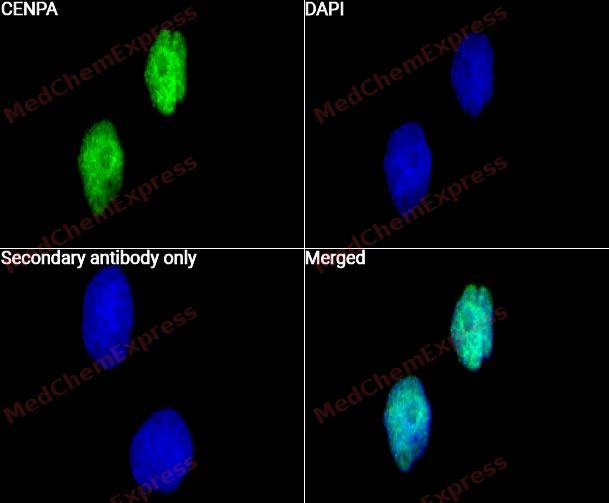 Immunocytochemistry analysis of HepG2 cells labeling CENPA with CENPA Antibody (HY-P81580) at 1/50 dilution. Cells were fixed in 4% paraformaldehyde for 15 minutes at room temperature, permeabilized with 0.1% Triton X-100 for 10 minutes at room temperature, then blocked with QuickBlock™ Blocking Buffer for Immunol Staining for 10 min at room temperature. Cells were then incubated with CENPA Antibody (HY-P81580) at 1/50 dilution in QuickBlock™ Blocking Buffer for Immunol Staining at 4 ℃. Alexa Fluor® 488-conjugated AffiniPure Goat Anti-Rabbit IgG H&L(HY-P8002, Green) was used as the secondary antibody at 1/1,000 dilution. PBS instead of the primary antibody was used as the secondary antibody only control. The Nuclear counterstain was DAPI (Blue).
 -
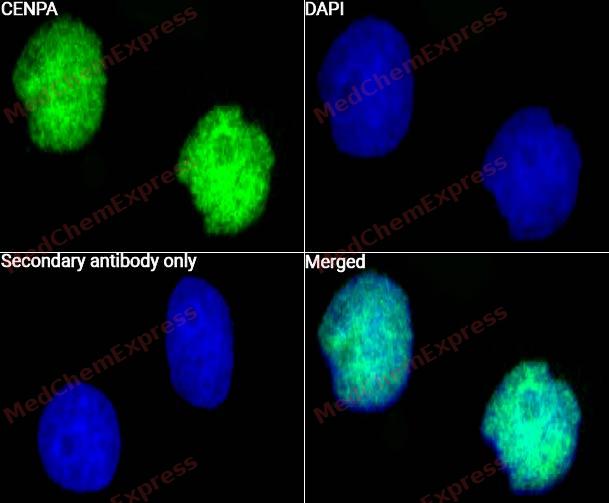 Immunocytochemistry analysis of HeLa cells labeling CENPA with CENPA Antibody (HY-P81580)at 1/50 dilution. Cells were fixed in 4% paraformaldehyde for 15 minutes at room temperature, permeabilized with 0.1% Triton X-100 for 10 minutes at room temperature, then blocked with QuickBlock™ Blocking Buffer for Immunol Staining for 10 min at room temperature. Cells were then incubated with CENPA Antibody (HY-P81580) at 1/50 dilution in QuickBlock™ Blocking Buffer for Immunol Staining at 4 ℃. Alexa Fluor® 488-conjugated AffiniPure Goat Anti-Rabbit IgG H&L(HY-P8002, Green) was used as the secondary antibody at 1/1,000 dilution. PBS instead of the primary antibody was used as the secondary antibody only control. The Nuclear counterstain was DAPI (Blue).


Background
-
Function
CENPA is a Histone H3-like nucleosomal protein that is specifically found in centromeric nucleosomes. Replaces conventional H3 in the nucleosome core of centromeric chromatin that serves as an assembly site for the inner kinetochore. The presence of CENPA subtly modifies the nucleosome structure and the way DNA is wrapped around the nucleosome and gives rise to protruding DNA ends that are less well-ordered and rigid compared to nucleosomes containing histone H3. May serve as an epigenetic mark that propagates centromere identity through replication and cell division. Required for recruitment and assembly of kinetochore proteins, and as a consequence required for progress through mitosis, chromosome segregation and cytokinesis[1][2][3][4][5][6][7][8][9][10][11][12][13][14][15][16].
-
Subcellular Localization
Nucleus; Chromosome, centromere
-
Isoforms & Post-Translational Modification
P49450 has 2 isomers: P49450-1: 15991 Da (predicted); P49450-2: 13001 Da (predicted).
Ubiquitinated (Probable). Interaction with herpes virus HSV-1 ICP0 protein, leads to its degradation by the proteasome pathway;Trimethylated by NTMT1 at the N-terminal glycine after cleavage of Met-1. Methylation is low before incorporation into nucleosomes and increases with cell cycle progression, with the highest levels in mitotic nucleosomes;Phosphorylated by CDK1 at Ser-68 during early mitosis; this abolishes association with chromatin and centromeres, prevents interaction with HJURP and thereby prevents premature assembly of CENPA into centromeres (PubMed:25556658). Dephosphorylated at Ser-68 by PPP1CA during late mitosis (PubMed:25556658). Phosphorylation of Ser-7 by AURKA and AURKB during prophase is required for localization of AURKA and AURKB at inner centromere and is essential for normal cytokinesis (PubMed:11756469, PubMed:14667408, PubMed:18239465). Initial phosphorylation during prophase is mediated by AURKA and is maintained by AURKB;Poly-ADP-ribosylated by PARP1 -
Subunit
Component of centromeric nucleosomes, where DNA is wrapped around a histone octamer core (PubMed:20739937, PubMed:21743476, PubMed:23818633, PubMed:26878239). The octamer contains two molecules each of H2A, H2B, CENPA and H4 assembled in one CENPA-H4 heterotetramer and two H2A-H2B heterodimers (PubMed:20739937, PubMed:21743476, PubMed:23818633, PubMed:26878239). CENPA modulates the DNA-binding characteristics of nucleosomes so that protruding DNA ends have higher flexibility than in nucleosomes containing conventional histone H3 (PubMed:21743476, PubMed:27499292). Inhibits binding of histone H1 to nucleosomes, since histone H1 binds preferentially to rigid DNA linkers that protrude from nucleosomes (PubMed:27499292). Nucleosomes containing CENPA also contain histone H2A variants such as MACROH2A and H2A.Z/H2AZ1 (Probable). The CENPA-H4 heterotetramer is more compact and structurally more rigid than corresponding H3-H4 heterotetramers (PubMed:15282608, PubMed:20739937). Can assemble into nucleosomes that contain both CENPA and histone H3.3; these nucleosomes interact with a single CENPC chain (PubMed:25408271). Heterotrimer composed of HJURP, CENPA and histone H4, where HJURP interacts with the dimer formed by CENPA and histone H4 and prevents tetramerization of CENPA and H4 (PubMed:21478274). Component of the CENPA-NAC complex, at least composed of CENPA, CENPC, CENPH, CENPM, CENPN, CENPT and CENPU (PubMed:16622419). Interacts (via CATD domain) with HJURP; the interaction is direct and is required for its localization to centromeres (PubMed:15282608, PubMed:19410544, PubMed:19410545, PubMed:23818633, PubMed:25556658). Interacts with CENPC, CENPN and CENPT; interaction is direct. Part of a centromere complex consisting of CENPA, CENPT and CENPW (PubMed:19533040). Identified in centromere complexes containing histones H2A, H2B and H4, and at least CENPA, CENPB, CENPC, CENPT, CENPN, HJURP, SUPT16H, SSRP1 and RSF1 (PubMed:27499292). Can self-associate (PubMed:9024683). The CENPA-H4 heterotetramer can bind DNA by itself (in vitro) (PubMed:20739937). Interacts with CDK1, PPP1CA and RBBP7 (PubMed:25556658)
-
SwissProt ID
-
Synonyms
CENPA
-
Research Field
Epigenetics


Documentation
-
Data Sheet (232 KB)
-
SDS (251 KB)
- English - EN (251 KB)
- Français - FR (251 KB)
- Deutsch - DE (251 KB)
- Norwegian - NO (251 KB)
- Español - ES (251 KB)
- Swedish - SV (251 KB)
- Italian - IT (251 KB)
- Korean - KR (251 KB)
- Portuguese - PT (251 KB)
-
User Guide for Antibodies (1077 KB)

 Powered by Bioz
