



CRTC3 Antibody (YA1748)
(Synonyms: TORC3; FLJ21868; CRTC3)
Based on 1 Customer Validation
CRTC3 Antibody (YA1748) is a Rabbit-derived and non-conjugated IgG monoclonal antibody, targeting to CRTC3.
-
Host:
Rabbit
-
Isotype:
IgG
-
Application:
WB, ICC/IF
-
Reactivity :
Human, Mouse, Rat
-
Formulation:
Supplied in 50mM Tris-Glycine(pH 7.4), 0.15M NaCl, 40% Glycerol, 0.01% Sodium azide and 0.05% BSA
-
Conjugation:
Non-conjugated


To place orders, for customer services and technical support, please contact: MedChemExpress USA
Tel: 609-228-6898 E-mail: [email protected] [email protected]





Applications
| Application |
WB

WB: Western Blot
|
ICC/IF
ICC/IF: Immunocytochemistry/
Immunofluorescence |
|---|---|---|
| Dilution Ratio | 1:500-1:1000 | 1:50-1:200 |


Product Details
CRTC3 Antibody (YA1748) is a Rabbit-derived and non-conjugated IgG monoclonal antibody, targeting to CRTC3.
-
Host Rabbit

-
Clonality Recombinant, Monoclonal

-
Species ReactivityHuman, Mouse, Rat
-
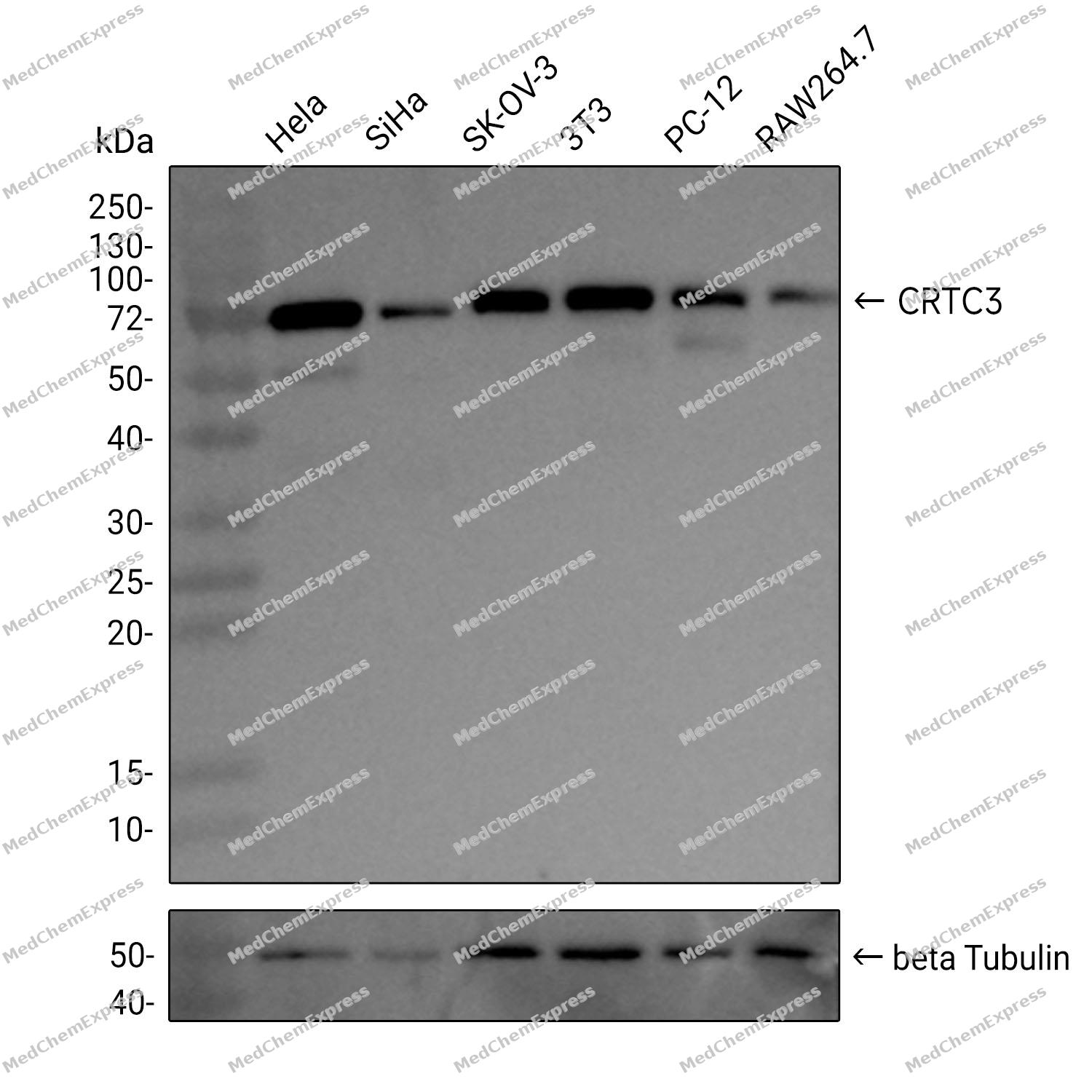
Observed Molecular WeightObserved band size: 78 kDa
Note: Due to possible protein modifications or aggregation, the molecular weight should be confirmed by actual measurement, and the predicted value is for reference only.

-
Calculated Molecular Weight Predicted band size: 67 kDa

Entrez Gene: 64784 Human ; 70461 Mouse ; 365297 Rat
SwissProt: Q6UUV7 Human ; Q91X84 Mouse ;
OMIM: 608986 Human
A synthetic peptide of human CRTC3
Endogenous
Affinity Purified
Non-conjugated
Unmodified
IgG


Product Properties
-
Appearance
Liquid
-
Formulation
Supplied in 50mM Tris-Glycine(pH 7.4), 0.15M NaCl, 40% Glycerol, 0.01% Sodium azide and 0.05% BSA
-
Concentration
Batch-dependent, Please check the COA for the concentration of each lot. Check Lot Concentration
-
Storage & Stability
Stored at -20°C for 1 year. Avoid repeated freeze / thaw cycles.
-
Shipping
Shipping with blue ice.


Verification Images
-
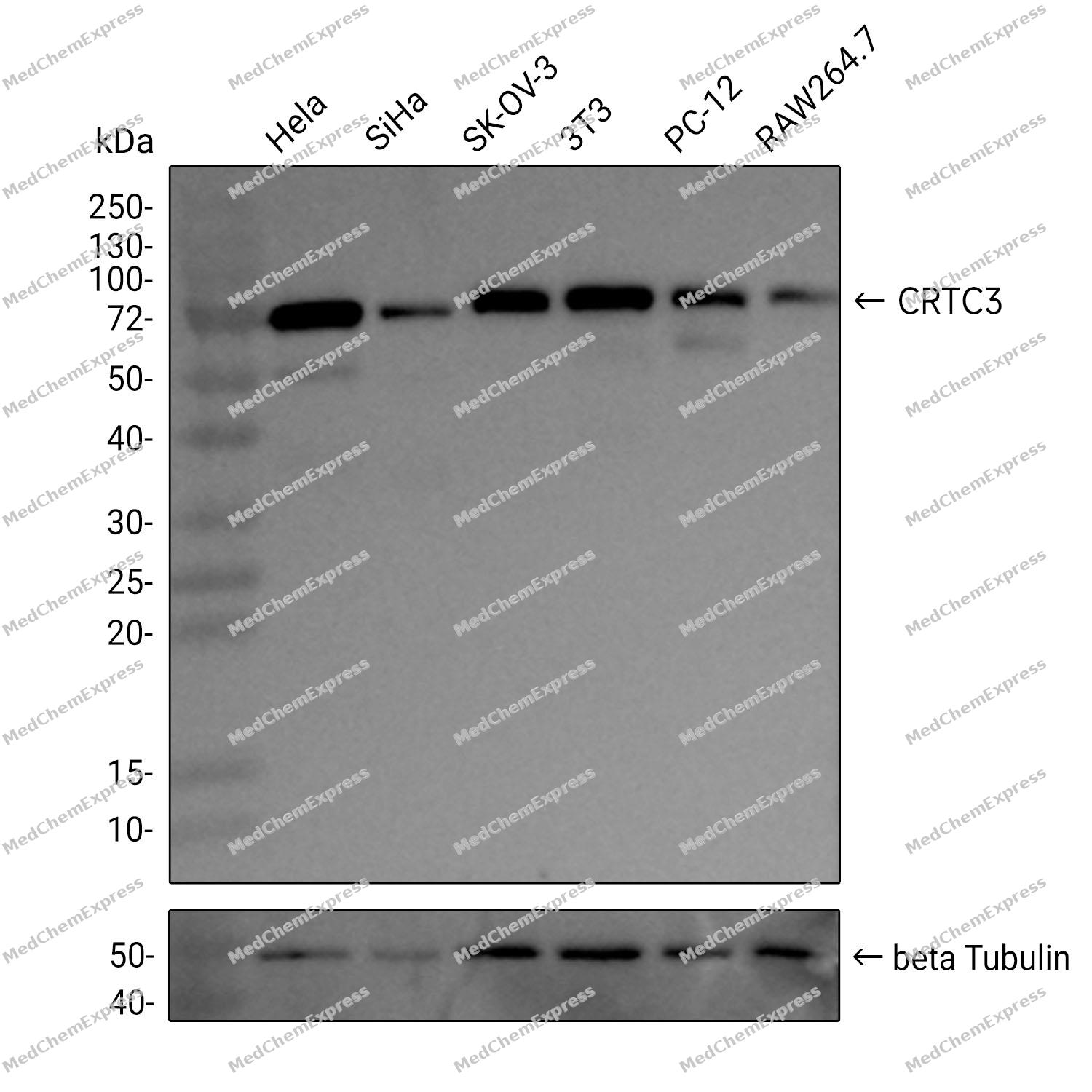 Western blot analysis was performed on extracts from Hela (lane 1, 15 μg), SiHa (lane 2, 15 μg), SK-OV-3 (lane 3, 15 μg), 3T3 (lane 4, 15 μg), PC-12 (lane 5, 15 μg), RAW264.7 (lane 6, 15 μg) using CRTC3 Rabbit mAb.Proteins were transferred to a PVDF membrane and blocked with 5% non-fat milk in TBST at 4°C overnight.The primary antibody (1:1000 dilution) and the loading control antibody (beta-Tubulin, HY-P80955, 1:5000 dilution) were incubated in 5% non-fat milk in TBST for 1 hour at 37°C.Goat Anti-Rabbit IgG-HRP Secondary Antibody (1:20000 dilution) was then applied for 40 minutes at 37°C.


Background
-
Function
CRTC3 transcriptional coactivator for CREB1 which activates transcription through both consensus and variant cAMP response element (CRE) sites. Acts as a coactivator, in the SIK/TORC signaling pathway, being active when dephosphorylated and acts independently of CREB1 'Ser-133' phosphorylation. Enhances the interaction of CREB1 with TAF4. Regulates the expression of specific CREB-activated genes such as the steroidogenic gene, StAR. Potent coactivator of PPARGC1A and inducer of mitochondrial biogenesis in muscle cells. Also coactivator for TAX activation of the human T-cell leukemia virus type 1 (HTLV-1) long terminal repeats (LTR)
-
Subcellular Localization
Nucleus; Cytoplasm
-
Expression
Tissue_specificity:It is primarily expressed in B cells and T cells. The highest expression level is found in lung tissue. It is also expressed in the brain, colon, heart, kidneys, ovaries, and prostate. Expression is weaker in the liver, pancreas, muscles, small intestine, spleen, and stomach. -
Isoforms & Post-Translational Modification
Q6UUV7 has 2 isomers: Q6UUV7-1: 66959 Da (predicted); Q6UUV7-3: 66830 Da (predicted).
Phosphorylation/dephosphorylation states of Ser-273 are required for regulating transduction of CREB activity (By similarity). CRTCs/TORCs are inactive when phosphorylated, and active when dephosphorylated at this site (By similarity). May be phosphorylated at Ser-391 by MAPK3/ERK1 and/or MAPK1/ERK2 or by some cyclin-dependent kinases such as CDK1,CDK2 or CDK5 (PubMed:30611118). Following adenylyl cyclase activation, dephosphorylated at Ser-162 and Ser-273 resulting in its dissociation from 14-3-3 proteins probably promoting CRTC3 translocation into the nucleus (PubMed:30611118) -
Subunit
Binding, as a tetramer, through its N-terminal region, with the bZIP domain of CREB1 enhances recruitment of TAF4 to the promoter (PubMed:14506290). 'Arg-314' in the bZIP domain of CREB1 is essential for this interaction (PubMed:14506290). Interacts (when phosphorylated at Ser-162 and Se-273) with 14-3-3 proteins (PubMed:30611118). Interacts with YWHAE (PubMed:30611118). Interacts (when phosphorylated at Ser-391) with phosphatase PP2A catalytic subunit PPP2CA and regulatory subunits PPP2R1A and PPP2R2A (PubMed:30611118). Interacts, via the N-terminal with the ankyrin repeats of BCL3, to form a complex with CREB1 on CRE and TxRE responsive elements and represses HTLV-1 LTR-mediated transcription (PubMed:17644518)
-
SwissProt ID
-
Synonyms
TORC3; FLJ21868; CRTC3
-
Research Field
Microbiology


Documentation
-
Data Sheet (235 KB)
-
SDS (251 KB)
- English - EN (251 KB)
- Français - FR (251 KB)
- Deutsch - DE (251 KB)
- Norwegian - NO (251 KB)
- Español - ES (251 KB)
- Swedish - SV (251 KB)
- Italian - IT (251 KB)
- Korean - KR (251 KB)
- Portuguese - PT (251 KB)
-
User Guide for Antibodies (1077 KB)

 Powered by Bioz
