



DDX21 Antibody (YA2663)
(Synonyms: GUA; GURDB; RH-II/GU; RH-II/GuA)
Based on 1 Customer Validation
DDX21 Antibody (YA2663) is a Rabbit-derived and non-conjugated IgG monoclonal antibody, targeting to DDX21.
-
Host:
Rabbit
-
Isotype:
IgG
-
Application:
WB, ICC/IF
-
Reactivity :
Human
-
Formulation:
Supplied in 50mM Tris-Glycine(pH 7.4), 0.15M NaCl, 40% Glycerol, 0.01% Sodium azide and 0.05% BSA
-
Conjugation:
Non-conjugated


To place orders, for customer services and technical support, please contact: MedChemExpress USA
Tel: 609-228-6898 E-mail: [email protected] [email protected]





Applications
| Application |
WB

WB: Western Blot
|
ICC/IF
ICC/IF: Immunocytochemistry/
Immunofluorescence |
|---|---|---|
| Dilution Ratio | 1:500-1:1000 | 1:50-1:200 |


Product Details
DDX21 Antibody (YA2663) is a Rabbit-derived and non-conjugated IgG monoclonal antibody, targeting to DDX21.
-
Host Rabbit

-
Clonality Recombinant, Monoclonal

-
Species ReactivityHuman
-
Observed Molecular WeightObserved band size: 87 kDa
Note: Due to possible protein modifications or aggregation, the molecular weight should be confirmed by actual measurement, and the predicted value is for reference only.

-
Calculated Molecular Weight Predicted band size: 87 kDa

A synthetic peptide of human DDX21 aa248-260.
Endogenous
Affinity Purified
Non-conjugated
Unmodified
IgG


Product Properties
-
Appearance
Liquid
-
Formulation
Supplied in 50mM Tris-Glycine(pH 7.4), 0.15M NaCl, 40% Glycerol, 0.01% Sodium azide and 0.05% BSA
-
Concentration
Batch-dependent, Please check the COA for the concentration of each lot. Check Lot Concentration
-
Storage & Stability
Stored at -20°C for 1 year. Avoid repeated freeze / thaw cycles.
-
Shipping
Shipping with blue ice.


Verification Images
-
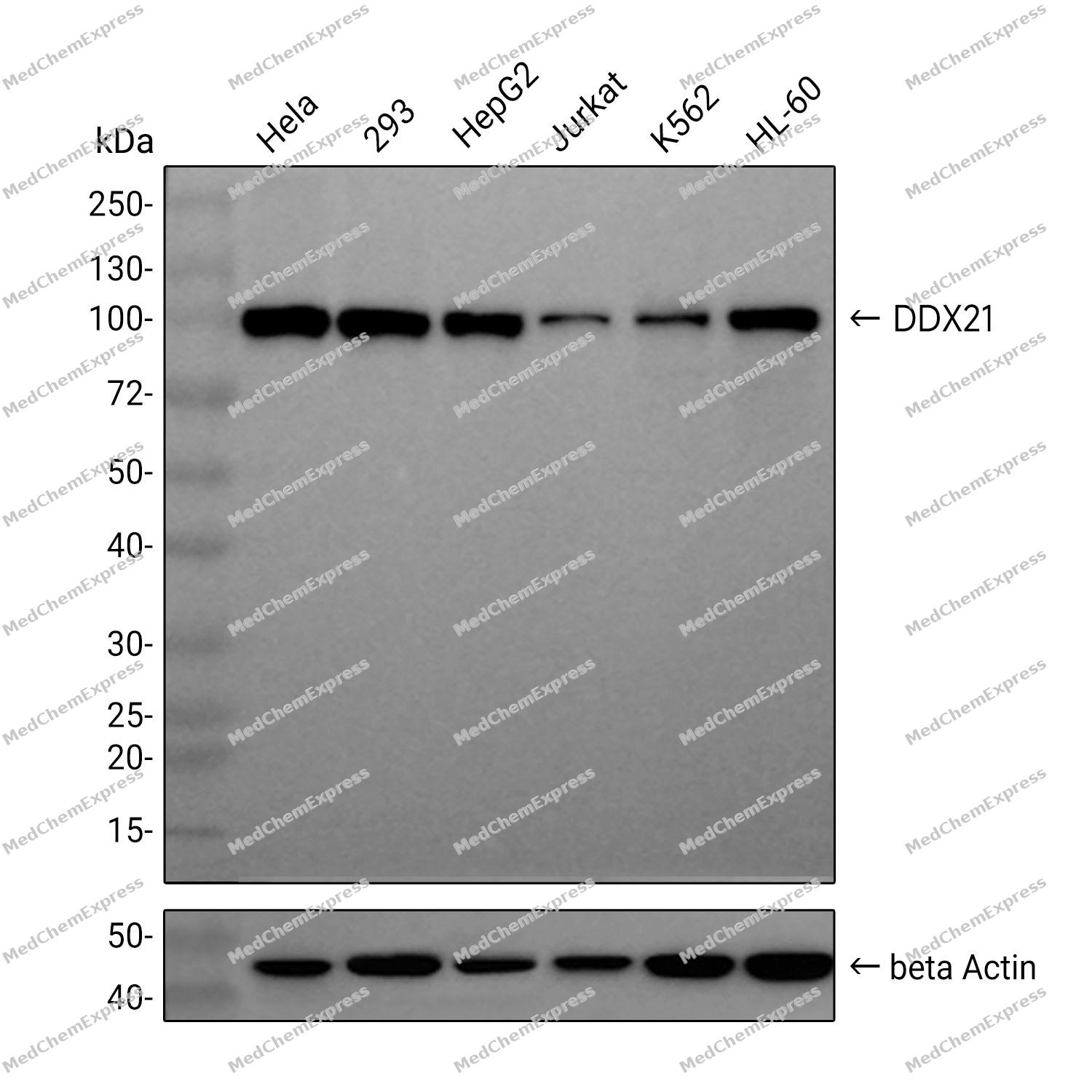
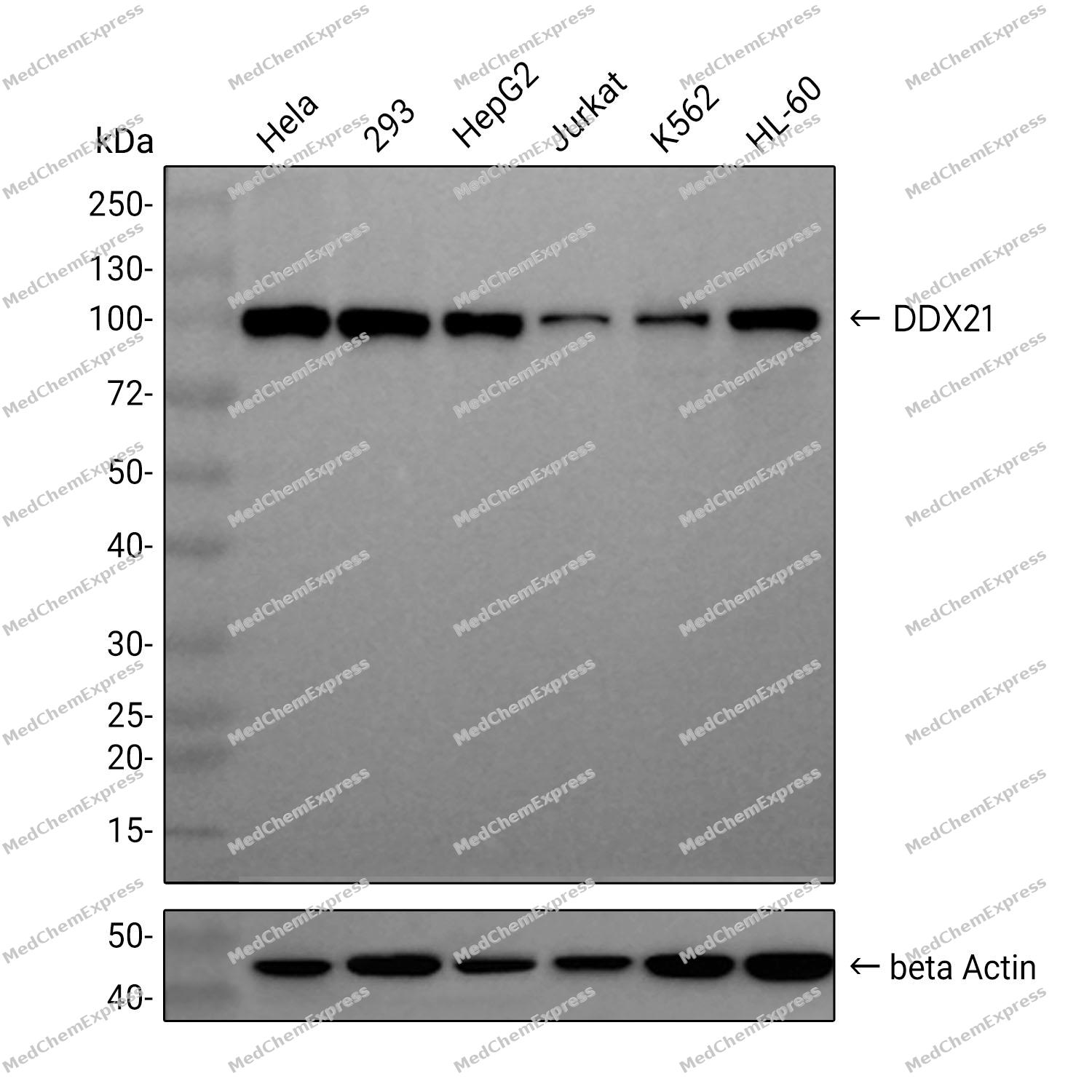 Western blot analysis was performed on extracts from Hela (lane 1, 15 μg), 293 (lane 2, 15 μg), HepG2 (lane 3, 15 μg), Jurkat (lane 4, 15 μg), K562 (lane 5, 15 μg), and HL-60 (lane 6, 15 μg) using DDX21 Rabbit mAb.Proteins were transferred to a PVDF membrane and blocked with 5% non-fat milk in TBST at 4°C overnight.The primary antibody (1:1000 dilution) and the loading control antibody (beta-Actin, HY-P80438, 1:5000 dilution) was incubated in 5% non-fat milk in TBST for 1 hour at 37°C.Goat Anti-Rabbit IgG-HRP Secondary Antibody (1:20000 dilution) was then applied for 40 minutes at 37°C.


Background
-
Function
DDX21 is a RNA helicase that acts as a sensor of the transcriptional status of both RNA polymerase (Pol) I and II: promotes ribosomal RNA (rRNA) processing and transcription from polymerase II (Pol II). Binds various RNAs, such as rRNAs, snoRNAs, 7SK and, at lower extent, mRNAs. In the nucleolus, localizes to rDNA locus, where it directly binds rRNAs and snoRNAs, and promotes rRNA transcription, processing and modification. Required for rRNA 2'-O-methylation, possibly by promoting the recruitment of late-acting snoRNAs SNORD56 and SNORD58 with pre-ribosomal complexes. In the nucleoplasm, binds 7SK RNA and is recruited to the promoters of Pol II-transcribed genes: acts by facilitating the release of P-TEFb from inhibitory 7SK snRNP in a manner that is dependent on its helicase activity, thereby promoting transcription of its target genes. Functions as a cofactor for JUN-activated transcription: required for phosphorylation of JUN at 'Ser-77'. Can unwind double-stranded RNA (helicase) and can fold or introduce a secondary structure to a single-stranded RNA (foldase). Together with SIRT7, required to prevent R-loop-associated DNA damage and transcription-associated genomic instability: deacetylation by SIRT7 activates the helicase activity, thereby overcoming R-loop-mediated stalling of RNA polymerases. Involved in rRNA processing. May bind to specific miRNA hairpins. Component of a multi-helicase-TICAM1 complex that acts as a cytoplasmic sensor of viral double-stranded RNA (dsRNA) and plays a role in the activation of a cascade of antiviral responses including the induction of pro-inflammatory cytokines via the adapter molecule TICAM1[1][2][3][4][5][6][7][8][9].
-
Subcellular Localization
Nucleus, nucleolus; Nucleus, nucleoplasm; Cytoplasm, cytosol; Mitochondrion
-
Isoforms & Post-Translational Modification
Q9NR30 has 2 isomers: Q9NR30-1: 87344 Da (predicted); Q9NR30-2: 79657 Da (predicted).
Acetylation by CREBBP/CBP inhibits the helicase activity (PubMed:28790157). Deacetylation by SIRT7 promotes the helicase activity and overcomes R-loop-mediated stalling of RNA polymerases (PubMed:28790157) -
Subunit
Homodimer; homodimerizes via its N-terminus. Found in a multi-helicase-TICAM1 complex at least composed of DHX36, DDX1, DDX21 and TICAM1; this complex exists in resting cells with or without poly(I:C) RNA ligand stimulation. Interacts (via C-terminus) with TICAM1 (via TIR domain). Interacts with DHX36 (via C-terminus); this interaction serves as bridges to TICAM1. Interacts (via C-terminus) with DDX1 (via B30.2/SPRY domain); this interaction serves as bridges to TICAM1. Component of the B-WICH complex, at least composed of SMARCA5/SNF2H, BAZ1B/WSTF, SF3B1, DEK, MYO1C, ERCC6, MYBBP1A and DDX21. Interacts with C1QBP. Interacts with JUN. Interacts with WDR46 (By similarity). Component of the B-WICH complex, at least composed of SMARCA5/SNF2H, BAZ1B/WSTF, SF3B1, DEK, MYO1C, ERCC6, MYBBP1A and DDX21. Interacts with C1QBP. Interacts with JUN (PubMed:11823437, PubMed:18180292). Interacts with WDR46 (PubMed:23848194). Interacts with MCM3AP isoform GANP (PubMed:23652018). Interacts with WDR43 (By similarity). Interacts with KPNA3 (PubMed:34564892). Interacts with GID4 (PubMed:38773330)
-
SwissProt ID
-
Synonyms
GUA; GURDB; RH-II/GU; RH-II/GuA
-
Research Field
Epigenetics and Nuclear Signaling


Documentation
-
Data Sheet (235 KB)
-
SDS (251 KB)
- English - EN (251 KB)
- Français - FR (251 KB)
- Deutsch - DE (251 KB)
- Norwegian - NO (251 KB)
- Español - ES (251 KB)
- Swedish - SV (251 KB)
- Italian - IT (251 KB)
- Korean - KR (251 KB)
- Portuguese - PT (251 KB)
-
User Guide for Antibodies (1077 KB)

 Powered by Bioz
