



FGFR3 Antibody (YA438)
(Synonyms: CD333, JTK4, FGFR3, Fibroblast growth factor receptor 3, FGFR-3)Based on 1 publication(s) in Google Scholar
FGFR3 Antibody (YA438) is a Rabbit-derived and non-conjugated IgG monoclonal antibody, targeting to FGFR3.
-
Host:
Rabbit
-
Isotype:
IgG
-
Application:
WB, ICC/IF, IHC-P
-
Reactivity :
Human, Mouse
-
Formulation:
Supplied in 1*TBS (pH7.4), 0.05% BSA and 40% Glycerol. Preservative: 0.05% Sodium Azide.
-
Conjugation:
Non-conjugated


To place orders, for customer services and technical support, please contact: MedChemExpress USA
Tel: 609-228-6898 E-mail: [email protected] [email protected]



Publications Citing Use of MedChemExpress (MCE) FGFR3 Antibody (YA438)
More

Applications
| Application |
WB

WB: Western Blot
|
ICC/IF
ICC/IF: Immunocytochemistry/
Immunofluorescence |
IHC-P
IHC-P: Immunohistochemistry-Paraffin
|
|---|---|---|---|
| Dilution Ratio | 1:1000 | 1:50-1:200 | 1:50-1:200 |


Product Details
FGFR3 Antibody (YA438) is a Rabbit-derived and non-conjugated IgG monoclonal antibody, targeting to FGFR3.
-
Host Rabbit

-
Clonality Recombinant,Monoclonal

-
Species ReactivityHuman, Mouse
-
Observed Molecular WeightObserved band size: 95-130 kDa
Note: Due to possible protein modifications or aggregation, the molecular weight should be confirmed by actual measurement, and the predicted value is for reference only.

-
Calculated Molecular Weight Predicted band size: 88 kDa

Synthetic peptide corresponding to Human FGFR3.AA range:30-63.
Endogenous
Protein A affinity purified.
Non-conjugated
Unmodified
IgG


Product Properties
-
Appearance
Solution
-
Formulation
Supplied in 1*TBS (pH7.4), 0.05% BSA and 40% Glycerol. Preservative: 0.05% Sodium Azide.
-
Concentration
Batch-dependent, Please check the COA for the concentration of each lot. Check Lot Concentration
-
Storage & Stability
Stored at -20°C for 1 year. Avoid repeated freeze / thaw cycles.
-
Shipping
Shipping with blue ice.


Publications (1)
-
Journal Impact Factor
-
Most Recent
-
Adv Sci (Weinh)
A Novel FGFR3-Targeting Antibody-Drug Conjugate Induces Tumor Cell Apoptosis through the cGAS-STING Pathway in Bladder Cancer. [Abstract]2025 Oct 30:e09933. PMID: 41168906


Verification Images
-
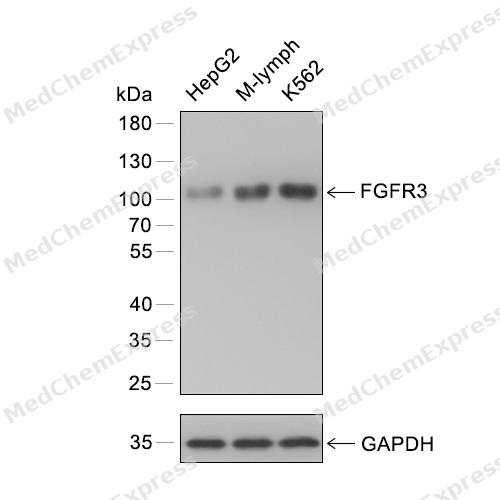 Western blot analysis of extracts from HepG2 (lane 1) and M-lymph (lane 2) and K562 (lane 3) using FGFR3 antibody. Proteins were transferred to a PVDF membrane and blocked with 5% nonfat powdered milk in PBST for 2 hour at room temperature. The primary antibody (1/1000) and Loading control antibody (GAPDH, 1/3000) was diluted with 5% nonfat powdered milk in PBST at 4°C overnight. Goat Anti-Rabbit IgG-HRP Secondary Antibody (1/8,000) was incubated for 45min at room temperature.


Background
-
Function
FGFR3 encodes a receptor tyrosine kinase that acts as a negative regulator of endochondral bone growth by limiting chondrocyte proliferation, hypertrophic differentiation, and osteogenesis in growth plate cartilage[1][2]. Mechanistically, activated FGFR3 signaling inhibits bone growth through MAPK-dependent suppression of chondrocyte differentiation and STAT1-associated suppression of chondrocyte proliferation[3]. In skeletal disease models, activating FGFR3 mutations explain achondroplasia as gain-of-function lesions that intensify this inhibitory growth-control program[1]. In cancer, activating FGFR3 mutations occur in bladder and cervix carcinomas, and FGFR3-TACC3 fusions show oncogenic activity in glioblastoma models[4][5]. Compared with related isoforms, alternative splicing of the FGFR3 IgIII domain generates IIIb/IIIc variants with distinct ligand-binding properties, and FGFR3 IIIb binds only acidic FGF in the reported binding assays[6]. For experimental and translational applications, erdafitinib, an FGFR1-4 tyrosine kinase inhibitor, produced clinical activity in advanced urothelial carcinoma with susceptible FGFR2/3 alterations and later improved overall survival versus chemotherapy after anti-PD-1/PD-L1 treatment[7][8].
-
Subcellular Localization
Cell membrane; Single-pass type I membrane protein; Cytoplasmic vesicle; Endoplasmic reticulum; Cell membrane; Single-pass type I membrane protein; Secreted; Cell membrane; Single-pass type I membrane protein
-
Expression
Tissue_specificity:Expressed in brain, kidney and testis. Very low or no expression in spleen, heart, and muscle. -
Subunit
Monomer. Homodimer after ligand binding. Interacts with FGF1, FGF2, FGF4, FGF6; FGF8, FGF9, FGF10, FGF17, FGF18, FGF19, FGF20 and FGF23 (in vitro). Interacts with KLB. Affinity for fibroblast growth factors (FGFs) is increased by heparan sulfate glycosaminoglycans that function as coreceptors. Likewise, KLB increases the affinity for FGF19 and FGF21. Interacts with PIK3R1, PLCG1, SOCS1 and SOCS3. Isoform 3 forms disulfide-linked dimers
-
SwissProt ID
-
Synonyms
CD333, JTK4, FGFR3, Fibroblast growth factor receptor 3, FGFR-3
-
Research Field
Cardiovascular
Documentation
-
Data Sheet (263 KB)
-
SDS (251 KB)
- English - EN (251 KB)
- Français - FR (251 KB)
- Deutsch - DE (251 KB)
- Norwegian - NO (251 KB)
- Español - ES (251 KB)
- Swedish - SV (251 KB)
- Italian - IT (251 KB)
- Korean - KR (251 KB)
- Portuguese - PT (251 KB)
-
User Guide for Antibodies (1077 KB)
References
[2]. Wang Q, Green RP, Zhao G, Ornitz DM. Differential regulation of endochondral bone growth and joint development by FGFR1 and FGFR3 tyrosine kinase domains. Development. 2001 Oct;128(19):3867-76. [Content Brief]
[3]. Murakami S, et al. Constitutive activation of MEK1 in chondrocytes causes Stat1-independent achondroplasia-like dwarfism and rescues the Fgfr3-deficient mouse phenotype. Genes Dev. 2004 Feb 1;18(3):290-305. [Content Brief]
[4]. Cappellen D, et al. Frequent activating mutations of FGFR3 in human bladder and cervix carcinomas. Nat Genet. 1999 Sep;23(1):18-20. [Content Brief]
[5]. Singh D, et al. Transforming fusions of FGFR and TACC genes in human glioblastoma. Science. 2012 Sep 7;337(6099):1231-5. [Content Brief]
[6]. Chellaiah AT, et al. Fibroblast growth factor receptor (FGFR) 3. Alternative splicing in immunoglobulin-like domain III creates a receptor highly specific for acidic FGF/FGF-1. J Biol Chem. 1994 Apr 15;269(15):11620-7. [Content Brief]
[7]. Loriot Y, et al. Erdafitinib in Locally Advanced or Metastatic Urothelial Carcinoma. N Engl J Med. 2019 Jul 25;381(4):338-348. [Content Brief]
[8]. Loriot Y, et al. Erdafitinib or Chemotherapy in Advanced or Metastatic Urothelial Carcinoma. N Engl J Med. 2023 Nov 23;389(21):1961-1971. [Content Brief]

 Powered by Bioz
