



FGFR1 Antibody (YA441)
(Synonyms: CD331, BFGFR, CEK, FGFBR, FLG, FLT2, HBGFR, FGFR1, Fibroblast growth factor receptor 1, FGFR-1, Basic fibroblast growth factor receptor 1, Fms-like tyrosine kinase 2, N-sam, Proto-oncogene c-Fgr, bFGF-R-1, FLT-2)Based on 1 Customer Validation
FGFR1 Antibody (YA441) is a Rabbit-derived and non-conjugated IgG monoclonal antibody, targeting to FGFR1.
-
Host:
Rabbit
-
Isotype:
IgG
-
Application:
WB, ICC/IF
-
Reactivity :
Human
-
Formulation:
Supplied in 1*TBS (pH7.4), 0.05% BSA and 40% Glycerol. Preservative: 0.05% Sodium Azide.
-
Conjugation:
Non-conjugated


To place orders, for customer services and technical support, please contact: MedChemExpress USA
Tel: 609-228-6898 E-mail: [email protected] [email protected]





Applications
| Application |
WB

WB: Western Blot
|
ICC/IF
ICC/IF: Immunocytochemistry/
Immunofluorescence |
|---|---|---|
| Dilution Ratio | 1:1000 | 1:50-1:100 |


Product Details
FGFR1 Antibody (YA441) is a Rabbit-derived and non-conjugated IgG monoclonal antibody, targeting to FGFR1.
-
Host Rabbit

-
Clonality Recombinant,Monoclonal

-
Species ReactivityHuman
-
Observed Molecular WeightObserved band size: 140 kDa
Note: Due to possible protein modifications or aggregation, the molecular weight should be confirmed by actual measurement, and the predicted value is for reference only.

-
Calculated Molecular Weight Predicted band size: 92 kDa

Synthetic peptide corresponding to Human FGFR1.AA range:766-822.
Endogenous
Protein A affinity purified.
Non-conjugated
Unmodified
IgG


Product Properties
-
Appearance
Solution
-
Formulation
Supplied in 1*TBS (pH7.4), 0.05% BSA and 40% Glycerol. Preservative: 0.05% Sodium Azide.
-
Concentration
Batch-dependent, Please check the COA for the concentration of each lot. Check Lot Concentration
-
Storage & Stability
Stored at -20°C for 1 year. Avoid repeated freeze / thaw cycles.
-
Shipping
Shipping with blue ice.


Verification Images
-
 Western blot analysis of extracts from SH-SY5Y (lane 1(20μg)) and Y79 (lane 2(15μg)) using FGFR1 Antibody (HY-P80395) . Proteins were transferred to a PVDF membrane and blocked with 5% nonfat dry milk in TBST for 1.5 hour at room temperature. The primary antibody (1/1000) and Loading control antibody (HSP90, 1/10000) was used in 5% nonfat dry milk in TBST at 4℃ overnight. Goat Anti-Rabbit IgG-HRP Secondary Antibody (1/10,000) was used for 1 hour at room temperature.
 -
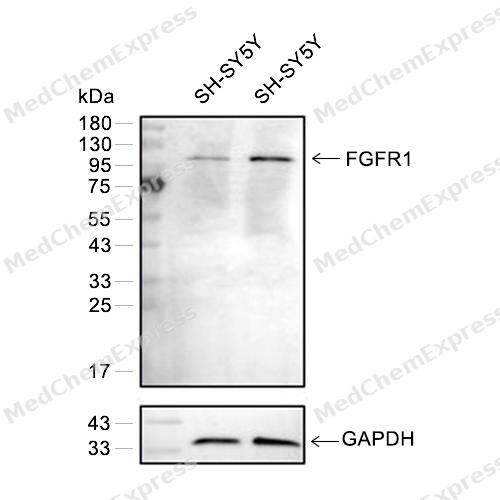 Western blot analysis of extracts from SH-SY5Y(lane 2(20μg) or lane 3(20μg)) using FGFR1 alpha (HY-P80395) Rabbit mAb. Proteins were transferred to a PVDF membrane and blocked with 5% BSA in TBST for 2 hour at room temperature. The primary antibody (HY-P80395, 1/1000) and Loading control antibody (GAPDH, HY-P80954, 1/3000) was used in 5% BSA in TBST at 4°C overnight. Goat Anti-Mouse/Rabbit IgG-HRP Secondary Antibody (HY-P8004/HY-P8001, 1/10,000) was used for 1 hour at room temperature.


Background
-
Function
FGFR1 is a cell-surface tyrosine kinase FGF receptor that mediates biological responses after ligand binding with heparin/heparan sulfate as a cofactor[1]. Mechanistically, FGFR signaling activates downstream MAPK, STAT, PI3K/Akt, PLCγ, DAG-PKC, and IP3-Ca2+ branches that regulate proliferation, differentiation, apoptosis, and migration[2]. In adipocytes, FGFR1c is abundantly expressed in white adipose tissue, where adipocyte FGFR1 supports FGF21-stimulated metabolic transcriptional activity and glucose, insulin, triglyceride, and energy-expenditure responses[1][3]. In neural lineage models, FGF2 activation of FGFR1 inhibits oligodendrocyte progenitor differentiation, while oligodendroglial FGFR1 deletion ameliorates experimental autoimmune encephalomyelitis and reduces myelin and axonal loss[4][5]. Compared with related isoforms, FGFR1/2/3 generate IIIb and IIIc splice variants with distinct ligand-binding specificity, whereas FGFR4 lacks this IIIb/IIIc isoform structure[1]. For experimental applications, the β-Klotho antibody 39F7 specifically activates β-Klotho/FGFR1c signaling, while PD173074 blocks FGFR1 signaling in TGF-β1-induced epithelial-to-mesenchymal transition models[6][7].
-
Subcellular Localization
Cell membrane; Single-pass type I membrane protein; Nucleus; Cytoplasm, cytosol; Cytoplasmic vesicle
-
Expression
Tissue_specificity:This protein was detected in astrocytomas, neuroblastomas, and adrenocortical cell lines. Some subtypes were also detected in foreskin fibroblast cell lines, but subtypes 17, 18, and 19 were not detected in these cells. -
Isoforms & Post-Translational Modification
P11362 has 21 isomers: P11362-1: 91868 Da (predicted); P11362-8: 73475 Da (predicted); P11362-17: 6682 Da (predicted); P11362-2: 91668 Da (predicted); P11362-9: 73274 Da (predicted); P11362-3: 82162 Da (predicted); P11362-10: 63769 Da (predicted); P11362-4: 81962 Da (predicted); P11362-11: 63569 Da (predicted); P11362-5: 74133 Da (predicted); P11362-12: 55740 Da (predicted); P11362-6: 73933 Da (predicted); P11362-13: 55540 Da (predicted); P11362-7: 91580 Da (predicted); P11362-14: 81875 Da (predicted); P11362-15: 16487 Da (predicted); P11362-16: 33412 Da (predicted); P11362-18: 33125 Da (predicted); P11362-19: 91760 Da (predicted); P11362-20: 90618 Da (predicted); P11362-21: 95344 Da (predicted).
Autophosphorylated. Binding of FGF family members together with heparan sulfate proteoglycan or heparin promotes receptor dimerization and autophosphorylation on tyrosine residues. Autophosphorylation occurs in trans between the two FGFR molecules present in the dimer and proceeds in a highly ordered manner. Initial autophosphorylation at Tyr-653 increases the kinase activity by a factor of 50 to 100. After this, Tyr-583 becomes phosphorylated, followed by phosphorylation of Tyr-463, Tyr-766, Tyr-583 and Tyr-585. In a third stage, Tyr-654 is autophosphorylated, resulting in a further tenfold increase of kinase activity. Phosphotyrosine residues provide docking sites for interacting proteins and so are crucial for FGFR1 function and its regulation;Ubiquitinated. FGFR1 is rapidly ubiquitinated by NEDD4 after autophosphorylation, leading to internalization and lysosomal degradation. CBL is recruited to activated FGFR1 via FRS2 and GRB2, and mediates ubiquitination and subsequent degradation of FGFR1;N-glycosylated in the endoplasmic reticulum. The N-glycan chains undergo further maturation to an Endo H-resistant form in the Golgi apparatus -
Subunit
Monomer. Homodimer after ligand binding. Interacts predominantly with FGF1 and FGF2, but can also interact with FGF3, FGF4, FGF5, FGF6, FGF8, FGF10, FGF19, FGF21, FGF22 and FGF23 (in vitro) (PubMed:12181353, PubMed:16597617, PubMed:1697263, PubMed:1722683, PubMed:17623664, PubMed:8663044, PubMed:9655399). Ligand specificity is determined by tissue-specific expression of isoforms, and differences in the third Ig-like domain are crucial for ligand specificity. Affinity for fibroblast growth factors (FGFs) is increased by heparan sulfate glycosaminoglycans that function as coreceptors. Likewise, KLB increases the affinity for FGF19, FGF21 and FGF23 (PubMed:19966287). Interacts (phosphorylated on Tyr-766) with PLCG1 (via SH2 domains) (PubMed:1379697, PubMed:1656221, PubMed:21765395). Interacts with FRS2 (PubMed:21765395). Interacts with RPS6KA1 (PubMed:15117958). Interacts (via C-terminus) with NEDD4 (via WW3 domain) (PubMed:21765395). Interacts with KL (By similarity). Interacts with SHB (via SH2 domain) (PubMed:12181353). Interacts with GRB10 (PubMed:10454568). Interacts with ANOS1; this interaction does not interfere with FGF2-binding to FGFR1, but prevents binding of heparin-bound FGF2 (PubMed:19696444). Interacts with SOX2 and SOX3. Interacts with FLRT1, FLRT2 and FLRT3 (By similarity). Found in a ternary complex with FGF1 and ITGAV:ITGB3 (PubMed:18441324, PubMed:20422052)
-
SwissProt ID
-
Synonyms
CD331, BFGFR, CEK, FGFBR, FLG, FLT2, HBGFR, FGFR1, Fibroblast growth factor receptor 1, FGFR-1, Basic fibroblast growth factor receptor 1, Fms-like tyrosine kinase 2, N-sam, Proto-oncogene c-Fgr, bFGF-R-1, FLT-2
-
Research Field
Cardiovascular


Documentation
-
Data Sheet (263 KB)
-
SDS (252 KB)
- English - EN (252 KB)
- Français - FR (252 KB)
- Deutsch - DE (252 KB)
- Norwegian - NO (252 KB)
- Español - ES (252 KB)
- Swedish - SV (252 KB)
- Italian - IT (252 KB)
- Korean - KR (252 KB)
- Portuguese - PT (252 KB)
-
User Guide for Antibodies (1077 KB)
References
[1]. Ohta H, et al. Fgf signaling in adipocytes as a target for metabolic diseases. Mol Metab. 2012 Dec 14;2(1):3-4. [Content Brief]
[3]. Lee S, et al. Structures of β-klotho reveal a 'zip code'-like mechanism for endocrine FGF signalling. Nature. 2018 Jan 25;553(7689):501-505. [Content Brief]
[4]. Zhou YX, et al. Retroviral lineage analysis of fibroblast growth factor receptor signaling in FGF2 inhibition of oligodendrocyte progenitor differentiation. Glia. 2006 Nov 1;54(6):578-90. [Content Brief]
[5]. Rajendran R, et al. Oligodendroglial fibroblast growth factor receptor 1 gene targeting protects mice from experimental autoimmune encephalomyelitis through ERK/AKT phosphorylation. Brain Pathol. 2018 Mar;28(2):212-224. [Content Brief]
[6]. Min X, et al. Agonistic β-Klotho antibody mimics fibroblast growth factor 21 (FGF21) functions. J Biol Chem. 2018 Sep 21;293(38):14678-14688. [Content Brief]
[7]. Životić M, et al. Modulation of NCAM/FGFR1 signaling suppresses EMT program in human proximal tubular epithelial cells. PLoS One. 2018 Nov 1;13(11):e0206786. [Content Brief]

 Powered by Bioz
