



Fibronectin Antibody (YA762)
(Synonyms: FN1; FN; Fibronectin; FN; Cold-insoluble globulin; CIG)Based on 1 publication(s) in Google Scholar
Fibronectin Antibody (YA762) is a Mouse-derived and non-conjugated IgG1 monoclonal antibody, targeting to Fibronectin.
-
Host:
Mouse
-
Isotype:
IgG
-
Application:
WB, IHC-F, IHC-P, ICC/IF
-
Reactivity :
Human, Mouse, Rat
-
Formulation:
Supplied in 1*PBS (pH 7.3), 50% glycerol and 0.5% BSA. Preservative: 0.02% sodium azide.
-
Conjugation:
Non-conjugated


To place orders, for customer services and technical support, please contact: MedChemExpress USA
Tel: 609-228-6898 E-mail: [email protected] [email protected]



Publications Citing Use of MedChemExpress (MCE) Fibronectin Antibody (YA762)
More

Applications
| Application |
WB

WB: Western Blot
|
IHC-P
IHC-P: Immunohistochemistry-Paraffin
|
IHC-F
IHC-F: Immunohistochemistry-Frozen
|
ICC/IF
ICC/IF: Immunocytochemistry/
Immunofluorescence |
|---|---|---|---|---|
| Dilution Ratio | 1:500-1:1000 | 1:50-1:100 | 1:50-1:100 | 1:50-1:200 |


Product Details
Fibronectin Antibody (YA762) is a Mouse-derived and non-conjugated IgG1 monoclonal antibody, targeting to Fibronectin.
-
Host Mouse

-
Clonality Monoclonal

-
Species ReactivityHuman, Mouse, Rat
-
Observed Molecular WeightObserved band size: 285 kDa
Note: Due to possible protein modifications or aggregation, the molecular weight should be confirmed by actual measurement, and the predicted value is for reference only.

-
Calculated Molecular Weight Predicted band size: 272 kDa

Entrez Gene: 2335 Human ; 14268 Mouse ;
SwissProt: P02751 Human ; P11276 Mouse ; P04937 Rat
OMIM: 601894 Human
Synthetic peptide corresponding to Fibronectin.The exact sequence is proprietary to MCE.
Endogenous
affinity purified
Non-conjugated
Unmodified
IgG


Product Properties
-
Appearance
Solution
-
Formulation
Supplied in 1*PBS (pH 7.3), 50% glycerol and 0.5% BSA. Preservative: 0.02% sodium azide.
-
Concentration
Batch-dependent, Please check the COA for the concentration of each lot. Check Lot Concentration
-
Storage & Stability
Stored at -20°C for 1 year. Avoid repeated freeze / thaw cycles.
-
Shipping
Shipping with blue ice.


Publications (1)
-
Journal Impact Factor
-
Most Recent
-
Ecotoxicol Environ Saf
A network toxicology and machine learning approach to investigate the mechanism of kidney injury from melamine and cyanuric acid co-exposure. [Abstract]2025 Mar 15:293:118029. PMID: 40088607


Verification Images
-
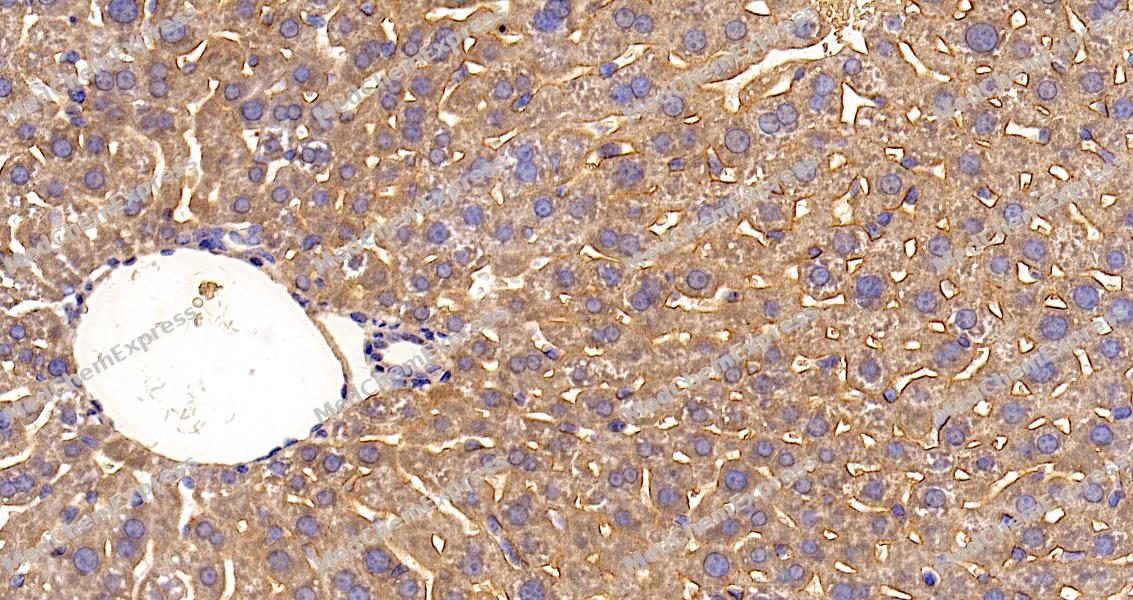 Immunohistochemical analysis of paraffin-embedded mouse liver tissue using Fibronectin Antibody. The section was pre-treated using heat mediated antigen retrieval with sodium citrate buffer (pH 6.0) for 8 minutes. The tissues were blocked in QuickBlock for 20 minutes at room temperature, washed with ddH2O and PBS, and then probed with the primary antibody at 1/100 dilution in 4℃ overnight. The detection was performed using an HRP conjugated compact polymer system. DAB was used as the chromogen. Tissues were counterstained with hematoxylin and mounted with DPX.
 -
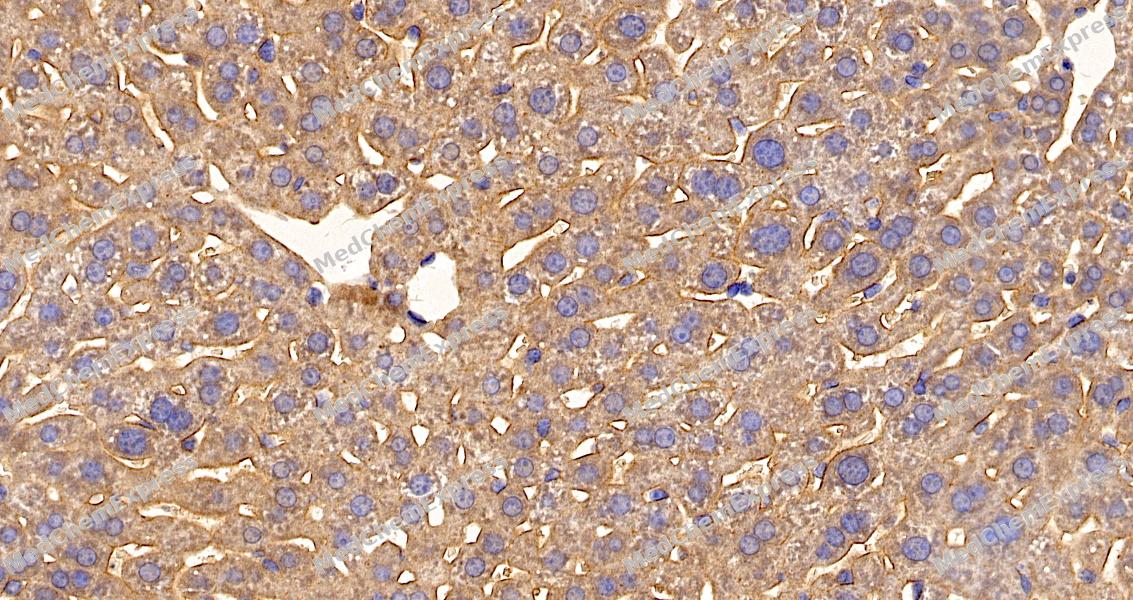 Immunohistochemical analysis of paraffin-embedded mouse liver tissue using Fibronectin Antibody. The section was pre-treated using heat mediated antigen retrieval with sodium citrate buffer (pH 6.0) for 8 minutes. The tissues were blocked in QuickBlock for 20 minutes at room temperature, washed with ddH2O and PBS, and then probed with the primary antibody at 1/100 dilution in 4℃ overnight. The detection was performed using an HRP conjugated compact polymer system. DAB was used as the chromogen. Tissues were counterstained with hematoxylin and mounted with DPX.


Background
-
Function
Fibronectin is a Fibronectins bind cell surfaces and various compounds including collagen, fibrin, heparin, DNA, and actin. Fibronectins are involved in cell adhesion, cell motility, opsonization, wound healing, and maintenance of cell shape. Involved in osteoblast compaction through the fibronectin fibrillogenesis cell-mediated matrix assembly process, essential for osteoblast mineralization. Participates in the regulation of type I collagen deposition by osteoblasts. Acts as a ligand for the LILRB4 receptor, inhibiting FCGR1A/CD64-mediated monocyte activation; Binds fibronectin and induces fibril formation. This fibronectin polymer, named superfibronectin, exhibits enhanced adhesive properties. Both anastellin and superfibronectin inhibit tumor growth, angiogenesis and metastasis. Anastellin activates p38 MAPK and inhibits lysophospholipid signaling; Secreted by contracting muscle, induces liver autophagy, a degradative pathway for nutrient mobilization and damage removal, and systemic insulin sensitization via hepatic ITGA5:ITGB1 integrin receptor signaling[1][2][3][4][5].
-
Subcellular Localization
Secreted, extracellular space, extracellular matrix; Secreted
-
Expression
Tissue_specificity:Fibronectin (protein level) is expressed in the internal limiting membrane of the retina and around blood vessels (PubMed: 29777959) . Plasma fibronectin (soluble dimer form) is secreted by hepatocytes. Cellular fibronectin (dimer or cross-linked polymer form) is produced by fibroblasts, epithelial cells, and other cell types and deposited in the extracellular matrix in fibrous form. Urine contains Ugl-Y1, Ugl-Y2, and Ugl-Y3 (PubMed: 17614963) . -
Isoforms & Post-Translational Modification
P02751 has 17 isomers: P02751-15: 272320 Da (predicted); P02751-1: 262625 Da (predicted); P02751-2: 71971 Da (predicted); P02751-3: 259216 Da (predicted); P02751-4: 222976 Da (predicted); P02751-5: 243334 Da (predicted); P02751-6: 240509 Da (predicted); P02751-7: 268912 Da (predicted); P02751-8: 252811 Da (predicted); P02751-9: 246688 Da (predicted); P02751-10: 239626 Da (predicted); P02751-11: 262406 Da (predicted); P02751-12: 221292 Da (predicted); P02751-13: 249322 Da (predicted); P02751-14: 249402 Da (predicted); P02751-16: 73683 Da (predicted); P02751-17: 256502 Da (predicted).
Sulfated;It is not known whether both or only one of Thr-2155 and Thr-2156 are/is glycosylated;Forms covalent cross-links mediated by a transglutaminase, such as F13A or TGM2, between a glutamine and the epsilon-amino group of a lysine residue, forming homopolymers and heteropolymers (e.g. fibrinogen-fibronectin, collagen-fibronectin heteropolymers);Phosphorylated by FAM20C in the extracellular medium;Proteolytic processing produces the C-terminal NC1 peptide, anastellin;Some lysine residues are oxidized to allysine by LOXL3, promoting fibronectin activation and matrix formation;Serotonylated on Gln residues by TGM2 in response to hypoxia -
Subunit
Mostly heterodimers or multimers of alternatively spliced variants, connected by 2 disulfide bonds near the carboxyl ends; to a lesser extent homodimers. Interacts with FBLN1, AMBP, TNR, LGALS3BP and COL13A1. Interacts with FBLN7 (By similarity). Interacts with COMP (PubMed:12225811). Interacts (via type III repeats 9-14) with TNFAIP6 (via CUB domain); this interaction enhances fibronectin fibril assembly. TNFAIP6 may act as a bridging molecule between FN1 and THBS1 (PubMed:18042364). Interacts with TNR; the interaction inhibits cell adhesion and neurite outgrowth (By similarity). Interacts with FST3 and MYOC. Interacts with SVEP1 (By similarity)
-
SwissProt ID
-
Synonyms
FN1; FN; Fibronectin; FN; Cold-insoluble globulin; CIG
-
Research Field
Cardiovascular
Documentation
-
Data Sheet (262 KB)
-
SDS (251 KB)
- English - EN (251 KB)
- Français - FR (251 KB)
- Deutsch - DE (251 KB)
- Norwegian - NO (251 KB)
- Español - ES (251 KB)
- Swedish - SV (251 KB)
- Italian - IT (251 KB)
- Korean - KR (251 KB)
- Portuguese - PT (251 KB)
-
User Guide for Antibodies (1077 KB)
References
[1]. Owens RJ, et al. Mapping the collagen-binding site of human fibronectin by expression in Escherichia coli. EMBO J. 1986 Nov;5(11):2825-30. [Content Brief]
[2]. Garcia-Pardo A, et al. Primary structure of human plasma fibronectin. Characterization of a 38 kDa domain containing the C-terminal heparin-binding site (Hep III site) and a region of molecular heterogeneity. Biochem J. 1987 Feb 1;241(3):923-8. [Content Brief]
[3]. Calaycay J, et al. Primary structure of a DNA- and heparin-binding domain (Domain III) in human plasma fibronectin. J Biol Chem. 1985 Oct 5;260(22):12136-41. [Content Brief]
[4]. Rostagno A, et al. Further characterization of the NH2-terminal fibrin-binding site on fibronectin. J Biol Chem. 1994 Dec 16;269(50):31938-45. [Content Brief]
[5]. Su MT, et al. Blockade of checkpoint ILT3/LILRB4/gp49B binding to fibronectin ameliorates autoimmune disease in BXSB/Yaa mice. Int Immunol. 2021 Jul 23;33(8):447-458. [Content Brief]

 Powered by Bioz
