



G3BP1 Antibody (YA7546)

Based on 1 Customer Validation
G3BP1 Antibody (YA7546) is a Rabbit-derived and non-conjugated IgG, Kappa monoclonal antibody, targeting to G3BP1.
-
Host:
Rabbit
-
Isotype:
IgG,Kappa
-
Application:
WB, IHC-P, ICC/IF, IP, ELISA
-
Reactivity :
Human, Mouse, Rat
-
Formulation:
Supplied in PBS (pH7.4) containing 50% glycerol, 0.05% Proclin 300, 0.05%BSA
-
Conjugation:
Non-conjugated


To place orders, for customer services and technical support, please contact: MedChemExpress USA
Tel: 609-228-6898 E-mail: [email protected] [email protected]





Applications
| Application |
IHC-P

IHC-P: Immunohistochemistry-Paraffin
|
WB
WB: Western Blot
|
ICC/IF
ICC/IF: Immunocytochemistry/
Immunofluorescence |
ELISA
ELISA: Enzyme Linked Immunosorbent Assay
|
IP
IP: Immunoprecipitation
|
|---|---|---|---|---|---|
| Dilution Ratio | 1:200-1:1000 | 1:2000-1:10000 | 1:200-1:1000 | 1:5000-1:20000 | 1:50-1:200 |


Product Details
G3BP1 Antibody (YA7546) is a Rabbit-derived and non-conjugated IgG, Kappa monoclonal antibody, targeting to G3BP1.
-
Host Rabbit

-
Clonality Monoclonal,Recombinant

-
Species ReactivityHuman, Mouse, Rat
-
Observed Molecular WeightObserved band size: 68 kDa
Note: Due to possible protein modifications or aggregation, the molecular weight should be confirmed by actual measurement, and the predicted value is for reference only.

-
Calculated Molecular Weight Predicted band size: 52 kDa

The exact sequence is proprietary to MCE.
Endogenous
Protein A affinity purified
Non-conjugated
Unmodified
IgG,Kappa


Product Properties
-
Appearance
Liquid
-
Formulation
Supplied in PBS (pH7.4) containing 50% glycerol, 0.05% Proclin 300, 0.05%BSA
-
Concentration
Batch-dependent, Please check the COA for the concentration of each lot. Check Lot Concentration
-
Storage & Stability
Stored at -20°C for 1 year. Avoid repeated freeze / thaw cycles.
-
Shipping
Shipping with blue ice.


Verification Images
-
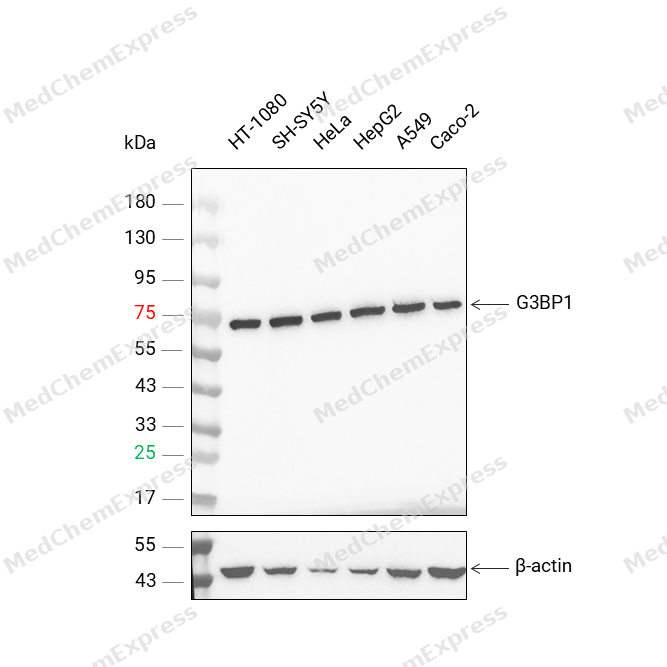 Western blot analysis was performed on protein extracts (25 μg) from HT-1080 (lane 1), SH-SY5Y (lane 2), HeLa (lane 3), HepG2 (lane 4), A549 (lane 5), and Caco-2 (lane 6) using G3BP1 antibody. Proteins were transferred onto a 0.45 μm NC membrane using the Trans-Blot® Turbo™ system for 13 min. The membrane was then blocked with 5% nonfat milk in TBST (HY-K1025) for 1 h at room temperature. The primary antibody (1:1000) and loading control antibody β-actin (HY-P80438) (1:5000) were diluted in 5% nonfat milk in TBST and incubated with the membrane overnight at 4°C. After washing, the membrane was incubated with HRP-conjugated goat anti-rabbit IgG (H&L) secondary antibody (HY-P8001) (1:5000) diluted in 5% nonfat milk in TBST for 1 h at room temperature. Protein bands were visualized using an Ultra High Sensitivity ECL detection kit (HY-K1005).


Background
-
Function
G3BP1 is a Protein involved in various processes, such as stress granule formation and innate immunity. Plays an essential role in stress granule formation. Stress granules are membraneless compartments that store mRNAs and proteins, such as stalled translation pre-initiation complexes, in response to stress. Promotes formation of stress granules phase-separated membraneless compartment by undergoing liquid-liquid phase separation (LLPS) upon unfolded RNA-binding: functions as a molecular switch that triggers RNA-dependent LLPS in response to a rise in intracellular free RNA concentrations. Also acts as an ATP- and magnesium-dependent helicase: unwinds DNA/DNA, RNA/DNA, and RNA/RNA substrates with comparable efficiency. Acts unidirectionally by moving in the 5' to 3' direction along the bound single-stranded DNA. Unwinds preferentially partial DNA and RNA duplexes having a 17 bp annealed portion and either a hanging 3' tail or hanging tails at both 5'- and 3'-ends. Plays an essential role in innate immunity by promoting CGAS and RIGI activity. Participates in the DNA-triggered cGAS/STING pathway by promoting the DNA binding and activation of CGAS. Triggers the condensation of cGAS, a process probably linked to the formation of membrane-less organelles. Also enhances RIGI-induced type I interferon production probably by helping RIGI at sensing pathogenic RNA. May also act as a phosphorylation-dependent sequence-specific endoribonuclease in vitro: Cleaves exclusively between cytosine and adenine and cleaves MYC mRNA preferentially at the 3'-UTR[1][2][3][4][5][6][7][8][9][10][11][12][13][14][15][16][17][18].
-
Subcellular Localization
Cytoplasm, cytosol,Perikaryon,Cytoplasm, Stress granule,Nucleus
-
Expression
Tissue_Specificity: Ubiquitous -
Isoforms & Post-Translational Modification
Q13283 has two isomers: Q13283-1: 52164 Da (predicted); Q13283-2: 13874 Da (predicted).
Phosphorylation of the acidic disordered region regulates stress granule assembly (PubMed:32302571, PubMed:32302572)丨Ubiquitinated by TRIM21 via 'Lys-63'-linked polyubiquitination in the NTF2 domain in response to heat shock, leading to stress granule disassembly: ubiquitination promotes interaction with the FAF2 adapter, followed by interaction with VCP, which extracts G3BP1 from stress granules, leading to stress granule disassembly (PubMed:34739333, PubMed:36692217)丨(Microbial infection) Cleaved by human enterovirus 71; this cleavage induces the disassembly of cytoplasmic stress granules (PubMed:30006004)丨Arg-435 is dimethylated, probably to asymmetric dimethylarginine丨(Microbial infection) Cleaved by Encephalomyocarditis virus protease 3C; this cleavage suppresses the formation of cytoplasmic stress granules -
Subunit
Homodimer and oligomer (PubMed:12642610, PubMed:24324649)
-
SwissProt ID


Documentation
-
Data Sheet (231 KB)
-
SDS (251 KB)
- English - EN (251 KB)
- Français - FR (251 KB)
- Deutsch - DE (251 KB)
- Norwegian - NO (251 KB)
- Español - ES (251 KB)
- Swedish - SV (251 KB)
- Italian - IT (251 KB)
- Korean - KR (251 KB)
- Portuguese - PT (251 KB)
-
User Guide for Antibodies (1077 KB)

 Powered by Bioz
