



HDAC9 Antibody (YA2967)
(Synonyms: Histone deacetylase 9; HD9; Histone deacetylase 7B; HD7; HD7b; Histone deacetylase-related protein; MEF2-interacting transcription repressor MITR; HDAC9; HDAC7; HDAC7B; HDRP; KIAA0744; MITR)
Based on 1 Customer Validation
HDAC9 Antibody (YA2967) is a Rabbit-derived and non-conjugated IgG monoclonal antibody, targeting to HDAC9.
-
Host:
Rabbit
-
Isotype:
IgG
-
Application:
WB, IHC-P
-
Reactivity :
Human
-
Formulation:
Supplied in 50mM Tris-Glycine(pH 7.4), 0.15M NaCl, 40% Glycerol, 0.01% Sodium azide and 0.05% BSA
-
Conjugation:
Non-conjugated


To place orders, for customer services and technical support, please contact: MedChemExpress USA
Tel: 609-228-6898 E-mail: [email protected] [email protected]





Applications
| Application |
WB

WB: Western Blot
|
IHC-P
IHC-P: Immunohistochemistry-Paraffin
|
|---|---|---|
| Dilution Ratio | 1:500-1:1000 | 1:50-1:100 |


Product Details
HDAC9 Antibody (YA2967) is a Rabbit-derived and non-conjugated IgG monoclonal antibody, targeting to HDAC9.
-
Host Rabbit

-
Clonality Recombinant,Monoclonal

-
Species ReactivityHuman
-
Observed Molecular WeightObserved band size: 150 kDa
Note: Due to possible protein modifications or aggregation, the molecular weight should be confirmed by actual measurement, and the predicted value is for reference only.

-
Calculated Molecular Weight Predicted band size: 111 kDa

A synthetic peptide of human HDAC9
Endogenous
Affinity Purified
Non-conjugated
Unmodified
IgG


Product Properties
-
Appearance
Solution
-
Formulation
Supplied in 50mM Tris-Glycine(pH 7.4), 0.15M NaCl, 40% Glycerol, 0.01% Sodium azide and 0.05% BSA
-
Concentration
Batch-dependent, Please check the COA for the concentration of each lot. Check Lot Concentration
-
Storage & Stability
Stored at -20°C for 1 year. Avoid repeated freeze / thaw cycles.
-
Shipping
Shipping with blue ice.


Verification Images
-
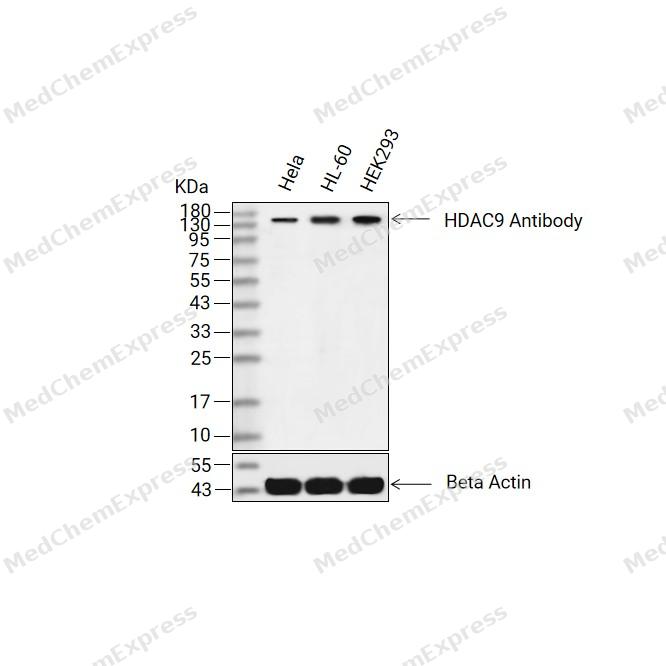 Western blot analysis of extracts from Hela(lane 2(20ug) ,HL-60(lane 3(20ug) and HEK293(lane 4(20ug) using HDAC9 Antibody (HY-P83222) Rabbit mAb. Proteins were transferred to a PVDF membrane and blocked with 5% non-fat milk in TBST for 2 hour at room temperature. The primary antibody (1/1000) and Loading control antibody (Beta Actin, HY-P83730, 1/10000) was used in 5% non-fat milk in TBST at 4°C overnight. Goat Anti-Mouse/Rabbit IgG-HRP Secondary Antibody (1/10000) was used for 1 hour at room temperature.


Background
-
Function
HDAC9 is a class IIa histone deacetylase linked to cardiac muscle development, bone formation, adipocyte differentiation, innate immunity, and cancer biology[1]. Mechanistically, HDAC9 forms a myogenic negative-feedback circuit because MEF2 directly induces HDAC9, while HDAC9 associates with MEF2 proteins and suppresses their transcriptional activity[2]. In ischemic disease models, HDAC9 promotes brain ischemic injury through IκBα/NF-κB and MAPK signaling, and HDAC9 inhibition reduces inflammation-linked injury[3]. Stroke-focused evidence further supports HDAC9 inhibition as a treatment concept, including reduced infarct volume and improved neurological function in HDAC9-knockout mice after ischemic reperfusion injury[4]. In cancer models, HDAC9 regulates breast cancer cell proliferation and modifies cellular responses to histone deacetylase inhibitors[5]. Compared with related class IIa isoforms HDAC4, HDAC5, and HDAC7, HDAC9 should be analyzed as an isoform-specific disease regulator while class IIa-selective inhibitors remain useful experimental probes across this subgroup[6].
-
Subcellular Localization
Nucleus
-
Expression
Tissue_specificity:Broadly expressed, with highest levels in brain, heart, muscle and testis. Isoform 3 is present in human bladder carcinoma cells (at protein level) -
Isoforms & Post-Translational Modification
Q9UKV0 has 11 isomers: Q9UKV0-1: 111297 Da (predicted); Q9UKV0-2: 101805 Da (predicted); Q9UKV0-3: 65887 Da (predicted); Q9UKV0-4: 97471 Da (predicted); Q9UKV0-5: 117208 Da (predicted); Q9UKV0-6: 112451 Da (predicted); Q9UKV0-7: 117577 Da (predicted); Q9UKV0-8: 65508 Da (predicted); Q9UKV0-9: 60761 Da (predicted); Q9UKV0-10: 62852 Da (predicted); Q9UKV0-11: 57092 Da (predicted).
Phosphorylated on Ser-220 and Ser-450; which promotes 14-3-3-binding, impairs interaction with MEF2, and antagonizes antimyogenic activity. Phosphorylated on Ser-240; which impairs nuclear accumulation (By similarity). Isoform 7 is phosphorylated on Tyr-1010. Phosphorylated by the PKC kinases PKN1 and PKN2, impairing nuclear import;Sumoylated -
Subunit
Homodimer. Interacts with CTBP1.
-
SwissProt ID
-
Synonyms
Histone deacetylase 9; HD9; Histone deacetylase 7B; HD7; HD7b; Histone deacetylase-related protein; MEF2-interacting transcription repressor MITR; HDAC9; HDAC7; HDAC7B; HDRP; KIAA0744; MITR
-
Research Field
Epigenetics and Nuclear Signaling


Documentation
-
Data Sheet (262 KB)
-
SDS (252 KB)
- English - EN (252 KB)
- Français - FR (252 KB)
- Deutsch - DE (252 KB)
- Norwegian - NO (252 KB)
- Español - ES (252 KB)
- Swedish - SV (252 KB)
- Italian - IT (252 KB)
- Korean - KR (252 KB)
- Portuguese - PT (252 KB)
-
User Guide for Antibodies (1077 KB)
References
[1]. Yang C, et al. Histone deacetylase (HDAC) 9: versatile biological functions and emerging roles in human cancer. Cell Oncol (Dordr). 2021 Oct;44(5):997-1017. [Content Brief]
[2]. Haberland M, et al. Regulation of HDAC9 gene expression by MEF2 establishes a negative-feedback loop in the transcriptional circuitry of muscle differentiation. Mol Cell Biol. 2007 Jan;27(2):518-25. [Content Brief]
[3]. Lu S, et al. HDAC9 promotes brain ischemic injury by provoking IκBα/NF-κB and MAPKs signaling pathways. Biochem Biophys Res Commun. 2018 Sep 10;503(3):1322-1329. [Content Brief]
[4]. Markus HS. HDAC9 Inhibition as a Novel Treatment for Stroke. Stroke. 2023 Dec;54(12):3182-3189. doi: 10.1161/STROKEAHA.123.044862. Epub 2023 Nov 9. PMID: 37942644. et al. HDAC9 Inhibition as a Novel Treatment for Stroke. Stroke. 2023 Dec;54(12):3182-3189. [Content Brief]
[5]. Lapierre M, et al. Histone deacetylase 9 regulates breast cancer cell proliferation and the response to histone deacetylase inhibitors. Oncotarget. 2016 Apr 12;7(15):19693-708. [Content Brief]
[6]. Lobera M, et al. Selective class IIa histone deacetylase inhibition via a nonchelating zinc-binding group. Nat Chem Biol. 2013 May;9(5):319-25. [Content Brief]

 Powered by Bioz
