



HINT1 Antibody (YA2983)
(Synonyms: HINT1; HINT; PKCI1; PRKCNH1; Histidine triad nucleotide-binding protein 1; Adenosine 5'-monophosphoramidase; Protein kinase C inhibitor 1; Protein kinase C-interacting protein 1; PKCI-1)
Based on 1 Customer Validation
HINT1 Antibody (YA2983) is a Rabbit-derived and non-conjugated IgG monoclonal antibody, targeting to HINT1.
-
Host:
Rabbit
-
Isotype:
IgG
-
Application:
WB, ICC/IF, IP
-
Reactivity :
Human
-
Formulation:
Supplied in 50mM Tris-Glycine(pH 7.4), 0.15M NaCl, 40% Glycerol, 0.01% Sodium azide and 0.05% BSA
-
Conjugation:
Non-conjugated


To place orders, for customer services and technical support, please contact: MedChemExpress USA
Tel: 609-228-6898 E-mail: [email protected] [email protected]





Applications
| Application |
WB

WB: Western Blot
|
ICC/IF
ICC/IF: Immunocytochemistry/
Immunofluorescence |
IP
IP: Immunoprecipitation
|
|---|---|---|---|
| Dilution Ratio | 1:500-1:1000 | 1:50-1:200 | 1:20 |


Product Details
HINT1 Antibody (YA2983) is a Rabbit-derived and non-conjugated IgG monoclonal antibody, targeting to HINT1.
-
Host Rabbit

-
Clonality Recombinant,Monoclonal

-
Species ReactivityHuman
-
Observed Molecular WeightObserved band size: 14 kDa
Note: Due to possible protein modifications or aggregation, the molecular weight should be confirmed by actual measurement, and the predicted value is for reference only.

-
Calculated Molecular Weight Predicted band size: 14 kDa

A synthetic peptide of human HINT1 aa5-18.
Endogenous
Affinity Purified
Non-conjugated
Unmodified
IgG


Product Properties
-
Appearance
Solution
-
Formulation
Supplied in 50mM Tris-Glycine(pH 7.4), 0.15M NaCl, 40% Glycerol, 0.01% Sodium azide and 0.05% BSA
-
Concentration
Batch-dependent, Please check the COA for the concentration of each lot. Check Lot Concentration
-
Storage & Stability
Stored at -20°C for 1 year. Avoid repeated freeze / thaw cycles.
-
Shipping
Shipping with blue ice.


Verification Images
-
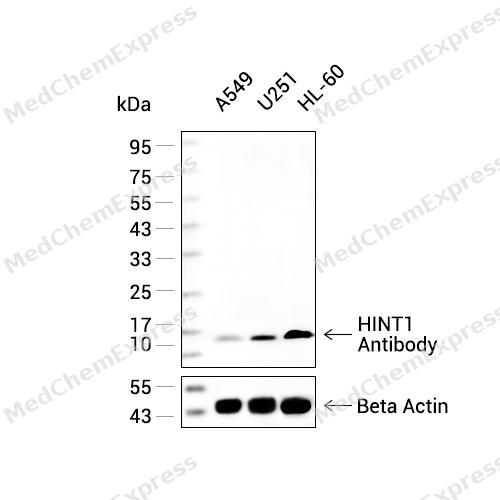 Western blot analysis of extracts from A549(lane 2(20ug) , U251(lane 3(20ug) and HL-60(lane 4(20ug) using HINT1 Antibody (HY-P83238) Rabbit mAb. Proteins were transferred to a PVDF membrane and blocked with 5% non-fat milk in TBST for 2 hour at room temperature. The primary antibody (1/1000) and Loading control antibody (Beta Actin, HY-P80438, 1/10000) was used in 5% non-fat milk in TBST at 4°C overnight. Goat Anti-Mouse/Rabbit IgG-HRP Secondary Antibody (1/10000) was used for 1 hour at room temperature.
 -
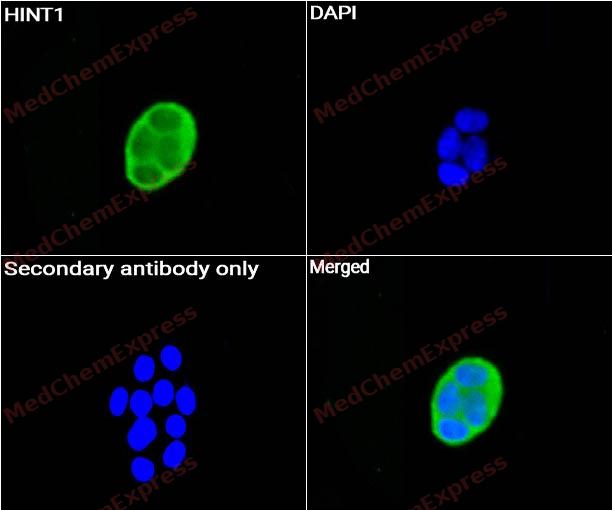 Immunocytochemistry analysis of MCF-7 cells labeling HINT1 with HINT1 antibody (HY-P83238) at 1/50 dilution. Cells were fixed in 4% paraformaldehyde for 15 minutes at room temperature, permeabilized with 0.1% Triton X-100 for 10 minutes at room temperature, then blocked with QuickBlock™ Blocking Buffer for Immunol Staining for 10 min at room temperature. Cells were then incubated with HINT1 antibody (HY-P83238) at 1/50 dilution in QuickBlock™ Blocking Buffer for Immunol Staining at 4 ℃. Alexa Fluor® 488-conjugated AffiniPure Goat Anti-Rabbit IgG H&L(HY-P8002, Green) was used as the secondary antibody at 1/1,000 dilution. PBS instead of the primary antibody was used as the secondary antibody only control. The Nuclear counterstain was DAPI (Blue).
 -
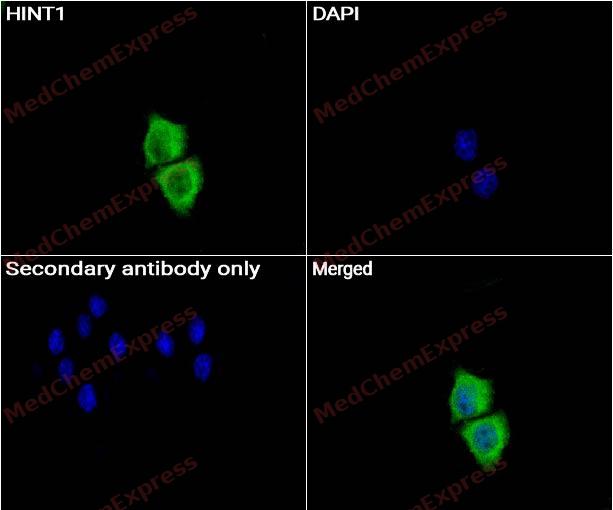 Immunocytochemistry analysis of HeLa cells labeling HINT1 with HINT1 antibody (HY-P83238) at 1/50 dilution. Cells were fixed in 4% paraformaldehyde for 15 minutes at room temperature, permeabilized with 0.1% Triton X-100 for 10 minutes at room temperature, then blocked with QuickBlock™ Blocking Buffer for Immunol Staining for 10 min at room temperature. Cells were then incubated with HINT1 antibody (HY-P83238) at 1/50 dilution in QuickBlock™ Blocking Buffer for Immunol Staining at 4 ℃. Alexa Fluor® 488-conjugated AffiniPure Goat Anti-Rabbit IgG H&L(HY-P8002, Green) was used as the secondary antibody at 1/1,000 dilution. PBS instead of the primary antibody was used as the secondary antibody only control. The Nuclear counterstain was DAPI (Blue).


Background
-
Function
Histidine triad nucleotide-binding protein 1 (HINT1) functions as a zinc- and calmodulin-regulated cysteine SUMO protease that modulates protein sumoylation[1]. Mechanistically, HINT1 interacts with transcription factors and signaling proteins, including teneurin1, RGSZ2, PKCγ, and Raf-1, influencing neural and tumor-associated pathways[1][2][3]. In the central nervous system, HINT1 regulates postsynaptic dopamine receptor activity and modulates behavioral responses to psychostimulants, implicating it in schizophrenia-related circuits[4]. HINT1 also participates in oxidative stress and apoptosis in the prefrontal cortex via the PKCε/ALDH-2/4HNE pathway, supporting its relevance in major depressive disorder models[5]. Compared with its homolog HINT2, which is liver- and mitochondria-specific, HINT1 exhibits ubiquitous expression and distinct nuclear-cytosolic localization, underscoring isoform-specific functions in neuronal signaling and tumor suppression[6]. In experimental pharmacology, HINT1 deletion in mice leads to bipolar-like behaviors, providing a model for testing σ1R antagonists and other modulators of glutamatergic neurotransmission[7]. Furthermore, HINT1 is required for cannabinoid receptor-mediated regulation of NMDA receptor activity, positioning it as a critical mediator in neuroprotective signaling[2]. Collectively, HINT1 integrates post-translational modification, neurotransmission, and apoptotic pathways, establishing its utility as a target for mechanistic studies and therapeutic exploration[1][4][5][2][7][3].
-
Subcellular Localization
Cytoplasm; Nucleus
-
Expression
Tissue_specificity:Widely expressed -
Subunit
Homodimer. Interacts with CDK7. Interacts with RUVBL1 and RUVBL2 and is associated with the LEF1/TCF1-CTNNB1 complex and with a KAT5 histone acetyltransferase complex. Identified in a complex with MITF and CTNNB1. Interacts with CDC34 and RBX1, and is part of a SCF (SKP2-CUL1-F-box protein) E3 ubiquitin-protein ligase complex (PubMed:19112177). Interacts with SUMO1, SUMO2 and RGS17 (By similarity). Interacts with the Ten-1 ICD form of TENM1 (By similarity). Interacts with CALM1; interaction increases in the presence of calcium ions (By similarity)
-
SwissProt ID
-
Synonyms
HINT1; HINT; PKCI1; PRKCNH1; Histidine triad nucleotide-binding protein 1; Adenosine 5'-monophosphoramidase; Protein kinase C inhibitor 1; Protein kinase C-interacting protein 1; PKCI-1
-
Research Field
Epigenetics and Nuclear Signaling


Documentation
-
Data Sheet (262 KB)
-
SDS (252 KB)
- English - EN (252 KB)
- Français - FR (252 KB)
- Deutsch - DE (252 KB)
- Norwegian - NO (252 KB)
- Español - ES (252 KB)
- Swedish - SV (252 KB)
- Italian - IT (252 KB)
- Korean - KR (252 KB)
- Portuguese - PT (252 KB)
-
User Guide for Antibodies (1077 KB)
References
[1]. Cortés-Montero E, et al. The Axonal Motor Neuropathy-Related HINT1 Protein Is a Zinc- and Calmodulin-Regulated Cysteine SUMO Protease. Antioxid Redox Signal. 2019 Sep 1;31(7):503-520. [Content Brief]
[2]. Barbier E, et al. Supersensitivity to amphetamine in protein kinase-C interacting protein/HINT1 knockout mice. Neuropsychopharmacology. 2007 Aug;32(8):1774-82. [Content Brief]
[3]. Liu F, et al. HINT1 Is Involved in the Chronic Mild Stress Elicited Oxidative Stress and Apoptosis Through the PKC ε/ALDH-2/4HNE Pathway in Prefrontal Cortex of Rats. Front Behav Neurosci. 2021 Jun 9;15:690344. [Content Brief]
[4]. Anderson KA, et al. HINT2 and fatty liver disease: mitochondrial protein hyperacetylation gives a hint? Hepatology. 2013 May;57(5):1681-3. [Content Brief]
[5]. Sánchez-Blázquez P, et al. Cannabinoid receptors couple to NMDA receptors to reduce the production of NO and the mobilization of zinc induced by glutamate. Antioxid Redox Signal. 2013 Nov 20;19(15):1766-82. [Content Brief]
[6]. Sánchez-Blázquez P, et al. Sigma 1 Receptor Antagonists Inhibit Manic-Like Behaviors in Two Congenital Strains of Mice. Int J Neuropsychopharmacol. 2018 Oct 1;21(10):938-948. [Content Brief]
[7]. Sánchez-Blázquez P, et al. Mu-opioid receptors transiently activate the Akt-nNOS pathway to produce sustained potentiation of PKC-mediated NMDAR-CaMKII signaling. PLoS One. 2010 Jun 23;5(6):e11278. [Content Brief]

 Powered by Bioz
