



Huntingtin Antibody (YA354)
(Synonyms: HD, IT15, HTT, Huntingtin, Huntington disease protein, HD protein)
Based on 1 Customer Validation
Huntingtin Antibody (YA354) is a Rabbit-derived and non-conjugated IgG monoclonal antibody, targeting to Huntingtin.
-
Host:
Rabbit
-
Isotype:
IgG
-
Application:
WB, IHC-P, IHC-F, ICC/IF, FC, IF-Tissue
-
Reactivity :
Human, Mouse, Rat, Pig
-
Formulation:
Supplied in 1*TBS (pH7.4), 0.05% BSA and 40% Glycerol. Preservative: 0.05% Sodium Azide.
-
Conjugation:
Non-conjugated


To place orders, for customer services and technical support, please contact: MedChemExpress USA
Tel: 609-228-6898 E-mail: [email protected] [email protected]





Applications
| Application |
WB

WB: Western Blot
|
IHC-P
IHC-P: Immunohistochemistry-Paraffin
|
FC
FC: Flow Cytometry
|
IHC-F
IHC-F: Immunohistochemistry-Frozen
|
ICC/IF
ICC/IF: Immunocytochemistry/
Immunofluorescence |
IF-Tissue
IF-Tissue: Immunofluorescence-Tissue
|
|---|---|---|---|---|---|---|
| Dilution Ratio | 1:500 | 1:50-1:200 | 1:50-1:100 | 1:200 | 1:100 | 1:100-1:200 |


Product Details
Huntingtin Antibody (YA354) is a Rabbit-derived and non-conjugated IgG monoclonal antibody, targeting to Huntingtin.
-
Host Rabbit

-
Clonality Recombinant,Monoclonal

-
Species ReactivityHuman, Mouse, Rat, Pig
-
Observed Molecular WeightObserved band size: 348 kDa
Note: Due to possible protein modifications or aggregation, the molecular weight should be confirmed by actual measurement, and the predicted value is for reference only.

-
Calculated Molecular Weight Predicted band size: 348 kDa

Entrez Gene: 3064 Human ; 15194 Mouse ; 29424 Rat
SwissProt: P42858 Human ; P42859 Mouse ; P51111 Rat
OMIM: 143100 Human
Synthetic peptide within N-terminal Human Huntingtin .
Endogenous
Protein A affinity purified.
Non-conjugated
Unmodified
IgG


Product Properties
-
Appearance
Solution
-
Formulation
Supplied in 1*TBS (pH7.4), 0.05% BSA and 40% Glycerol. Preservative: 0.05% Sodium Azide.
-
Concentration
Batch-dependent, Please check the COA for the concentration of each lot. Check Lot Concentration
-
Storage & Stability
Stored at -20°C for 1 year. Avoid repeated freeze / thaw cycles.
-
Shipping
Shipping with blue ice.


Verification Images
-
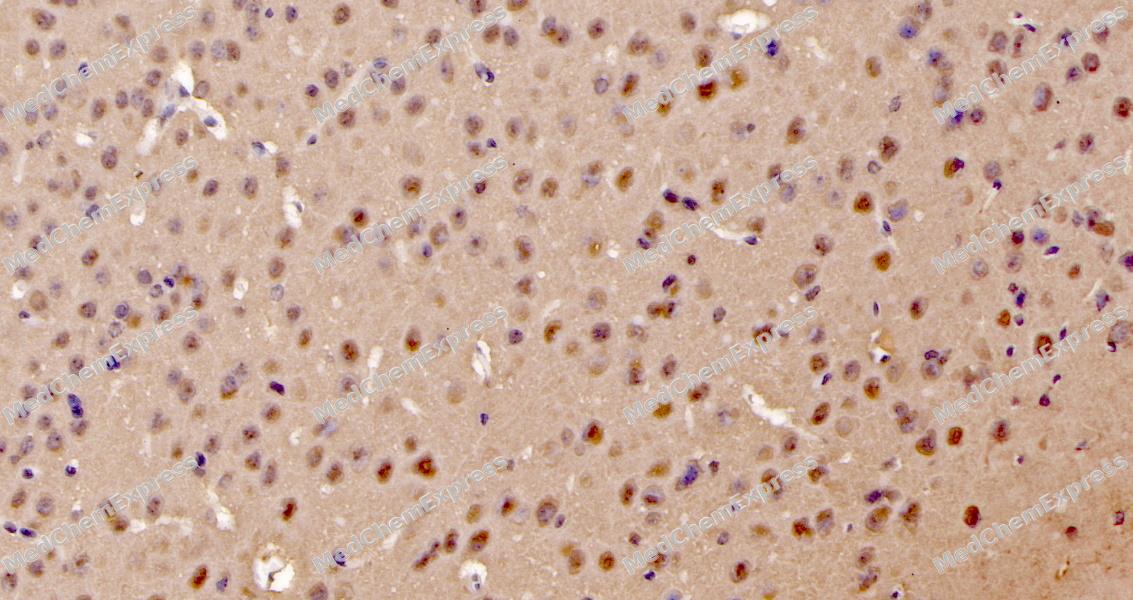 Immunohistochemical analysis of paraffin-embedded mouse brain tissue using Huntingtin Antibody. The section was pre-treated using heat mediated antigen retrieval with sodium citrate buffer (pH 6.0) for 8 minutes. The tissues were blocked in QuickBlock for 20 minutes at room temperature, washed with ddH2O and PBS, and then probed with the primary antibody at 1/100 dilution in 4℃ overnight. The detection was performed using an HRP conjugated compact polymer system. DAB was used as the chromogen. Tissues were counterstained with hematoxylin and mounted with DPX.
 -
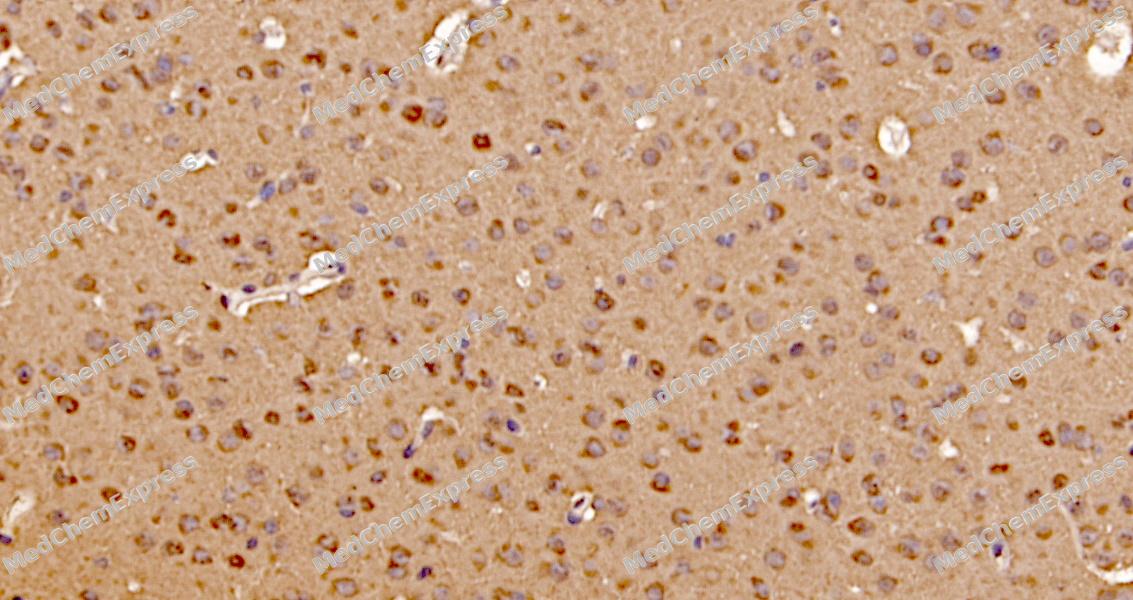 Immunohistochemical analysis of paraffin-embedded mouse brain tissue using Huntingtin Antibody. The section was pre-treated using heat mediated antigen retrieval with sodium citrate buffer (pH 6.0) for 8 minutes. The tissues were blocked in QuickBlock for 20 minutes at room temperature, washed with ddH2O and PBS, and then probed with the primary antibody at 1/100 dilution in 4℃ overnight. The detection was performed using an HRP conjugated compact polymer system. DAB was used as the chromogen. Tissues were counterstained with hematoxylin and mounted with DPX.
 -
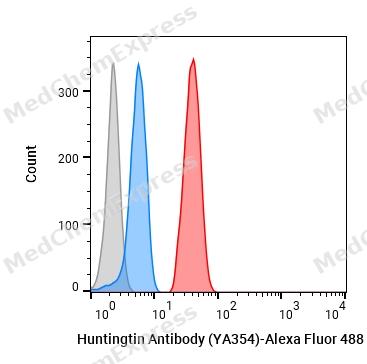 Flow cytometric analysis of 1.5X10^6 SH-SY5Y cells labeling Huntingtin Antibody (YA354) (HY-P80188, red). Cells were fixed with 4% paraformaldehyde. Then stained with the primary antibody at 1/200 dilution for an hour at 4℃. Goat Anti-Rabbit IgG H&L (AF488) (HY-P8002) was used as the secondary antibody at 1/1,000 dilution for 30 minutes at 4℃. Rabbit IgG Isotype Control (HY-P80879, blue) was used as the isotype control, cells without incubation with primary antibody were used as the unlabeled control (black).
 -
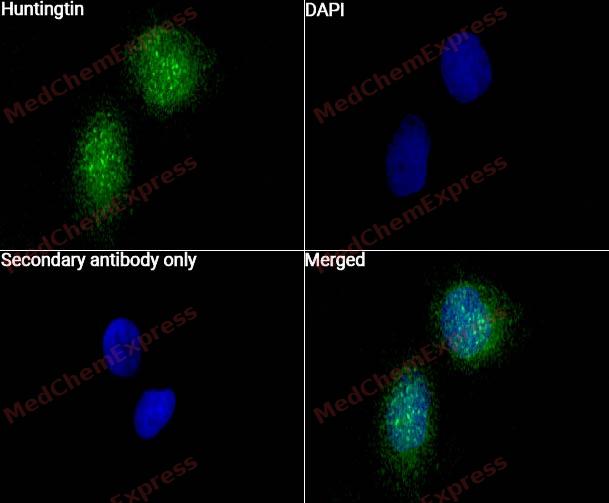 Immunocytochemistry analysis of Hela cells labeling Huntingtin with Huntingtin Antibody (HY-P80188) at 1/50 dilution. Cells were fixed in 4% paraformaldehyde for 15 minutes at room temperature, permeabilized with 0.1% Triton X-100 for 10 minutes at room temperature, then blocked with QuickBlock™ Blocking Buffer for Immunol Staining for 10 min at room temperature. Cells were then incubated with Huntingtin Antibody (HY-P80188) at 1/50 dilution in QuickBlock™ Blocking Buffer for Immunol Staining at 4 ℃. Alexa Fluor® 488-conjugated AffiniPure Goat Anti-Rabbit IgG H&L(HY-P8002, Green) was used as the secondary antibody at 1/1,000 dilution. PBS instead of the primary antibody was used as the secondary antibody only control. The Nuclear counterstain was DAPI (Blue).
 -
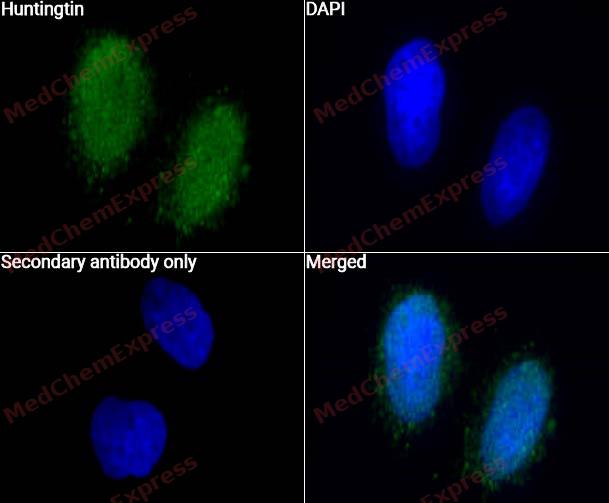 Immunocytochemistry analysis of Hela cells labeling Huntingtin with Huntingtin Antibody (HY-P80188) at 1/100 dilution. Cells were fixed in 4% paraformaldehyde for 15 minutes at room temperature, permeabilized with 0.1% Triton X-100 for 10 minutes at room temperature, then blocked with QuickBlock™ Blocking Buffer for Immunol Staining for 10 min at room temperature. Cells were then incubated with Huntingtin Antibody (HY-P80188) at 1/100 dilution in QuickBlock™ Blocking Buffer for Immunol Staining at 4 ℃. Alexa Fluor® 488-conjugated AffiniPure Goat Anti-Rabbit IgG H&L(HY-P8002, Green) was used as the secondary antibody at 1/1,000 dilution. PBS instead of the primary antibody was used as the secondary antibody only control. The Nuclear counterstain was DAPI (Blue).


Background
-
Function
Huntingtin (HTT) is a soluble 3144 amino acid (348 kDa) protein, with the highest levels of expression being found in the CNS and testes. An abnormal expansion of a glutamine stretch (polyQ) in N-terminal sequence of huntingtin leads to the devastating neurodegenerative disorder Huntington's disease (HD) . Subcellular fractionation and microscopic studies have shown that huntingtin is associated with vesicles and microtubules by interacting with huntingtin-associated protein 1 (HAP1), which is reported to form a complex with the dynactin and modulate or regulate the dynein–dynactin complex. There is evidence that huntingtin participates in post-Golgi trafficking of proteins that follow the regulated secretory pathway.
-
Subcellular Localization
Cytoplasm; Nucleus; Early endosome; Cytoplasmic vesicle, autophagosome
-
Expression
Tissue_specificity:Expressed in the brain cortex (at protein level) . Widely expressed with the highest level of expression in the brain (nerve fibers, varicosities, and nerve endings) . In the brain, the regions where it can be mainly found are the cerebellar cortex, the neocortex, the striatum, and the hippocampal formation -
Subunit
Interacts with PFN1 (PubMed:18573880). Interacts through its N-terminus with PRPF40A (PubMed:9700202). Interacts with PQBP1 (PubMed:10332029). Interacts with SETD2 (PubMed:10958656, PubMed:11461154, PubMed:9700202). Interacts with SH3GLB1 (By similarity). Interacts with SYVN (PubMed:17141218). Interacts with TPR; the interaction is inhibited by forms of Huntingtin with expanded polyglutamine stretch (PubMed:15654337). Interacts with ZDHHC13 (via ANK repeats) (PubMed:26198635). Interacts with ZDHHC17 (via ANK repeats) (PubMed:26198635, PubMed:28757145, PubMed:28882895). Interacts with F8A1/F8A2/F8A3 (PubMed:16476778, PubMed:29466333). Found in a complex with F8A1/F8A2/F8A3, HTT and RAB5A; mediates the recruitment of HTT by RAB5A (PubMed:16476778)
-
SwissProt ID
-
Synonyms
HD, IT15, HTT, Huntingtin, Huntington disease protein, HD protein
-
Research Field
Neuroscience


Documentation
-
Data Sheet (233 KB)
-
SDS (251 KB)
- English - EN (251 KB)
- Français - FR (251 KB)
- Deutsch - DE (251 KB)
- Norwegian - NO (251 KB)
- Español - ES (251 KB)
- Swedish - SV (251 KB)
- Italian - IT (251 KB)
- Korean - KR (251 KB)
- Portuguese - PT (251 KB)
-
User Guide for Antibodies (1077 KB)

 Powered by Bioz
