



IKK alpha + IKK beta Antibody (YA349)
(Synonyms: IKKB, IKBKB, Inhibitor of nuclear factor kappa-B kinase subunit beta, I-kappa-B-kinase beta, IKK-B, IKK-beta, IkBKB, I-kappa-B kinase 2, Nuclear factor NF-kappa-B inhibitor kinase beta, Serine/threonine protein kinase IKBKB, IKK-2, IKK2, NFKBIKB)
Based on 1 Customer Validation
IKK alpha + IKK beta Antibody (YA349) is a Rabbit-derived and non-conjugated IgG monoclonal antibody, targeting to IKK alpha + IKK beta.
-
Host:
Rabbit
-
Isotype:
IgG
-
Application:
WB, ICC/IF, IP
-
Reactivity :
Human, Mouse
-
Formulation:
Supplied in 1*TBS (pH7.4), 0.05% BSA and 40% Glycerol. Preservative: 0.05% Sodium Azide.
-
Conjugation:
Non-conjugated


To place orders, for customer services and technical support, please contact: MedChemExpress USA
Tel: 609-228-6898 E-mail: [email protected] [email protected]





Applications
| Application |
WB

WB: Western Blot
|
ICC/IF
ICC/IF: Immunocytochemistry/
Immunofluorescence |
IP
IP: Immunoprecipitation
|
|---|---|---|---|
| Dilution Ratio | 1:500-1:1000 | 1:100-1:500 | Use at an assay dependent concentration. |


Product Details
IKK alpha + IKK beta Antibody (YA349) is a Rabbit-derived and non-conjugated IgG monoclonal antibody, targeting to IKK alpha + IKK beta.
-
Host Rabbit

-
Clonality Recombinant,Monoclonal

-
Species ReactivityHuman, Mouse
-
Observed Molecular WeightObserved band size: 87 kDa
Note: Due to possible protein modifications or aggregation, the molecular weight should be confirmed by actual measurement, and the predicted value is for reference only.

-
Calculated Molecular Weight Predicted band size: 87 kDa

Entrez Gene: 1147 Human ; 3551 Human ; 12675 Mouse ; 16150 Mouse ;
SwissProt: O14920 Human ; O15111 Human ; O88351 Mouse ; Q60680 Mouse ;
OMIM: 615592 Human
Synthetic peptide corresponding to Human IKK beta.AA range:450-652.
Endogenous
Protein A affinity purified.
Non-conjugated
Unmodified
IgG


Product Properties
-
Appearance
Solution
-
Formulation
Supplied in 1*TBS (pH7.4), 0.05% BSA and 40% Glycerol. Preservative: 0.05% Sodium Azide.
-
Concentration
Batch-dependent, Please check the COA for the concentration of each lot. Check Lot Concentration
-
Storage & Stability
Stored at -20°C for 1 year. Avoid repeated freeze / thaw cycles.
-
Shipping
Shipping with blue ice.


Verification Images
-
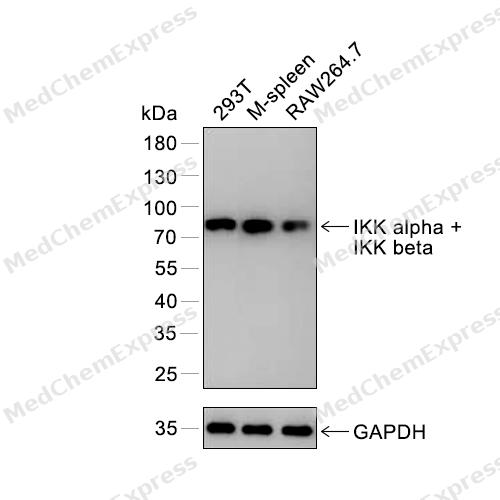 Western blot analysis of extracts from 293T (lane 1) and M-spleen (lane 2) and RAW264.7 (lane 3) using IKK alpha + IKK beta antibody. Proteins were transferred to a PVDF membrane and blocked with 5% nonfat powdered milk in PBST for 2 hour at room temperature. The primary antibody (1/1000) and loading control antibody (GAPDH, 1/3000) was diluted with 5% nonfat powdered milk in PBST at 4°C overnight. Goat Anti-Rabbit IgG-HRP Secondary Antibody (1/8,000) was incubated for 45min at room temperature.
 -
 Immunocytochemistry analysis of Hela cells labeling IKK alpha + IKK beta with IKK alpha + IKK beta Antibody (HY-P80414) at 1/100 dilution. Cells were fixed in 4% paraformaldehyde for 15 minutes at room temperature, permeabilized with 0.1% Triton X-100 in PBS for 15 minutes at room temperature, then blocked with quick block buffer for 10 minutes at room temperature. Cells were then incubated with IKK alpha + IKK beta Antibody (HY-P80414) at 1/100 dilution in quick block buffer overnight at 4 ℃. AF488-conjugated Goat Anti-Rabbit IgG H&L(HY-P8002, Green) was used as the secondary antibody at 1/1,000 dilution. PBS instead of the primary antibody was used as the secondary antibody only control. The Nuclear counterstain was DAPI (Blue).
 -
 Immunocytochemistry analysis of NIH-3T3 cells labeling IKK alpha + IKK beta with IKK alpha + IKK beta Antibody (HY-P80414) at 1/100 dilution. Cells were fixed in 4% paraformaldehyde for 15 minutes at room temperature, permeabilized with 0.1% Triton X-100 in PBS for 15 minutes at room temperature, then blocked with quick block buffer for 10 minutes at room temperature. Cells were then incubated with IKK alpha + IKK beta Antibody (HY-P80414) at 1/100 dilution in quick block buffer overnight at 4 ℃. AF488-conjugated Goat Anti-Rabbit IgG H&L(HY-P8002, Green) was used as the secondary antibody at 1/1,000 dilution. PBS instead of the primary antibody was used as the secondary antibody only control. The Nuclear counterstain was DAPI (Blue).


Background
-
Function
IKK alpha + IKK beta serine kinase that plays an essential role in the NF-kappa-B signaling pathway which is activated by multiple stimuli such as inflammatory cytokines, bacterial or viral products, DNA damages or other cellular stresses. Acts as a part of the canonical IKK complex in the conventional pathway of NF-kappa-B activation. Phosphorylates inhibitors of NF-kappa-B on 2 critical serine residues. These modifications allow polyubiquitination of the inhibitors and subsequent degradation by the proteasome. In turn, free NF-kappa-B is translocated into the nucleus and activates the transcription of hundreds of genes involved in immune response, growth control, or protection against apoptosis. In addition to the NF-kappa-B inhibitors, phosphorylates several other components of the signaling pathway including NEMO/IKBKG, NF-kappa-B subunits RELA and NFKB1, as well as IKK-related kinases TBK1 and IKBKE. IKK-related kinase phosphorylations may prevent the overproduction of inflammatory mediators since they exert a negative regulation on canonical IKKs. Phosphorylates FOXO3, mediating the TNF-dependent inactivation of this pro-apoptotic transcription factor. Also phosphorylates other substrates including NAA10, NCOA3, BCL10 and IRS1. Phosphorylates RIPK1 at 'Ser-25' which represses its kinase activity and consequently prevents TNF-mediated RIPK1-dependent cell death. Phosphorylates the C-terminus of IRF5, stimulating IRF5 homodimerization and translocation into the nucleus. Following bacterial lipopolysaccharide (LPS)-induced TLR4 endocytosis, phosphorylates STAT1 at 'Thr-749' which restricts interferon signaling and anti-inflammatory responses and promotes innate inflammatory responses. IKBKB-mediated phosphorylation of STAT1 at 'Thr-749' promotes binding of STAT1 to the ARID5A promoter, resulting in transcriptional activation of ARID5A and subsequent ARID5A-mediated stabilization of IL6. It also promotes binding of STAT1 to the IL12B promoter and activation of IL12B transcription[1][2][3][4][5][6][7][8][9][10][11][12][13][14].
-
Subcellular Localization
Cytoplasm; Nucleus; Membrane raft
-
Expression
Tissue_specificity:It is highly expressed in the heart, placenta, skeletal muscle, kidney, pancreas, spleen, thymus, prostate, testis, and peripheral blood. -
Subunit
Component of the I-kappa-B-kinase (IKK) core complex consisting of CHUK, IKBKB and IKBKG; probably four alpha/CHUK-beta/IKBKB dimers are associated with four gamma/IKBKG subunits (PubMed:32935379).
-
SwissProt ID
-
Synonyms
IKKB, IKBKB, Inhibitor of nuclear factor kappa-B kinase subunit beta, I-kappa-B-kinase beta, IKK-B, IKK-beta, IkBKB, I-kappa-B kinase 2, Nuclear factor NF-kappa-B inhibitor kinase beta, Serine/threonine protein kinase IKBKB, IKK-2, IKK2, NFKBIKB
-
Research Field
Signal Transduction


Documentation
-
Data Sheet (264 KB)
-
SDS (252 KB)
- English - EN (252 KB)
- Français - FR (252 KB)
- Deutsch - DE (252 KB)
- Norwegian - NO (252 KB)
- Español - ES (252 KB)
- Swedish - SV (252 KB)
- Italian - IT (252 KB)
- Korean - KR (252 KB)
- Portuguese - PT (252 KB)
-
User Guide for Antibodies (1077 KB)
References
[1]. Cui J, et al. NLRC5 negatively regulates the NF-kappaB and type I interferon signaling pathways. Cell. 2010 Apr 30;141(3):483-96. [Content Brief]
[2]. Tsuchiya Y, et al. Nuclear IKKbeta is an adaptor protein for IkappaBalpha ubiquitination and degradation in UV-induced NF-kappaB activation. Mol Cell. 2010 Aug 27;39(4):570-82. [Content Brief]
[3]. Clark K, et al. Novel cross-talk within the IKK family controls innate immunity. Biochem J. 2011 Feb 15;434(1):93-104. [Content Brief]
[4]. Cardinez C, et al. Gain-of-function IKBKB mutation causes human combined immune deficiency. J Exp Med. 2018 Nov 5;215(11):2715-2724. [Content Brief]
[5]. Mercurio F, et al. IKK-1 and IKK-2: cytokine-activated IkappaB kinases essential for NF-kappaB activation. Science. 1997 Oct 31;278(5339):860-6. [Content Brief]
[6]. Salmerón A, et al. Direct phosphorylation of NF-kappaB1 p105 by the IkappaB kinase complex on serine 927 is essential for signal-induced p105 proteolysis. J Biol Chem. 2001 Jun 22;276(25):22215-22. [Content Brief]
[7]. Cohen S, et al. Dual effects of IkappaB kinase beta-mediated phosphorylation on p105 Fate: SCF(beta-TrCP)-dependent degradation and SCF(beta-TrCP)-independent processing. Mol Cell Biol. 2004 Jan;24(1):475-86. [Content Brief]
[8]. Yoboua F, et al. Respiratory syncytial virus-mediated NF-kappa B p65 phosphorylation at serine 536 is dependent on RIG-I, TRAF6, and IKK beta. J Virol. 2010 Jul;84(14):7267-77. [Content Brief]
[9]. Hu MC, et al. IkappaB kinase promotes tumorigenesis through inhibition of forkhead FOXO3a. Cell. 2004 Apr 16;117(2):225-37. [Content Brief]
[10]. Lobry C, et al. Negative feedback loop in T cell activation through IkappaB kinase-induced phosphorylation and degradation of Bcl10. Proc Natl Acad Sci U S A. 2007 Jan 16;104(3):908-13. [Content Brief]
[11]. Kuo HP, et al. Phosphorylation of ARD1 by IKKbeta contributes to its destabilization and degradation. Biochem Biophys Res Commun. 2009 Nov 6;389(1):156-61. [Content Brief]
[12]. Lopez-Pelaez M, et al. Protein kinase IKKβ-catalyzed phosphorylation of IRF5 at Ser462 induces its dimerization and nuclear translocation in myeloid cells. Proc Natl Acad Sci U S A. 2014 Dec 9;111(49):17432-7. [Content Brief]
[13]. Metwally H, et al. Threonine phosphorylation of STAT1 restricts interferon signaling and promotes innate inflammatory responses. Proc Natl Acad Sci U S A. 2024 Apr 23;121(17):e2402226121. [Content Brief]
[14]. Metwally H, et al. Noncanonical STAT1 phosphorylation expands its transcriptional activity into promoting LPS-induced IL-6 and IL-12p40 production. Sci Signal. 2020 Mar 24;13(624):. [Content Brief]

 Powered by Bioz
