



INCENP Antibody (YA6960)
(Synonyms: binds and activates aurora B and C in vivo and in vitro antibody; Chromosomal passenger protein antibody; INCE_HUMAN antibody; INCENP antibody; Inner centromere protein antibody; Inner centromere protein antigens 135/155kDa antibody; Inner centromere protein antigens 135kD 155kD antibody; Inner centromere protein INCENP antibody)
Based on 1 Customer Validation
INCENP Antibody (YA6960) is a Mouse-derived and non-conjugated IgG1 monoclonal antibody, targeting to INCENP.
-
Host:
Mouse
-
Isotype:
IgG
-
Application:
ICC/IF, IHC-P, FC
-
Reactivity :
Human
-
Formulation:
Supplied in in PBS with 0.05% sodium azide.
-
Conjugation:
Non-conjugated


To place orders, for customer services and technical support, please contact: MedChemExpress USA
Tel: 609-228-6898 E-mail: [email protected] [email protected]





Applications
| Application |
IHC-P

IHC-P: Immunohistochemistry-Paraffin
|
ICC/IF
ICC/IF: Immunocytochemistry/
Immunofluorescence |
FC
FC: Flow Cytometry
|
ELISA
ELISA: Enzyme Linked Immunosorbent Assay
|
|---|---|---|---|---|
| Dilution Ratio | 1:200-1:1000 | 1:200-1:1000 | 1:200-1:400 | 1:10000 |


Product Details
INCENP Antibody (YA6960) is a Mouse-derived and non-conjugated IgG1 monoclonal antibody, targeting to INCENP.
-
Host Mouse

-
Clonality Monoclonal

-
Species ReactivityHuman
-
Observed Molecular WeightObserved band size: 105.4 kDa
Note: Due to possible protein modifications or aggregation, the molecular weight should be confirmed by actual measurement, and the predicted value is for reference only.

-
Calculated Molecular Weight Predicted band size: 105.4 kDa

Purified recombinant fragment of human INCENP (AA: 369-583) expressed in E. Coli.
Endogenous
Protein A affinity purified.
Non-conjugated
Unmodified
IgG


Product Properties
-
Appearance
Solution
-
Formulation
Supplied in in PBS with 0.05% sodium azide.
-
Concentration
Batch-dependent, Please check the COA for the concentration of each lot. Check Lot Concentration
-
Storage & Stability
Stored at -20°C for 1 year. Avoid repeated freeze / thaw cycles.
-
Shipping
Shipping with blue ice.


Verification Images
-
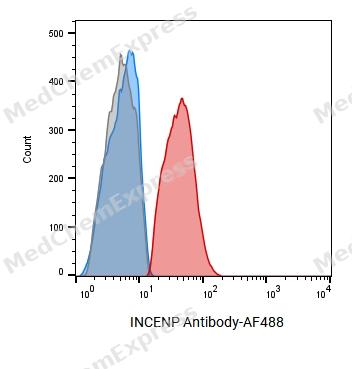 Flow cytometric analysis of 1X10^6 HT-29 cells labeling INCENP Antibody(red). Cells were fixed with 4% paraformaldehyde and permeabilised with 0.2% Triton X-100. Then stained with the primary antibody at 1/400 dilution overnight at 4℃. AF 488 Goat Anti-mouse IgG H&L was used as the secondary antibody at 1/1,000 dilution for 45 minutes at room temperature. Mouse IgG Isotype Control (blue) was used as the isotype control, cells without incubation with primary antibody were used as the unlabeled control (black).
 -
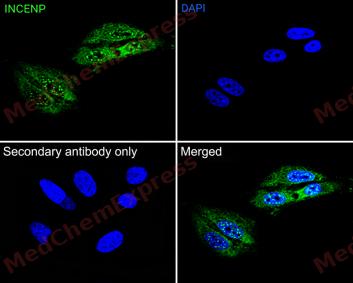 Immunofluorescence analysis of Hela cells labeling INCENP antibody at 1/50 dilution. Cells were fixed in 4% paraformaldehyde for 15 minutes at room temperature, permeabilized with 0.1% Triton X-100 in PBS for 15 minutes at room temperature, then blocked with 1% BSA in 10% negative goat serum for 1 hour at room temperature.Cells were then incubated with INCENP antibody at 1/50 dilution in 1% BSA in PBST overnight at 4 ℃. AF 488 Goat Anti-mouse IgG H&L (green) was used as the secondary antibody at 1/500 dilution. PBS instead of the primary antibody was used as the secondary antibody only control. The Nuclear counterstain was DAPI (Blue)


Background
-
Function
INCENP component of the chromosomal passenger complex (CPC), a complex that acts as a key regulator of mitosis. The CPC complex has essential functions at the centromere in ensuring correct chromosome alignment and segregation and is required for chromatin-induced microtubule stabilization and spindle assembly. Acts as a scaffold regulating CPC localization and activity. The C-terminus associates with AURKB or AURKC, the N-terminus associated with BIRC5/survivin and CDCA8/borealin tethers the CPC to the inner centromere, and the microtubule binding activity within the central SAH domain directs AURKB/C toward substrates near microtubules. The flexibility of the SAH domain is proposed to allow AURKB/C to follow substrates on dynamic microtubules while ensuring CPC docking to static chromatin. Activates AURKB and AURKC. Required for localization of CBX5 to mitotic centromeres. Controls the kinetochore localization of BUB1[1][2][3][4][5].
-
Subcellular Localization
Nucleus,Chromosome, centromere,Cytoplasm, cytoskeleton, spindle,Midbody,Chromosome, centromere, kinetochore
-
Isoforms & Post-Translational Modification
Q9NQS7 has two isomers: Q9NQS7-1: 105429 Da (predicted); Q9NQS7-2: 104992 Da (predicted).
Phosphorylation by AURKB or AURKC at its C-terminal part is important for AURKB or AURKC activation by INCENP -
Subunit
Component of the chromosomal passenger complex (CPC) composed of at least BIRC5/survivin, CDCA8/borealin, INCENP, AURKB or AURKC; in the complex binds directly to AURKB or AURKC via the IN box, and forms a triple-helix bundle-based subcomplex with BIRC5 and CDCA8 via its N-terminus (PubMed:17956729, PubMed:27332895)
-
SwissProt ID
-
Synonyms
binds and activates aurora B and C in vivo and in vitro antibody; Chromosomal passenger protein antibody; INCE_HUMAN antibody; INCENP antibody; Inner centromere protein antibody; Inner centromere protein antigens 135/155kDa antibody; Inner centromere protein antigens 135kD 155kD antibody; Inner centromere protein INCENP antibody


Documentation

 Powered by Bioz
